RS Glossary
AI Overreliance
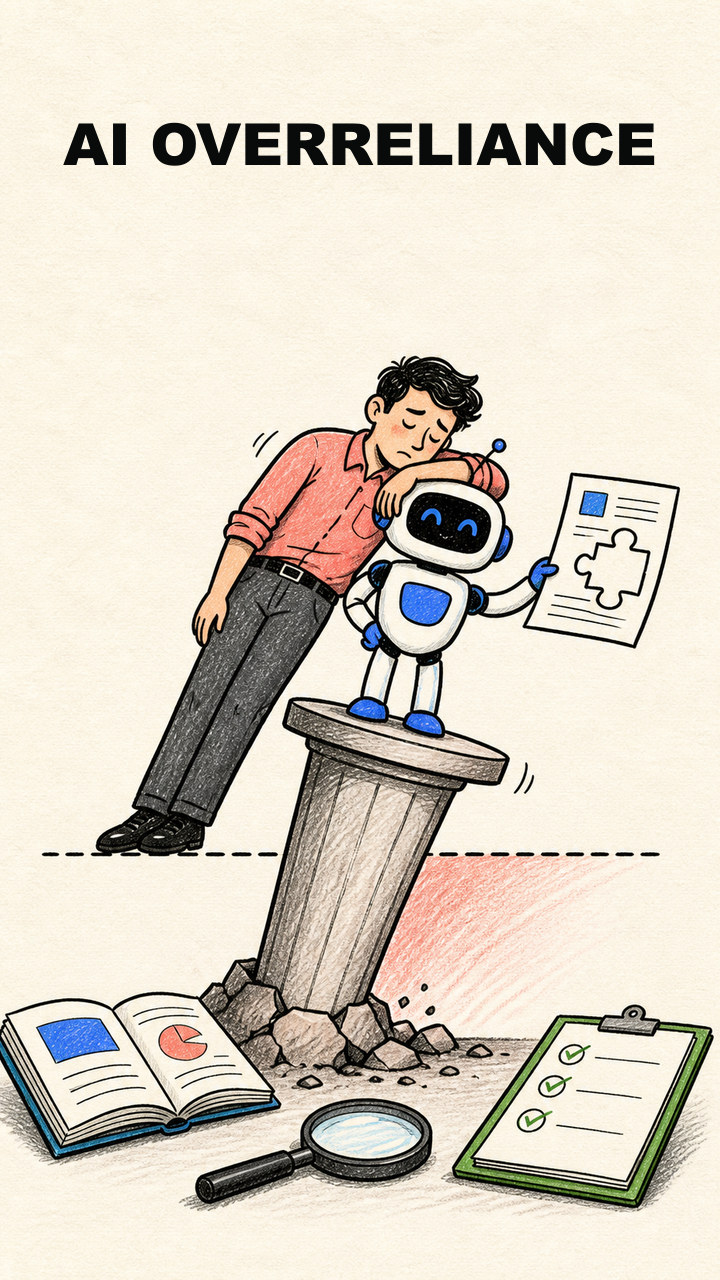
AI overreliance is depending on an AI system more than its demonstrated reliability, available evidence, and authorized role justify.
- Review state
- Reviewed in POC
- Freshness
- Current
- Version
- 1
- AI Overreliance
- Overreliance
Remember it this wayRely in proportion to proof.
In plain language
AI becomes overrelied upon when people let its speed, polish, or convenience substitute for judgment they still need to exercise. The problem can appear as uncritical acceptance of one answer, but it can also become a wider habit: skipping checks, weakening skills, or handing the system decisions it was only meant to support.
Why it matters
A plausible AI response can be wrong, incomplete, or outside the conditions in which the system was tested. When dependence outruns evidence, one mistake can pass through a workflow, repeat at scale, and leave no person clearly exercising responsibility.
Example
An analyst copies an AI-generated summary of a financial filing into a recommendation without opening the filing. The summary omits a limiting condition, and the recommendation treats a conditional forecast as a firm commitment.
Common misconception
Using AI often is not automatically overreliance, and an AI error alone does not prove it. The key question is whether the amount and kind of reliance fit the system's evidence, the stakes, and the human's assigned role. Automation Bias is a narrower decision tendency; AI Overreliance can shape an entire working pattern.
Related terms
Sources
- NIST, “Artificial Intelligence Risk Management Framework: Generative Artificial Intelligence Profile”identifies human overreliance on generative AI as a risk and connects it to automation bias.
- Si et al., “Large Language Models Help Humans Verify Truthfulness—Except When They Are Convincingly Wrong”reports a human study in which users overrelied on incorrect LLM explanations.
Learn more
- Use [[calibration|Calibration]] to match trust to demonstrated performance.
- Preserve [[human-ownership|Human Ownership]] for decisions whose consequences still belong to a person or organization.
Public history
30 recorded events · 30 public summaries
A potential shared concept was discussed and selected for initial glossary drafting.
The captured candidate received a complete initial draft and entered section-level human review.
Radar reviewed the initial definition draft for human consideration.
Radar reviewed the initial plain-language-explanation draft for human consideration.
Radar reviewed the initial why-it-matters draft for human consideration.
Radar reviewed the initial example draft for human consideration.
Radar reviewed the initial common-misconception draft for human consideration.
Radar reviewed the initial remember-it-this-way draft for human consideration.
Radar reviewed the initial related-terms draft for human consideration.
Radar reviewed the initial sources draft for human consideration.
Radar reviewed the initial learn-more draft for human consideration.
Definition review recorded as approve.
Plain-Language Explanation review recorded as approve.
Why It Matters review recorded as approve.
Example review recorded as approve.
Common Misconception review recorded as approve.
Remember It This Way review recorded as approve.
Related Terms review recorded as approve.
Sources review recorded as approve.
Learn More review recorded as approve.
All wording and media review gates are approved; the term is now canonical.
Definition review recorded as approve.
Plain-Language Explanation review recorded as approve.
Why It Matters review recorded as approve.
Example review recorded as approve.
Common Misconception review recorded as approve.
Remember It This Way review recorded as approve.
Related Terms review recorded as approve.
Sources review recorded as approve.
Learn More review recorded as approve.
Source: vault/Glossary/terms/ai-overreliance/term.md · sha256:c0706b9e1a538dd147a8820133ffe1ee90724ec8666eb939ff89380ac7a258ee · Release: rs-glossary-glossary-team-poc-0.5.5-2026-09-02