RS Glossary
Anchoring
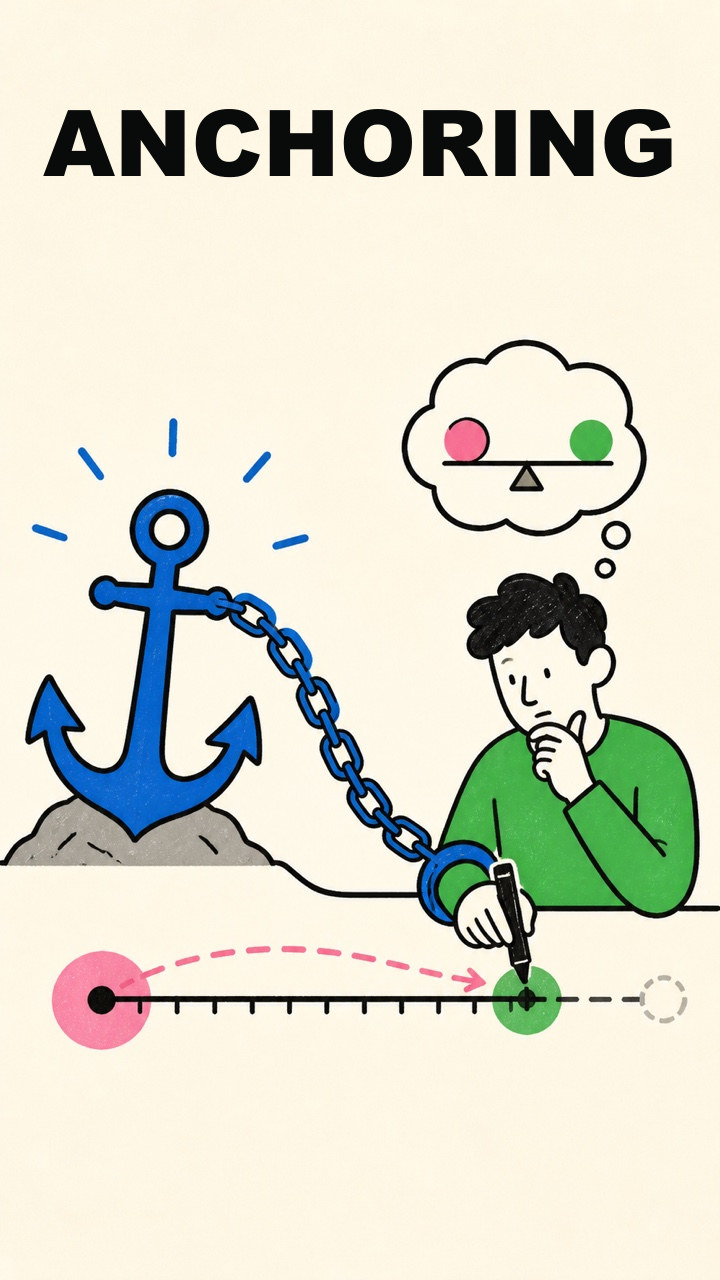
Anchoring is a judgment bias in which an initial value, claim, or frame exerts too much influence on a later estimate or decision, even when the starting point is incomplete or irrelevant.
- Review state
- Reviewed in POC
- Freshness
- Current
- Version
- 1
- anchoring
Remember it this wayThe first number pulls the next one.
In plain language
The first answer creates a mental starting point. People may adjust away from it, but often not far enough. In an AI conversation, an early estimate or framing can pull both the user and the model toward later answers that stay near it.
Why it matters
An arbitrary starting point can shape budgets, timelines, risk estimates, and interpretations. Recognizing the anchor helps a team generate an independent estimate, reconsider the frame, or compare several starting points before committing.
Example
An AI assistant suggests that a migration will take two weeks. Even after the team discovers several unexamined systems, its revised estimates remain close to two weeks because the first number became the reference point.
Common misconception
Anchoring does not mean people never change their minds. They may make several adjustments and still remain too close to the initial value. The effect can also occur when people know that the anchor is arbitrary.
Related terms
Sources
- Amos Tversky and Daniel Kahneman, “Judgment under Uncertainty: Heuristics and Biases”the classic account of anchoring and insufficient adjustment from an initial value.
Learn more
Public history
23 recorded events · 23 public summaries
Candidate vocabulary was imported from the Learning Lab discovery queue.
The captured candidate received a complete initial draft and entered section-level human review.
Radar reviewed the initial definition draft for human consideration.
Radar reviewed the initial plain-language-explanation draft for human consideration.
Radar reviewed the initial why-it-matters draft for human consideration.
Radar reviewed the initial example draft for human consideration.
Radar reviewed the initial common-misconception draft for human consideration.
Radar reviewed the initial remember-it-this-way draft for human consideration.
Radar reviewed the initial related-terms draft for human consideration.
Radar reviewed the initial sources draft for human consideration.
Radar reviewed the initial learn-more draft for human consideration.
A proposal was opened for section-level human review while preserving the current version.
A human reviewer opened a proposed revision while preserving the current approved or captured version.
definition approved by a human reviewer.
plain-language-explanation approved by a human reviewer.
why-it-matters approved by a human reviewer.
example approved by a human reviewer.
common-misconception approved by a human reviewer.
remember-it-this-way approved by a human reviewer.
related-terms approved by a human reviewer.
sources approved by a human reviewer.
learn-more approved by a human reviewer.
All section gates are approved; content version 1 is now a fully approved term.
Source: vault/Glossary/terms/anchoring/term.md · sha256:abd248ff979d78e4e76ff5b02763b3b73f076bbe6caec3f7668b3724544a052d · Release: rs-glossary-glossary-team-poc-0.5.5-2026-09-02