RS Glossary
Capability Provenance
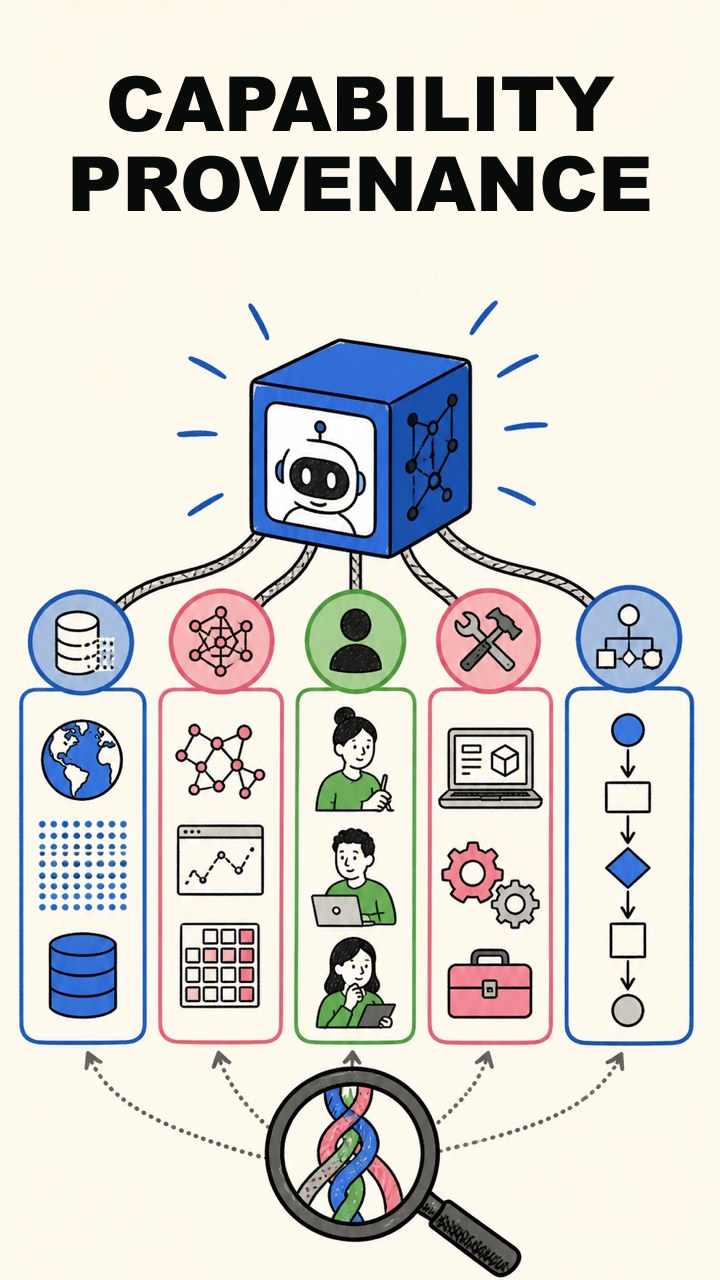
Capability provenance is the record of where an AI system's abilities came from — the models, data, human input, tools and processes that materially shaped what it can do.
- Review state
- Reviewed in POC
- Freshness
- Current
- Version
- 3
- Capability Provenance
Remember it this wayWhat made this system able to do that?
In plain language
Capability provenance explains where a system's abilities came from. It connects behavior to material contributors such as training, fine-tuning, retrieval, tools, human feedback, integration, and operational practice.
Why it matters
Teams cannot evaluate control, ownership, risk, or reproducibility if they cannot trace the important contributors to capability.
Example
A coding assistant's performance record identifies its base model, fine-tuning data, retrieval index, execution tools, reviewer feedback, and deployment configuration.
Common misconception
Capability provenance is not a claim that every output can be traced to one training example. It records material contributors to capability at an appropriate level.
Related terms
Sources
No sources recorded yet.
Learn more
- Use with [[verification|Verification]] and [[evidence-selection|Evidence Selection]].
Public history
26 recorded events · 26 public summaries
A potential shared concept was discussed and selected for initial glossary drafting.
The captured candidate received a complete initial draft and entered section-level human review.
Radar reviewed the initial definition draft for human consideration.
Radar reviewed the initial plain-language-explanation draft for human consideration.
Radar reviewed the initial why-it-matters draft for human consideration.
Radar reviewed the initial example draft for human consideration.
Radar reviewed the initial common-misconception draft for human consideration.
Radar reviewed the initial remember-it-this-way draft for human consideration.
Radar reviewed the initial related-terms draft for human consideration.
Radar reviewed the initial sources draft for human consideration.
Radar reviewed the initial learn-more draft for human consideration.
A proposal was opened for section-level human review while preserving the current version.
A human reviewer opened a proposed revision while preserving the current approved or captured version.
definition approved by a human reviewer.
plain-language-explanation approved by a human reviewer.
why-it-matters approved by a human reviewer.
example approved by a human reviewer.
common-misconception approved by a human reviewer.
remember-it-this-way approved by a human reviewer.
related-terms approved by a human reviewer.
sources approved by a human reviewer.
learn-more approved by a human reviewer.
All section gates are approved; content version 1 is now a fully approved term.
Definition review recorded as replace.
A personal-origin intake credit was removed from the Sources field; the field remains open for human review.
Sources review recorded as approve.
Source: vault/Glossary/terms/capability-provenance/term.md · sha256:b457d4d3cf34c7ad6635b16b923a6a64764ea7f2c021a228078ff628308ed534 · Release: rs-glossary-glossary-team-poc-0.5.5-2026-09-02