RS Glossary
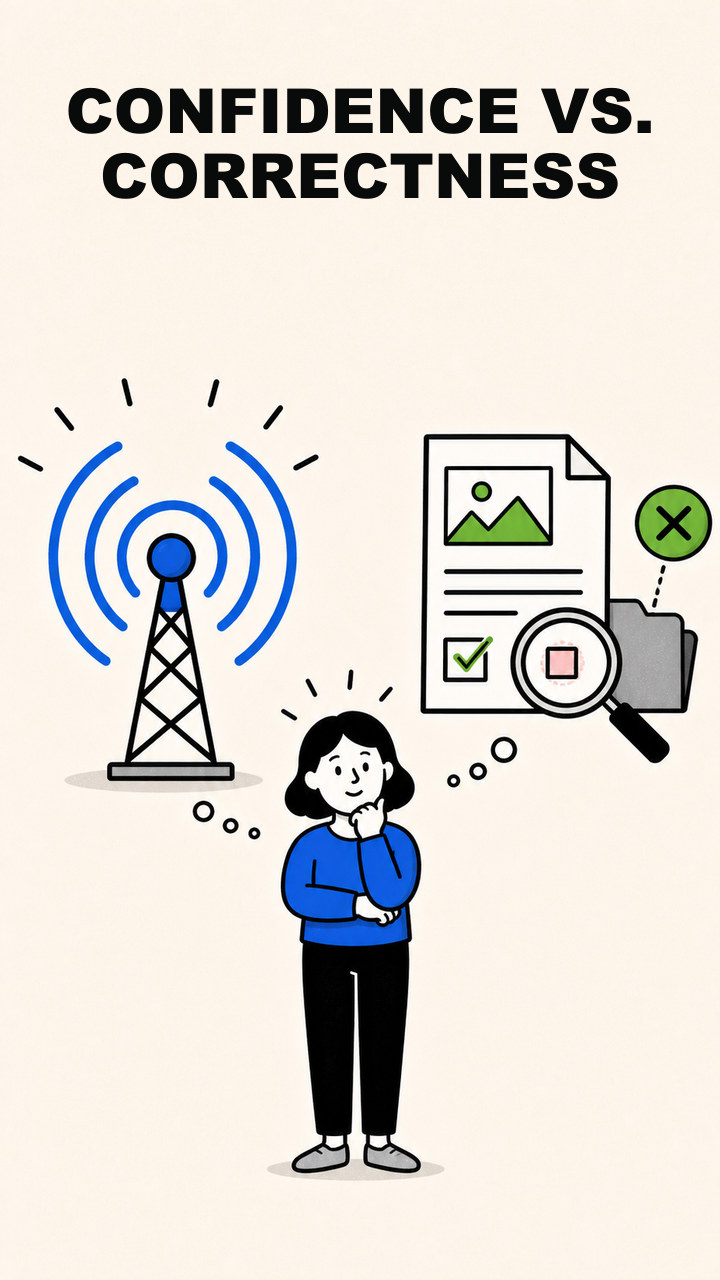
Confidence vs. Correctness
Confidence is the strength or certainty expressed with an answer. Correctness is whether the answer is supported by the relevant evidence and matches the facts or requirements. One does not establish the other.
- Review state
- Reviewed in POC
- Freshness
- Current
- Version
- 1
- confidence-vs-correctness
Remember it this wayCertainty is a signal, not a verdict.
In plain language
An answer can sound certain and be wrong. It can also be cautious and correct. Confidence is a signal to examine, while correctness is a conclusion that requires evidence.
Why it matters
Fluent AI responses can make confidence easy to mistake for knowledge. Separating the two helps people verify important claims, resist persuasive wording, and decide when uncertainty should change how they act.
Example
An assistant confidently states that a company policy permits a particular data use. The policy document says otherwise. The answer's tone was confident; its content was incorrect.
Common misconception
Low confidence does not prove an answer is wrong, and high confidence does not prove it is right. Calibration is a related measurement concept: it asks whether confidence levels match correctness rates across many comparable cases.
Related terms
Sources
- Chuan Guo and colleagues, “On Calibration of Modern Neural Networks”empirical confidence and accuracy are related but distinct properties.
- NIST, “AI RMF Core: Measure”uncertainty, benchmarks, testing, and documented evaluation as parts of reliable AI assessment.
Learn more
Public history
24 recorded events · 24 public summaries
Candidate vocabulary was imported from the Learning Lab discovery queue.
The captured candidate received a complete initial draft and entered section-level human review.
Radar reviewed the initial definition draft for human consideration.
Radar reviewed the initial plain-language-explanation draft for human consideration.
Radar reviewed the initial why-it-matters draft for human consideration.
Radar reviewed the initial example draft for human consideration.
Radar reviewed the initial common-misconception draft for human consideration.
Radar reviewed the initial remember-it-this-way draft for human consideration.
Radar reviewed the initial related-terms draft for human consideration.
Radar reviewed the initial sources draft for human consideration.
Radar reviewed the initial learn-more draft for human consideration.
A proposal was opened for section-level human review while preserving the current version.
A human reviewer opened a proposed revision while preserving the current approved or captured version.
definition approved by a human reviewer.
plain-language-explanation approved by a human reviewer.
why-it-matters approved by a human reviewer.
example approved by a human reviewer.
common-misconception approved by a human reviewer.
Radar issue confidence-calibration-boundary was accepted-as-is by the human section decision.
remember-it-this-way approved by a human reviewer.
related-terms approved by a human reviewer.
sources approved by a human reviewer.
learn-more approved by a human reviewer.
All section gates are approved; content version 1 is now a fully approved term.
Source: vault/Glossary/terms/confidence-vs-correctness/term.md · sha256:7926384ea5c699402d599bbb4d5ea2c8f6c082306a2e66b56cdb24920c1079c2 · Release: rs-glossary-glossary-team-poc-0.5.5-2026-09-02