RS Glossary
Content Credentials (C2PA)
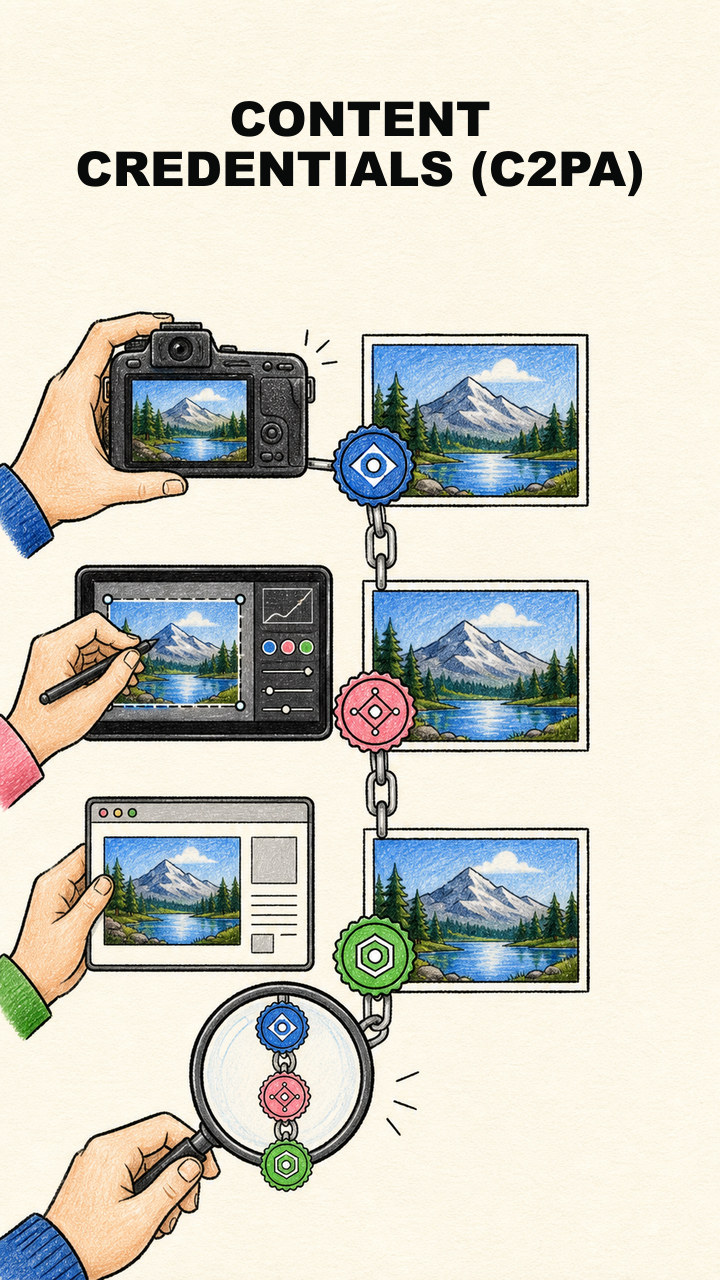
Content Credentials are cryptographically signed C2PA provenance records bound to a digital asset that can describe who or what created or changed it and how.
- Review state
- Reviewed in POC
- Freshness
- Current
- Version
- 1
- Content Credentials (C2PA)
- Content Credentials
- C2PA
- C2PA Content Credentials
Remember it this wayA signed history, not a truth stamp.
In plain language
A Content Credential works like a tamper-evident history attached to or associated with a piece of digital content. Compatible tools can add signed statements about capture, editing, ingredients, and the software or organization involved, and a viewer can validate the signatures and bindings.
Why it matters
Content Credentials can give creators, publishers, and audiences consistent evidence about a file's origin and editing history. They are useful for AI disclosure and media provenance because the history can travel across participating tools without depending on one platform's private label.
Example
A camera creates a signed record when a photograph is captured. An editor adds a signed record for the crop and color adjustment, and a publisher adds another when releasing it. A reader can inspect the resulting provenance chain.
Common misconception
A Content Credential is not a truth stamp and does not prove that a depicted event happened as claimed. A credential can be absent or removed, and its assertions are only as trustworthy as the signers and trust model. It provides evidence about provenance and tampering, not automatic fact-checking.
Related terms
Sources
- C2PA, *Content Credentials Technical Specification*the current technical standards for cryptographically bound content provenance, trust, and validation.
- C2PA, “C2PA and Content Credentials Explainer”explains Content Credentials as cryptographically bound structures that record an asset's provenance.
Learn more
- Compare the asset-specific record with the broader history captured by [[data-provenance|Data Provenance]].
- Use [[verification|Verification]] to inspect signatures, trust chains, and whether the credential supports the claim being made.
Public history
30 recorded events · 30 public summaries
A potential shared concept was discussed and selected for initial glossary drafting.
The captured candidate received a complete initial draft and entered section-level human review.
Radar reviewed the initial definition draft for human consideration.
Radar reviewed the initial plain-language-explanation draft for human consideration.
Radar reviewed the initial why-it-matters draft for human consideration.
Radar reviewed the initial example draft for human consideration.
Radar reviewed the initial common-misconception draft for human consideration.
Radar reviewed the initial remember-it-this-way draft for human consideration.
Radar reviewed the initial related-terms draft for human consideration.
Radar reviewed the initial sources draft for human consideration.
Radar reviewed the initial learn-more draft for human consideration.
Definition review recorded as approve.
Plain-Language Explanation review recorded as approve.
Why It Matters review recorded as approve.
Example review recorded as approve.
Common Misconception review recorded as approve.
Remember It This Way review recorded as approve.
Related Terms review recorded as approve.
Sources review recorded as approve.
Learn More review recorded as approve.
All wording and media review gates are approved; the term is now canonical.
Definition review recorded as approve.
Plain-Language Explanation review recorded as approve.
Why It Matters review recorded as approve.
Example review recorded as approve.
Common Misconception review recorded as approve.
Remember It This Way review recorded as approve.
Related Terms review recorded as approve.
Sources review recorded as approve.
Learn More review recorded as approve.
Source: vault/Glossary/terms/content-credentials-c2pa/term.md · sha256:6acb5bdd133c3f53b613c6d8067f25d69056ae571e52f6d5f4c7513444937c68 · Release: rs-glossary-glossary-team-poc-0.5.5-2026-09-02