RS Glossary
Loss Function
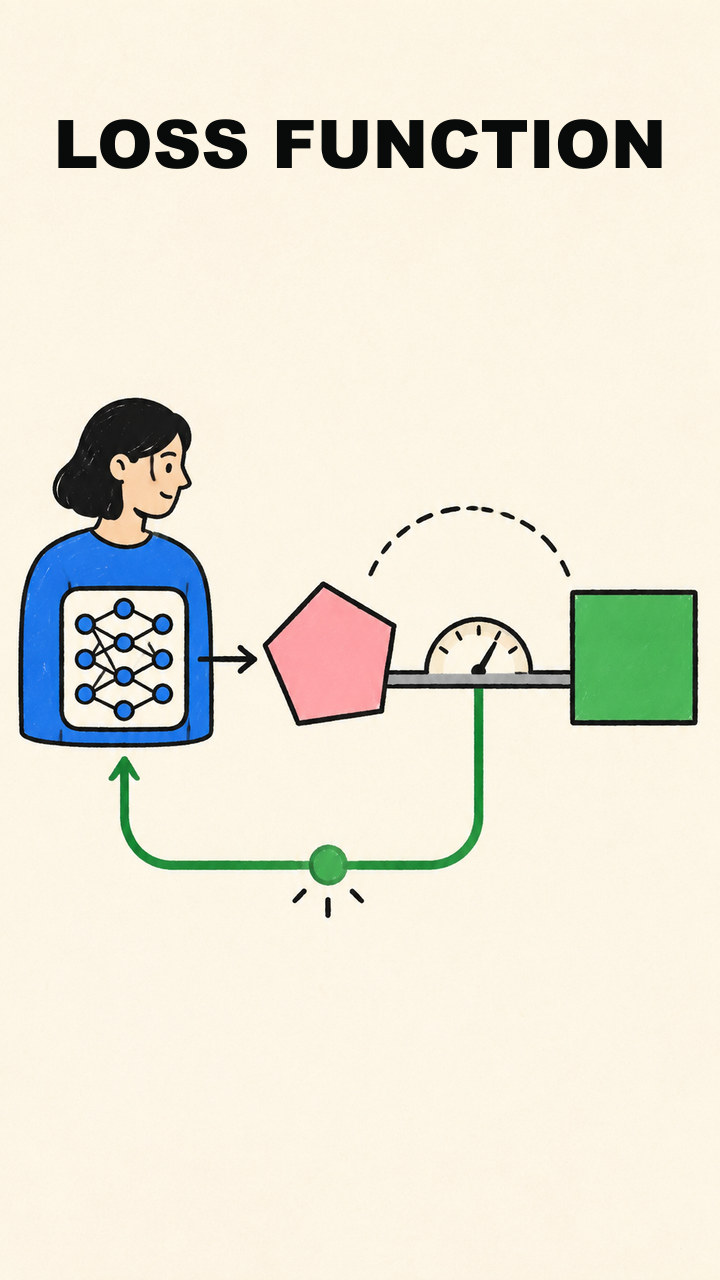
Loss is the value a model tries to reduce during training because it measures how wrong the current output is.
- Review state
- Reviewed in POC
- Freshness
- Current
- Version
- 2
- Loss Function
- Loss
- Objective Function
Remember it this wayThe loss function turns error into the signal training follows.
In plain language
A loss function converts the difference between a model’s output and the desired result into a value the training process can minimize. Different losses encode different kinds of error.
Why it matters
The loss function tells the optimizer what to reward and penalize. A poorly chosen loss can improve the training number while producing behavior that misses the real goal.
Example
A classifier uses cross-entropy loss so confident wrong predictions receive a larger penalty than correct predictions.
Common misconception
Loss is not the same as a business outcome or an evaluation metric. It is an optimization signal, and a lower training loss does not guarantee better real-world performance.
Related terms
Sources
- Google for Developers, “Machine Learning Glossary”provides established boundaries for core machine-learning vocabulary.
Learn more
- Compare [[training|Training]], [[ml-target|ML Target]], [[evaluation-metric|Evaluation Metric]], and [[parameters|Parameters]] to place Loss Function in the surrounding system.
- Follow the cited source material above for the method, standard, or research context behind this draft.
Public history
23 recorded events · 23 public summaries
A potential shared concept was discussed and selected for initial glossary drafting.
The captured candidate received a complete initial draft and entered section-level human review.
Radar reviewed the initial definition draft for human consideration.
Radar reviewed the initial plain-language-explanation draft for human consideration.
Radar reviewed the initial why-it-matters draft for human consideration.
Radar reviewed the initial example draft for human consideration.
Radar reviewed the initial common-misconception draft for human consideration.
Radar reviewed the initial remember-it-this-way draft for human consideration.
Radar reviewed the initial related-terms draft for human consideration.
Radar reviewed the initial sources draft for human consideration.
Radar reviewed the initial learn-more draft for human consideration.
Definition review recorded as approve.
Plain-Language Explanation review recorded as approve.
Why It Matters review recorded as approve.
Example review recorded as approve.
Common Misconception review recorded as approve.
Remember It This Way review recorded as approve.
Related Terms review recorded as approve.
Sources review recorded as approve.
Learn More review recorded as approve.
Sources review recorded as replace.
Radar verified the learner-facing sources after personal origin provenance was removed.
All nine current wording approvals were reconciled to Approved term status.
Source: vault/Glossary/terms/loss-function/term.md · sha256:0e4a11157f5b5b7fac9fda09e0b062cbad54a31217fca17429710b3962f9ada2 · Release: rs-glossary-glossary-team-poc-0.5.5-2026-09-02