RS Glossary
Model
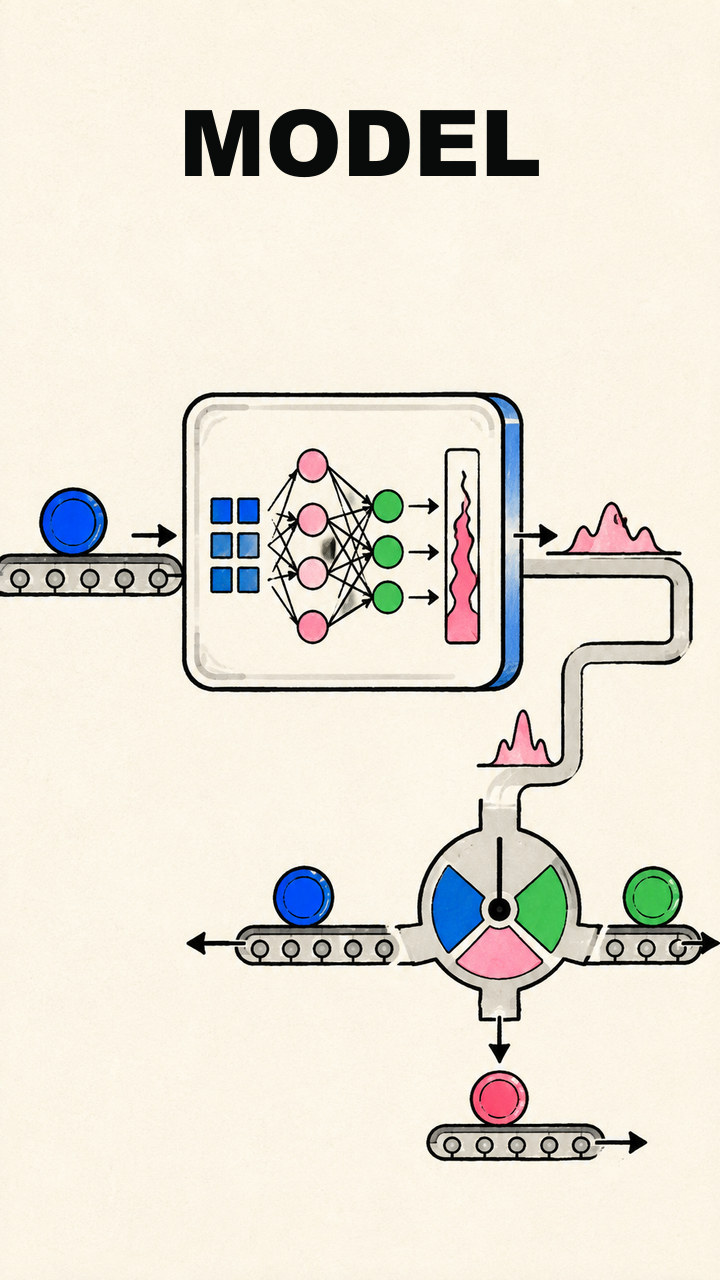
A model is the trained mathematical system that takes input and produces output, such as a classifier, generator, or language model.
- Review state
- Reviewed in POC
- Freshness
- Current
- Version
- 2
- Model
- Machine-Learning Model
Remember it this wayTraining produces the model; the system puts it to work.
In plain language
A model is the learned mathematical component produced by training. Given an input, it calculates an output such as a score, classification, prediction, or generated sequence.
Why it matters
Using model precisely keeps it separate from the application, interface, data pipeline, and policies around it. Most real-world behavior comes from the whole system, not the model alone.
Example
A fraud-detection model receives transaction features and returns a risk score. A separate application decides whether to approve, hold, or escalate the transaction.
Common misconception
A model is not the complete product and does not contain a literal copy of every training example. It is one learned component inside a larger system.
Related terms
Sources
- Google for Developers, “Machine Learning Glossary”provides established boundaries for core machine-learning vocabulary.
- NIST, “The Language of Trustworthy AI”provides a use-case-neutral vocabulary foundation for AI and machine learning.
Learn more
- Compare [[machine-learning|Machine Learning]], [[training|Training]], [[parameters|Parameters]], and [[system|System]] to place Model in the surrounding system.
- Follow the cited source material above for the method, standard, or research context behind this draft.
Public history
23 recorded events · 23 public summaries
A potential shared concept was discussed and selected for initial glossary drafting.
The captured candidate received a complete initial draft and entered section-level human review.
Radar reviewed the initial definition draft for human consideration.
Radar reviewed the initial plain-language-explanation draft for human consideration.
Radar reviewed the initial why-it-matters draft for human consideration.
Radar reviewed the initial example draft for human consideration.
Radar reviewed the initial common-misconception draft for human consideration.
Radar reviewed the initial remember-it-this-way draft for human consideration.
Radar reviewed the initial related-terms draft for human consideration.
Radar reviewed the initial sources draft for human consideration.
Radar reviewed the initial learn-more draft for human consideration.
Definition review recorded as approve.
Plain-Language Explanation review recorded as approve.
Why It Matters review recorded as approve.
Example review recorded as approve.
Common Misconception review recorded as approve.
Remember It This Way review recorded as approve.
Related Terms review recorded as approve.
Sources review recorded as approve.
Learn More review recorded as approve.
Sources review recorded as replace.
Radar verified the learner-facing sources after personal origin provenance was removed.
All nine current wording approvals were reconciled to Approved term status.
Source: vault/Glossary/terms/model/term.md · sha256:04294df53c8d5361ddfedab8031839f895d0f6680d1c2d4a351befd91026491e · Release: rs-glossary-glossary-team-poc-0.5.5-2026-09-02