RS Glossary
Resilience Debt
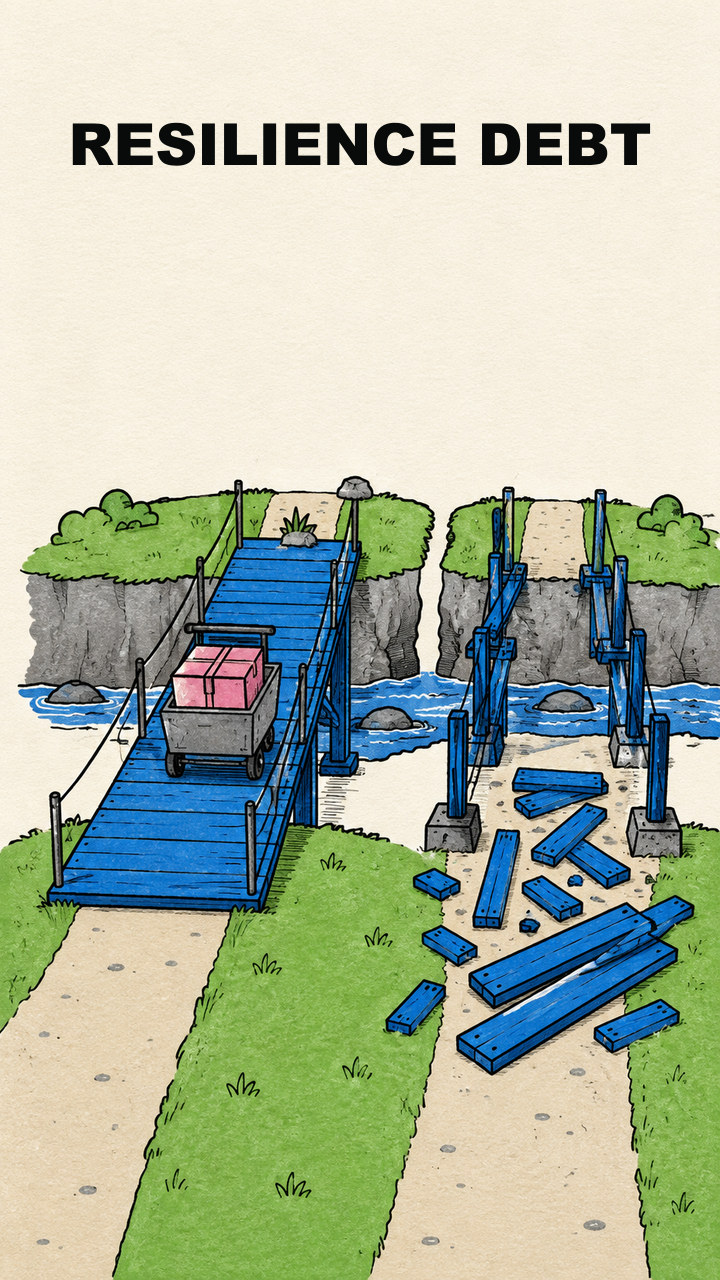
Efficiency or automation removing alternate skills, channels, or relationships needed during disruption.
- Review state
- Reviewed in POC
- Freshness
- Current
- Version
- 2
- Resilience Debt
Remember it this wayEfficiency removed the second way.
In plain language
Resilience debt builds when an organization makes the preferred way of working more efficient by removing its second ways to operate. Normal work may improve, but people lose fallback skills, alternate communication paths, accessible records, or practiced relationships that would keep essential service moving during an outage.
Why it matters
System recovery and business continuity are not the same. A platform may be recovering as designed while employees still need to contact customers, find commitments, approve exceptions, and perform critical work. Resilience debt remains hidden during normal operations and becomes expensive when the primary path disappears.
Example
A business stops printing the next day's schedule because its cloud platform has been reliable for years. During an outage, employees cannot see appointments or contact customers. A current offline schedule and a practiced manual process would not replace the platform, but they would preserve essential service until it returns.
Common misconception
Managing resilience debt does not mean duplicating every system or preserving every old method. It means identifying work that cannot stop, retaining a credible alternate path for that work, and practicing the handoff before disruption turns it into improvisation.
Related terms
Sources
No sources recorded yet.
Learn more
- Test whether critical work has an alternate route with [[operational-slack|Operational Slack]] and [[concentration-risk|Concentration Risk]] in view.
- Check whether the fallback also depends on knowledge at risk of an [[institutional-memory-cliff|Institutional Memory Cliff]].
Public history
22 recorded events · 22 public summaries
A potential shared concept was discussed and selected for initial glossary drafting.
The captured candidate received a complete initial draft and entered section-level human review.
Radar reviewed the initial definition draft for human consideration.
Radar reviewed the initial plain-language-explanation draft for human consideration.
Radar reviewed the initial why-it-matters draft for human consideration.
Radar reviewed the initial example draft for human consideration.
Radar reviewed the initial common-misconception draft for human consideration.
Radar reviewed the initial remember-it-this-way draft for human consideration.
Radar reviewed the initial related-terms draft for human consideration.
Radar reviewed the initial sources draft for human consideration.
Radar reviewed the initial learn-more draft for human consideration.
Definition review recorded as approve.
Plain-Language Explanation review recorded as approve.
Why It Matters review recorded as approve.
Example review recorded as approve.
Common Misconception review recorded as approve.
Remember It This Way review recorded as approve.
Related Terms review recorded as approve.
Sources review recorded as needs-revision.
Learn More review recorded as approve.
Sources review recorded as approve-proposed.
All nine current wording approvals were reconciled to Approved term status.
Source: vault/Glossary/terms/resilience-debt/term.md · sha256:3e7a82bd90bd5791336042ba0c3c2bcd621ff222ff51f08e11fee76b4b45161a · Release: rs-glossary-glossary-team-poc-0.5.5-2026-09-02