Someone raises a useful idea. The quiet question is not “will it win?” It is whether anyone will receive it — record it, own consideration, and return a disposition.
A recommendation is a proposed next step someone wants decided. A decision table is where it actually gets a yes, no, or wait — not every hallway chat. Deferred means parked with an owner and a reason. Lost means it vanished with no decision at all. A disposition is the yes / no / wait answer (or “route it elsewhere,” or lost).
Two distinctions that matter
Approval and denial are not the same as success and failure. A valid denial can clarify constraints and seed a better ask later.
Lost is not the same as denied. Lost means no decision happened. Denied means someone considered it and said no — for now.
What was true before
Recommendations always needed a receiving owner. Informal orgs used access, persistence, timing, and familiarity as the route. Before GenAI, fewer polished packets reached the table; the filter was often who could get in the room. The handoff problem is old.
What GenAI changes
Finished-looking recommendations arrive faster and in greater volume. More options can look “ready” before context, ownership, or comparison exist. The receiving process matters more, not less. GenAI accelerates recommendation traffic. It does not invent the need for judgment about what reaches the table — and it is not a product tour.
Five journeys (one system, different paths)
Denied → later influential
Someone proposes preparing a solution that might be needed — in that discussion, the room’s rough sense was maybe about a one-in-five chance. After discussion, the consensus is that it is too early. The denial is valid: uncertainty is real. Still, everyone heard the concern.
Months later the need is real. A new recommendation arrives — sharper, more focused, built with what people learned in the meantime. This time it is approved.
Example: A rumor circulated that a widely used API might be deprecated. People rely on it. Past early rumors were often inaccurate or premature, so it was reasonable to wait. Awareness of the situation was still valuable even when the situation became clearer.
The later approval does not mean the first proposal was “right all along.” It means a sound denial left learning in the room, and a better ask used it.
Lost
A hallway discussion produces a good idea. Each side thinks the other will take it and make it happen. Nobody owns the next step. The idea vanishes. That is lost — not denied. No disposition ever landed.
An alternative: My team now uses chatbots + an issue tracking system. When someone has an idea, if they have their phone with them, they add it to the list. If a group is having an informal conversation, we now alternate who adds new ideas to the tracking system so that nothing is lost.
Approved
Approval is not the end. A visible, sponsored proposal reaches the agenda and gets resources. Follow it past the meeting: does it have capacity, authority, and a review point? Approval is not proof of benefit until the work meets reality. Missing alternatives may never have reached the list.
After approval: We track the success and failures of our recommendations and use what we learn to improve our processes.
Deferred
Someone suggests adding GenAI to our intranet applications. The room wants it. Someone also points out that governance is still not settled. So the recommendation is parked with a reason — wait until that constraint clears — rather than pushed through or silently dropped. Deferral with a reason and an owner is different from abandonment.
We revisit deferred recommendations on a schedule so that our good ideas do not get lost. Of course, at reconsideration, the recommendation could be denied. Deliberate decisions are better than no decisions.
Conditionally Approved Pending Proofs-of-Concepts
A recommendation proposes logging every interaction on a site. It sounds strong. Early proofs of concept show it will not scale on the current architecture. The team revisits and narrows the ask: log top-level navigation only. Evidence changed the decision — including what not to do at full scope.
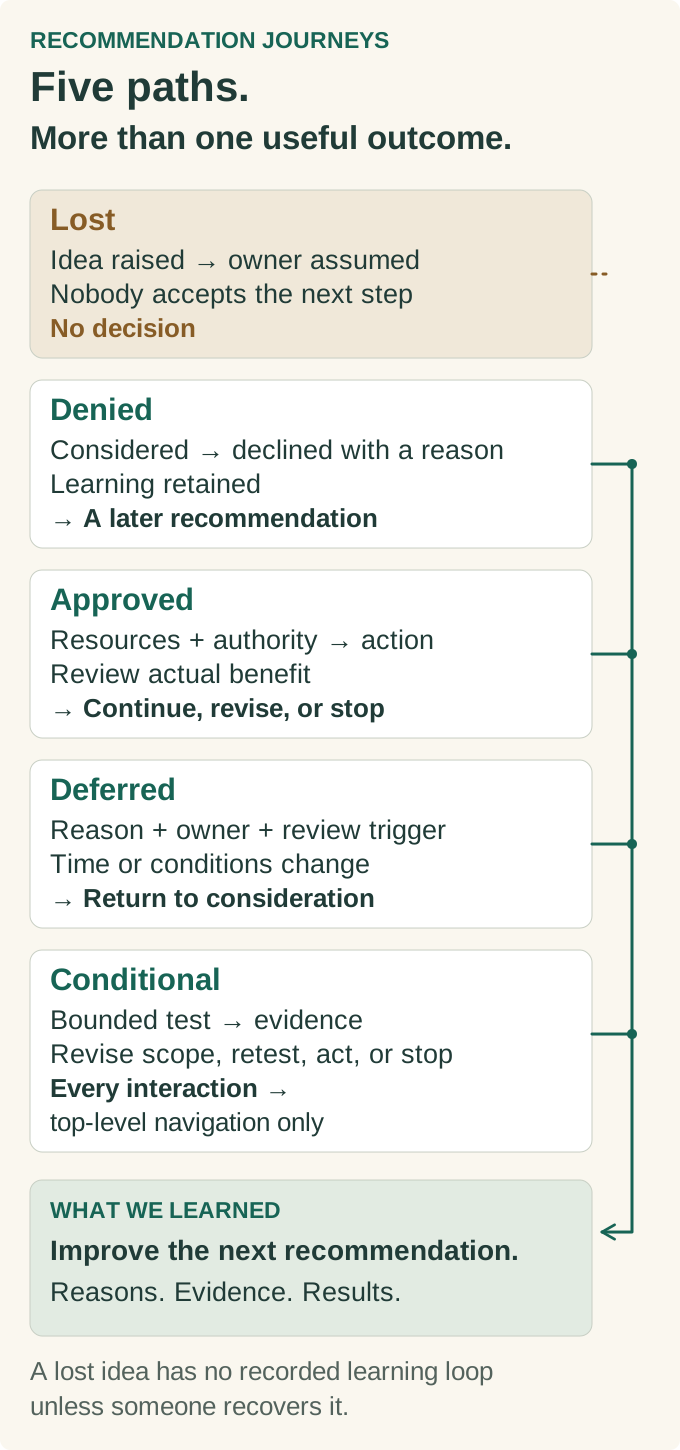
A decision can end a proposal while its learning continues. A lost recommendation never received a decision.
The Process
Only some reach the decision table
Decision-makers see a set of options. Legitimate filters include relevance, urgency, evidence, cost, capacity, and risk. Hierarchy, presentation, and sponsorship sit beside those filters. A reasonable decision can still be constrained by an incomplete list. Ask how missing perspectives get noticed.
Each receives an outcome — or disappears
Act, investigate, test, defer, deny, route elsewhere — or lost, unowned, unanswered. For considered decisions: preserve the reason, communicate it to the person who raised it, and name a next owner or reconsideration trigger when useful. Respectful consideration can preserve trust without agreement.
Approval meets the working environment
Approval still has to meet the working environment. Does it have authority and capacity? What work gets displaced? What outcome do we expect, and when do we review? A bounded test can justify revision or stopping. Approval alone is not evidence of benefit.
Return weeks or months later
Did the approved change help — and what else moved? Was the deferred idea reconsidered when its trigger arrived? Did the denied idea seed a stronger recommendation? In the API-aware path above, yes. Did the trial change understanding? Did the person whose idea vanished raise another — or stop contributing?
Light workflow
Drawn from the journeys — not a manual:
- Receive and acknowledge
- Retain enough context (need, evidence, uncertainty, ask)
- Route to someone who accepts responsibility
- Compare options (notice what’s missing from the list)
- Record and explain the disposition
- Enable authorized action — or a bounded test
- Review results
- Preserve learning for later recommendations (a denial may close this proposal while learning continues)
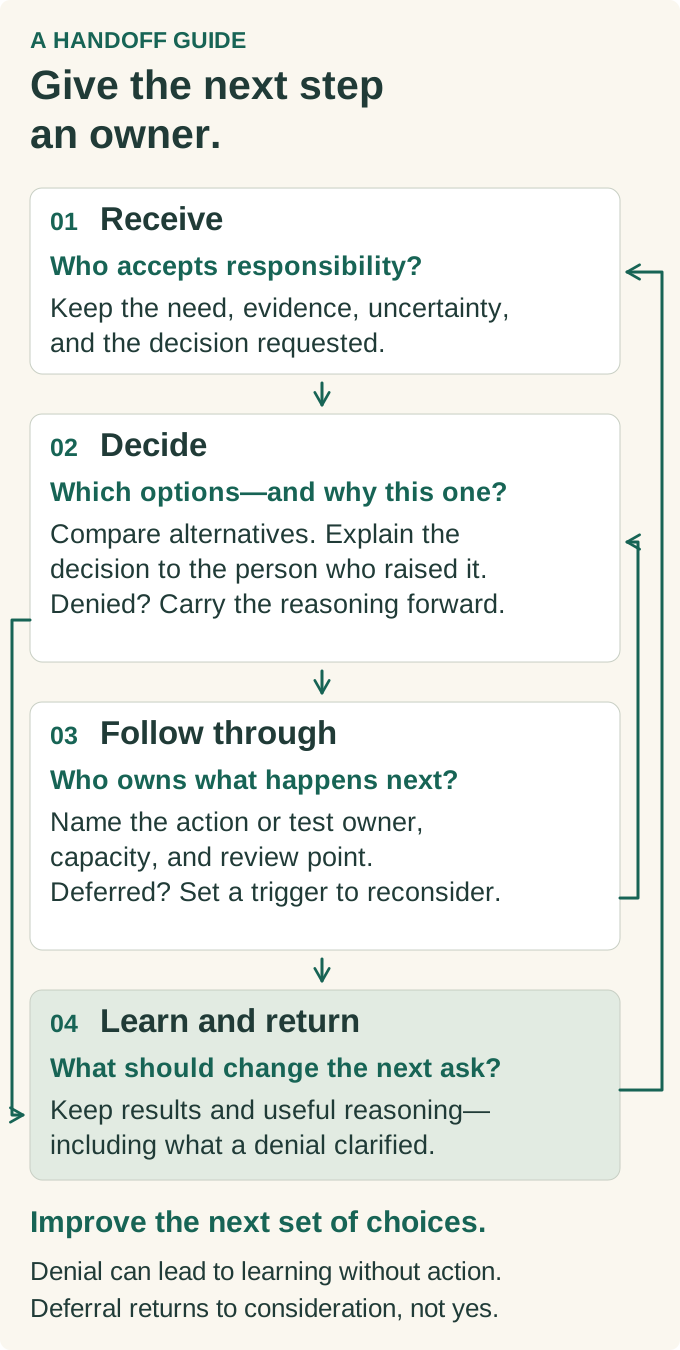
Before the conversation ends, make the next owner and next step clear.
Proportionate to consequence. No bureaucracy theater.
Close
A useful process gives recommendations fair consideration, makes decisions understandable, and lets what people learn improve the next set of choices. Somewhere to go is not a guarantee of yes — it is a guarantee of being received.
Credits
While this article is from my personal experiences, I decided to write it after reading Jason Baig's Substack article: How to Turn Analysis into Action.