Our deployments had been getting slower.
We assumed that was because the project was growing. The content was growing. Of course the pipeline would take longer.
A Codex tech-debt review found something less obvious.
What we found
We asked the agent to look around — not to build, not to fix yet. It found that our CI (the automated checks that run on every change) had gradually accumulated duplicated work.
A full candidate workflow could perform seven builds. Branch pushes were also triggering duplicate workflows. So were pull requests.
Nothing was broken. We had simply taught the system to repeat work.
That is tech debt in plain terms: work we taught the system to keep doing that slows us down or costs more than it should.
Two costs
The debt showed up in at least two places:
- Longer deployment time
- Higher compute and token spend on each deployment
No drama. Just friction that had started to feel normal.
The habit
Periodically, ask a coding agent something like this:
Don’t build anything. Don’t fix anything yet. Look around. What technical debt have we accumulated that is worth cleaning up?
The value is another set of eyes that does not share our assumptions about why the system behaves as it does.
Human review still matters
The AI’s recommendations still need human judgment.
Some duplication is intentional. Some ugly-but-stable code is better left alone. This is not “AI found debt, so always delete.” It is “AI found candidates; we decide.”
Early result
After we addressed this one issue, a deployment that had been taking about 30 minutes now takes about 20 minutes — about a third less time.
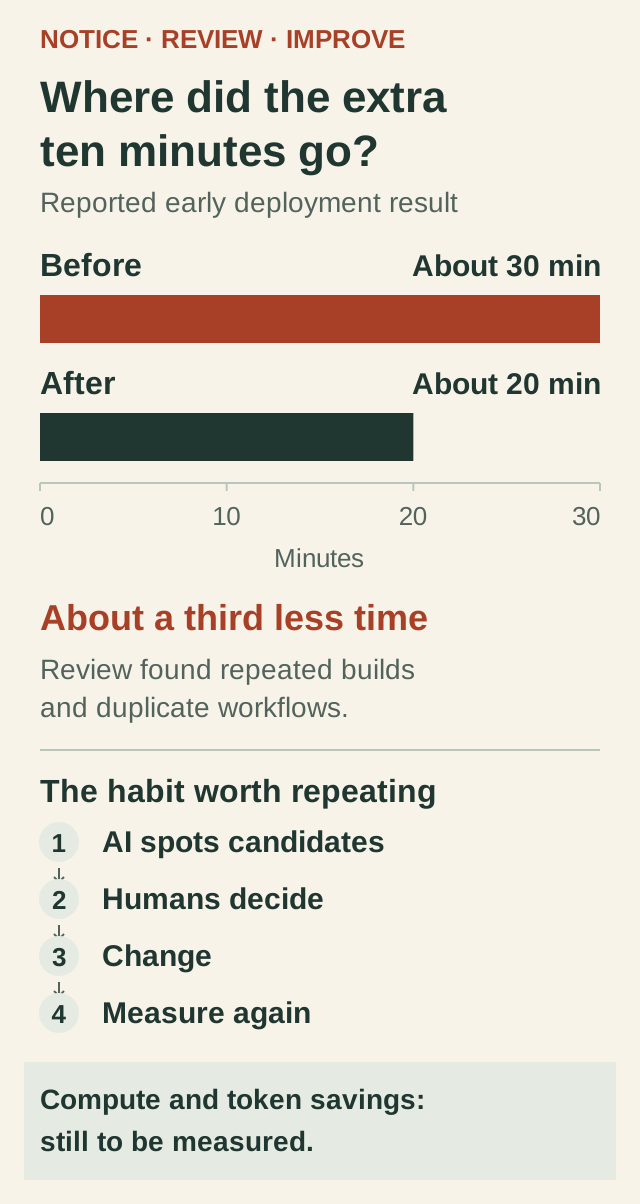
Our early deployment result after addressing duplicated work. The time reduction is reported in the article; compute and token savings still need measurement. Created with Codex for Renaissance Solutions.
We will measure the corresponding compute and token savings rather than assume them. Time improved. Spend needs its own check.
Core line
The system wasn’t just getting bigger. It had accumulated friction while growing.
Time to look for more tech debt.
Observe, then question, then change, then measure, then look again.