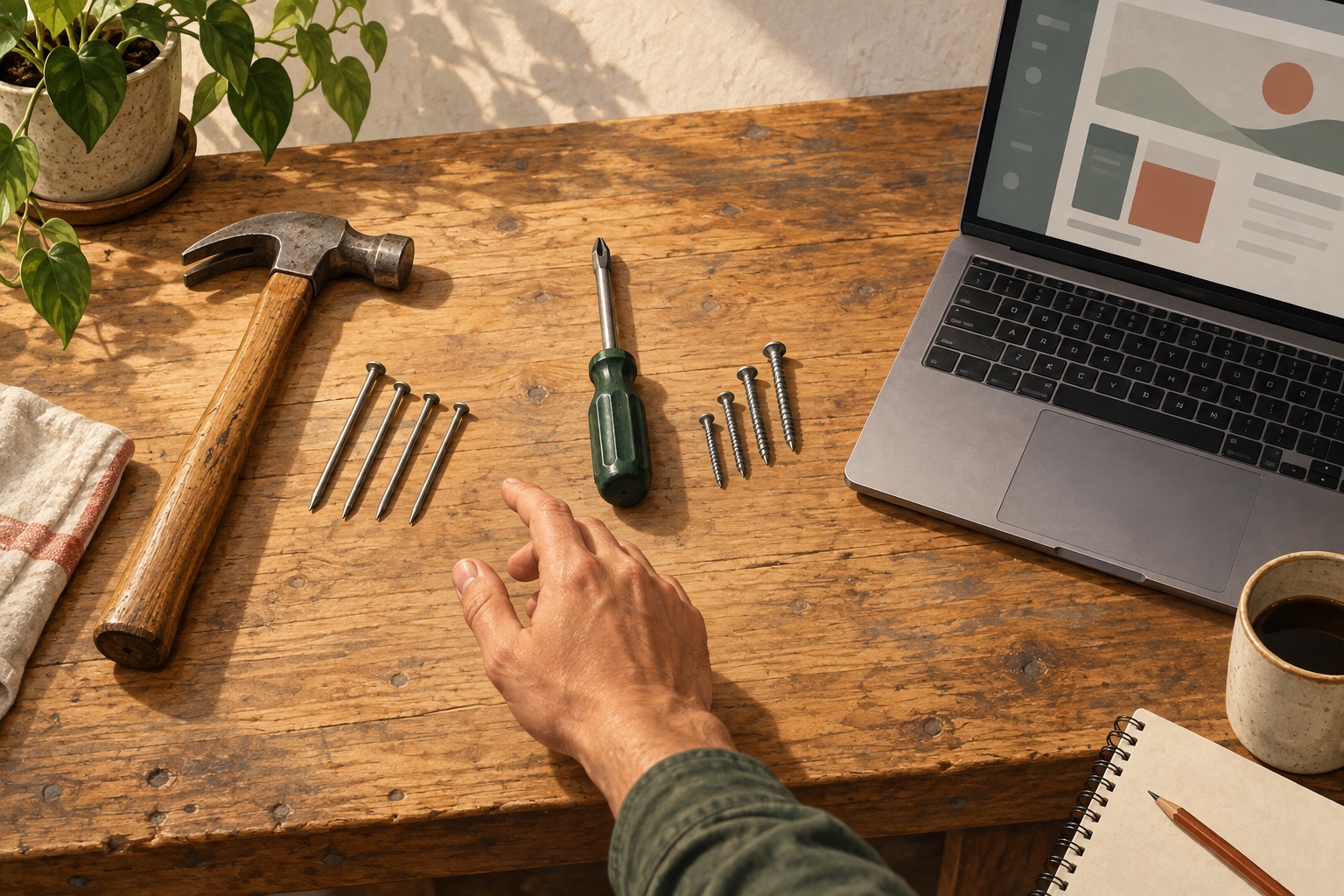
Start with the job, then choose the tool. AI-generated conceptual illustration for Renaissance Solutions.
Most of us were not handed tools without instruction.
The first time someone put a hammer in our hands, they probably watched closely. Not because hammers are bad, but because hammers are powerful enough to hurt fingers, dent walls, and turn enthusiasm into repair work.
The same is true in the kitchen. A child is not handed a hot pan, a knife, or a box of ingredients and left alone. They are shown what to touch, what not to touch, what to stir, what to watch, and what happens when heat keeps working after the burner is off.
We learn tools through guided use from parents, teachers, and many others (including YouTube). We also learn that power is not the same as fit. Not everything goes in the dryer. A hammer is not the right tool for a screw. “It worked once” is not the same as “this is what the tool is for.”
Two different skills get mixed up here. One is choosing the right tool for the job. The other is learning how to use that tool without damage. Hype blurs both. It teaches us to reach for the closest tool instead of the right one, and it makes us skip the practice that would teach us how to use it.
Generative AI is a useful tool that can draft, summarize, brainstorm, compare, explain, translate, and help us think. But the current hype often treats it like a universal hammer. Every problem starts to look like something to pound.
That is where small mistakes can turn into real problems. Not always dramatically. Sometimes the damage is subtle: a bad assumption, a confident wrong answer, a detail the answer left out, a decision made too quickly because the tool sounded sure.
We do not have to throw away the hammer. The answer is to teach people how to use it — and to teach them when not to reach for it.
Start with safe tasks. Show the failure modes. Explain when the tool is useful, when it is risky, and when another tool or another person is needed. Let people practice before the stakes are high.
Personally, I have found that fun toy projects provide a safe sandbox to experiment and learn. My best experiments took a few concepts mashed them together, one layer at a time. For example, creating a music video about an interesting topic requires: research, design, planning, writing, image generation, music and voice generation, lip syncing, and more.
The first step is simple. Before you hand someone GenAI — or reach for it yourself — ask what the job actually requires. When GenAI can help, give it a try; if you are not sure, you can have that conversation with your chatbot (just remember, it might not always know the answer).
Good tool use is learned. We learned it in garages, kitchens, workshops, basements, and cubicles. Keep other tools nearby while continuing to learn about new ones (AI and non-AI).
We've learned when to reach for a hammer or a screw driver. Now we are learning when to reach for a chatbot, an agent, the apps we have been using for years, or the command line.