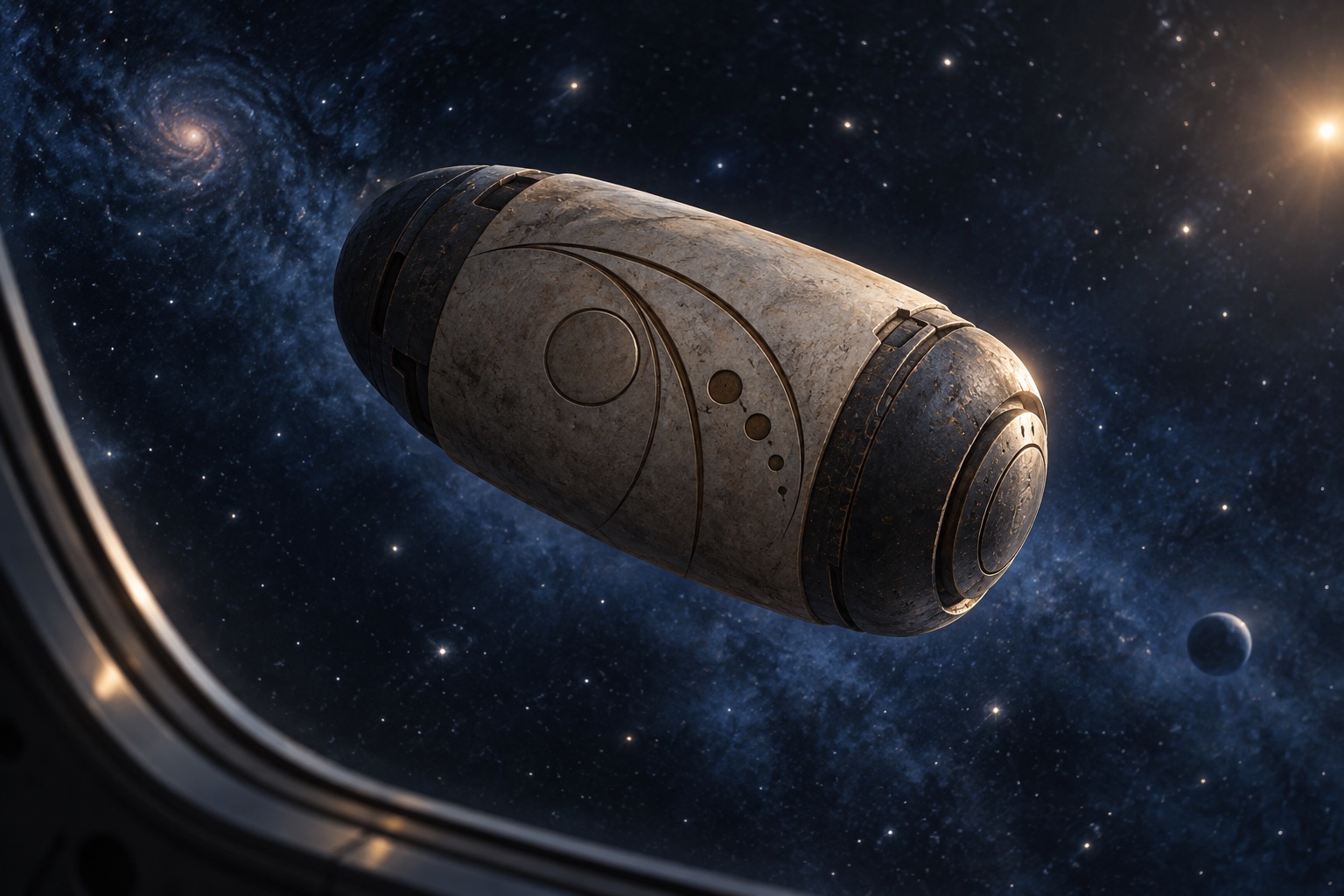
An imagined discovery can open a story. AI-generated illustration of a fictional premise.
The Spark
I was watching Project Hail Mary when the burial scene in space (no more spoilers) made me choke up and tear up.
Here on Earth, we often learn about vanished people through what they left behind: graves, tools, fragments of pottery, inscriptions, ships, homes, trash heaps, monuments, mistakes. Archaeology is one long act of listening to what remains.
So I wondered: What if first contact between planets did not begin with a message, a landing, or a handshake? What if it began with a burial site?
What if some future civilization, traveling through deep space, discovered the remains of another intelligent species not because anyone was looking for life, but because someone had once cared enough to bury their dead among the stars?
From there, the idea opened quickly. Space as cemetery. Space as archive. Space as a field of scattered memory. Explorers might find bodies, artifacts, memorial capsules, war wreckage, lost probes, and the ruins of civilizations that never met while alive but became knowable through what survived them.
And because I was brainstorming with AI, the rabbit hole had no bottom other than my 5-hour token allowance.
That is the point. Generative brainstorming can keep expanding as long as we keep talking. Since the tool will not call time, we must. We hear stories now about people getting lost in AI conversations, and other stories about people turning strange explorations into companies, books, courses, or careers. We must own our own mindfulness.
Most of us are somewhere in the middle. We are not trying to build an empire from every strange idea, and we are not trying to swear off exploration because the tool can get intense. We are curious people trying to learn how to brainstorm with AI while keeping our feet on the ground.
When the idea starts running
This is one of the great strengths of generative AI. We bring it a spark, it will sometimes bring the kindling. Whether or not it turns into a blaze is up to us.
It can name patterns, build timelines, suggest cultures, conflicts, rituals, technologies, ethical dilemmas, and story structures. It can help you see how an idea might fit inside Star Trek, Foundation, or something entirely your own.
That is useful. It is also fun. For writers, strategists, teachers, business owners, designers, and curious humans, this kind of brainstorming can loosen a stuck idea and help us explore possibilities we would not have reached alone. We should not flatten that value into fear.
But AI does not get tired. It does not look at the clock (until recently it did not even know whether it was morning or night). It does not feel the stiffness in your back, the residue of a hard week, or the difference between “this is a fun idea” and “I should change my life around this.”
It will keep going as long as the conversation keeps going. That does not make the AI malicious or the human foolish. Just the opposite, it means GenAI is always there, even when we should have taken a break. It is up to us to bring the boundaries.
The language of wonder
Unlike our friends and family, our GenAI chatbots and agents almost always sound confident, excited, even eager to help. It may tell us the idea is fascinating, cinematic, ready for a pitch, a screenplay, a course, a startup, or a movement. That can feel wonderful, especially when the idea matters to you. But it is worth being precise.
AI does not experience empathy, enthusiasm, or wonder. But it was trained on the language patterns humans use when we express those things. In conversation, it can surface those patterns back to us with surprising fluency. That distinction matters.
The emotional language came from us (humanity) — books, essays, scripts, conversations, grief, comedy, longing, and the other human traces in language. AI can reflect some of those human words and feelings back. Anyone who has cried over fiction, found courage in a speech by someone long dead, or taken comfort from a book already understands part of this.
So responding emotionally to AI-generated language is not strange. The issue is that AI can produce emotionally fluent language interactively, instantly, and endlessly. That is powerful. Powerful tools deserve mindful use.
Check the weather before navigating
Since we are human, there are times when we are more open to suggestion. We may be tired, grieving, in pain, between jobs, lonely, excited, overwhelmed, under financial pressure, or creatively energized. Those are not character flaws. They are like weather conditions. Before making decisions after an intense AI session, it helps to pause and check the weather:
- Am I rested?
- Am I grounded?
- Am I looking for clarity, comfort, distraction, validation, or permission?
- Did this conversation help me think, or did it make the idea feel more urgent than it was?
- Is this a real next step, or am I still inside the momentum of the brainstorm?
- What would I still believe about this tomorrow morning?
- Who could I sanity-check this with before I spend real time, money, or reputation?
- What is one small, reversible next step?
That kind of scan is about keeping the choice yours, not about fear. Sometimes the answer is to sleep on it. Sometimes it is to write the idea down and come back later. Sometimes it is to ask a trusted person whether the idea still sounds sturdy outside the chat.
A grounding pause on the same idea
Brainstorming expands possibilities. Deciding narrows them. AI is very good at the first. The human still has to decide what matters.
For the Galactic Archaeology idea, a grounding pause could be simple: a burial site among the stars is a story premise, not a discovery. The possibilities can stay open without becoming a pitch, a novel outline, or a claim about life elsewhere. One small next step could be to write down the premise and leave it until tomorrow. That preserves the idea without committing to a project.
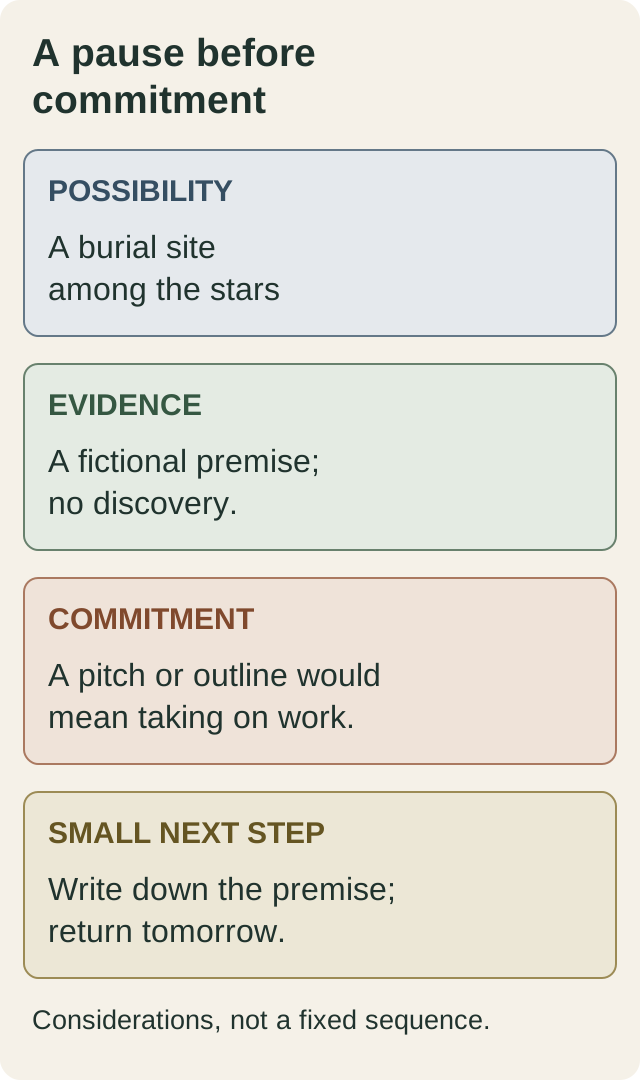
Keep the possibility. Check the evidence and the commitment before choosing a next step. Original diagram created with Codex for Renaissance Solutions.
Both modes matter. If we only ground, we may never explore. If we only explore, we may float away from our actual lives. The skill is moving between wonder and judgment without confusing one for the other.
The human holds the thread
When an idea does ask to become real, the work still belongs to us. AI can help us brainstorm, organize, and offer language. It cannot live our lives. It does not know our energy budget, what we owe our families and teams, or which ideas are worth the cost. Only we can decide that.
The wonder is real, so brainstorm with AI. Build worlds. Chase strange premises. Let it help you find doors you did not know were there. It is up to us to remember to pause before walking through one.
AI can expand the room. The human chooses the door.