CNN reported this week that, this spring, a U.S. special-operations analyst used AI help on a ship-manifest problem. The report identified a Chinese vessel’s cargo as tied to a nuclear-weapons program. Interception preparations began. Sources told CNN that boarding plans were underway and that aircraft were in the air. Just before the planned operation, officials dug deeper. The cargo ID was wrong. The operation stopped.1
What we still can’t know from this public reporting is whether that late check was a designed gate or a late save. That uncertainty changes the meaning of the story. It does not change the useful question for the rest of us: How far may an unverified claim travel before verification is mandatory?
What we know and what remains uncertain
Know (CNN reporting):
- AI helped with analysis and with packaging a standard trusted intel report
- The report identified the cargo as nuclear-program related
- Preparations for an intercept got underway
- Domain experts who know that kind of cargo rejected the ID; the operation stopped
Uncertain (don’t invent):
- Which model, product, or reasoning level
- How the wrong conclusion formed
- What human review happened at each stage
- Whether preparation equaled authorization
- Whether the final check was a required gate or an improvised rescue
- The full intended workflow
That last uncertainty is the open question. We will not manufacture the answer.
Speculative workflow (not reporting)
The following is not reporting. We are constructing one plausible workflow to see what it teaches.
Imagine two streams running at the same time:
- Preparation — options, resources, people, plans
- Verification — sources, cargo ID, domain experts, challenge the assumptions
They meet at a gate. Verified, then authorize consequential action. Not verified, then stand down.
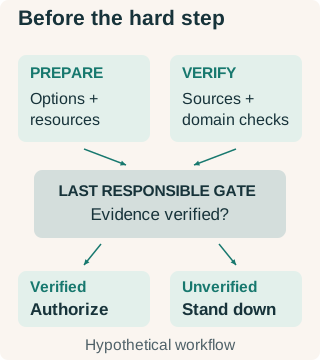
In the article's hypothetical workflow, preparation and verification meet at a gate before consequential action. This is an illustrative control pattern, not a reconstruction of the reported ship incident. Conceptual diagram created with Codex for Renaissance Solutions. CC0-1.0.
Aircraft already in the air is not proof of blind AI trust. Preparation can run while verification continues. Prep is not the same as authorization.
Give the practice credit — “hurry up and wait”
Parallel prep under time pressure is trained competence, not inherently reckless. We are not claiming this is what happened. Public reporting does not expose the full control flow. “Hurry up and wait” is a plausible reading of how serious organizations work under uncertainty.
The Last Responsible Gate
The Last Responsible Gate is the point where being wrong gets hard to reverse — or irreversible — so you verify before you go further.
An unverified claim is something that still needs a check before it should drive the next hard step.
Before the gate: investigate, calculate, prepare, draft, simulate, reserve, assemble. After the gate: money moves, people are disciplined, customers are accused, contracts end, production stops, public allegations go out, actions get hard to reverse.
Shrink the Pentagon — a five-person business
Before AI: Someone overhears that Acme is in trouble. A quick search. Tell the boss. “Our Acme?” Check the source. Wrong company — similar name. The gate works partly because the claim still looks uncertain.
With AI: A polished summary arrives. Dates. Risk language. A table. Recommendations. The same wrong-company mistake — mixing up two companies with similar names — is still possible. But the claim looks finished.
That packaging observation is the difference between how finished incomplete information can appear and not a claim that AI “tricks” you.1
Question: Why do we sometimes relax gates we already used before AI?
AI may not remove the gate — it may make us forget why it was there
Automation bias, in plain words: treating a polished automated answer as a shortcut instead of checking other sources.2
Before: “I think I heard…” With AI: “Analysis of Acme Industrial Financial Risk”
Key line: We didn’t intentionally remove the gate. The new tool may have made us forget why the gate was there.
The model isn’t shipping a claim on its own — the human workflow is what travels. Ask: "How far the claim is allowed to move, and who can stop it?"
Restore old human checks — don’t build bureaucracy
Ask: What would have made us double-check this before AI?
Where did you hear that? Our customer? Show the invoice, the bank record, the contract. Call Susan. Before we send that…
Principle: When AI enters a workflow, identify the gates humans previously used. Make sure the technology has not silently bypassed them.
How far may this claim travel? — checklist
- What is the claim?
- What can we safely do while it remains uncertain?
- What evidence would verify it?
- Where is the last responsible gate?
- Who owns that gate?
- Can they inspect the underlying source — not only the AI summary?
- Can they stop the next action?
- What would we have done to verify this before AI?
Close
We still don’t know if the final review in the ship story was an intended system, a narrow rescue, or something in between. We will not invent that answer.
Organizations have always acted on incomplete information. Good ones prepare without prematurely committing. AI doesn’t change that principle. It may change how convincing incomplete information looks while it moves.
So don’t merely ask whether a human is in the loop. Ask how far an unverified claim is allowed to travel before the next step gets hard to reverse — and where your last responsible gate stands.
Footnotes
-
Katie Bo Lillis & Zachary Cohen, CNN, 2026-09-18 (CNN Newsource / KEYT mirror fetched 2026-09-19): https://keyt.com/politics/cnn-us-politics/2026/09/18/exclusive-us-military-had-close-call-after-using-ai-for-false-intelligence-report-sources-say/ — AI-assisted SOCOM analyst report; intercept prep; SME check rejected cargo ID; packaging into a standard intel report; SOCOM Pacific / Pentagon no comment; cargo unknown to CNN. ↩ ↩2
-
Automation bias as using automated cues as a shortcut instead of vigilant checking — Skitka, Mosier & Burdick (1999), International Journal of Human-Computer Studies: https://doi.org/10.1006/ijhc.1999.0252 — observation only; no invented rates. ↩