This morning — 22 September 2026 — a ChatGPT / Codex desktop update temporarily made our Codex projects disappear.
The local data was still there. We had backups. A later app update restored access. Others have reported a similar pattern after desktop updates: projects vanish from the UI while chats remain — looked gone is not the same as deleted.
Relief came first. Then a quieter question stayed behind: if the screen says the work is missing, how sure are we that we can put the working environment back together — the setup you actually use to do the work — not only the files?
Two different claims
“We have a backup” and “we can recover our work” are two different claims.
A backup means copies exist somewhere. Recoverability means you can reconstruct that working environment. Green backup jobs and restored disks matter. They are not the same as proving you can resume the work.
That cousin question shows up outside GenAI too — service resilience is not the same as customer recoverability. Here the focus is narrower: GenAI as a place of sustained work.
What “AI work” includes
Restoring a folder of documents may not restore a usable GenAI project.
The working context can include more than files: conversations, instructions, configuration, project metadata, tool connections, permissions, and local state.
Those pieces have to relate correctly. If a link breaks, you may have the bytes back and still not have the workplace back.
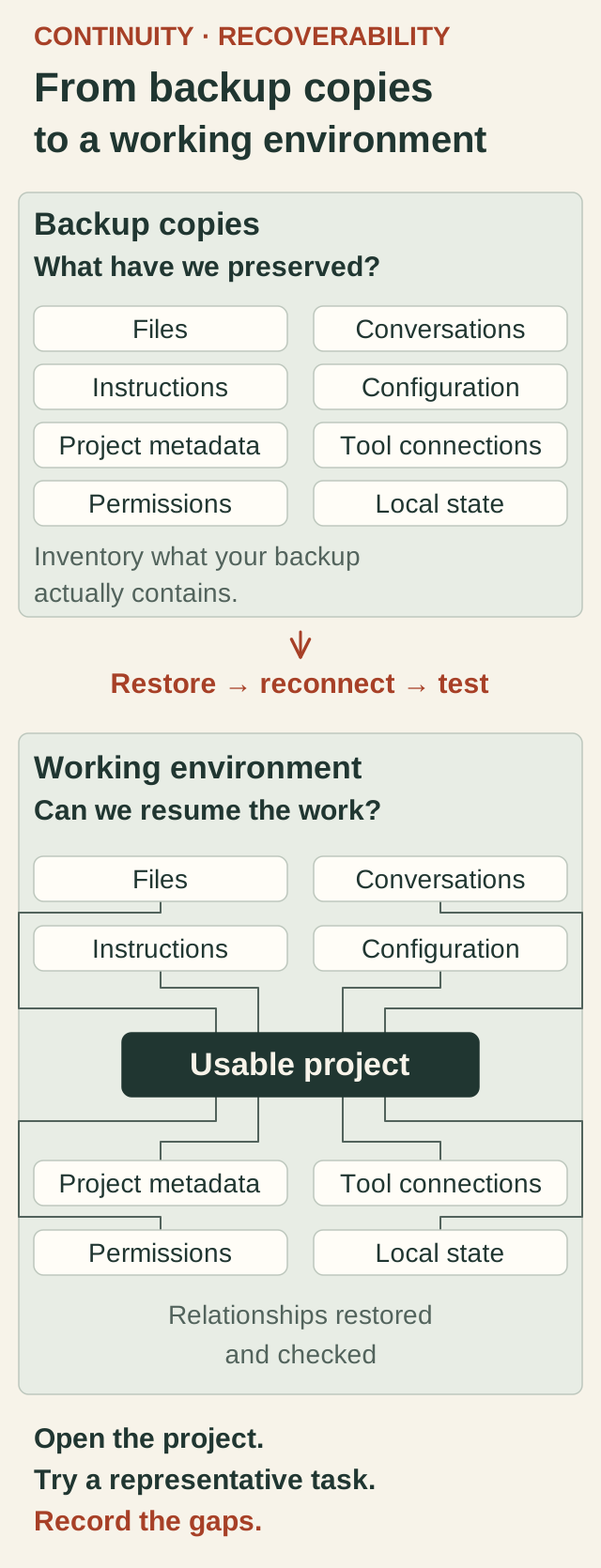
A recovery test checks both the pieces we can restore and whether they work together. Conceptual diagram created with Codex for Renaissance Solutions.
What vendors need to treat as requirements
As these tools become places where people do real work, continuity and recoverability belong on the product list — not as niceties.
Users need clear answers:
- What counts as a complete project?
- What is local versus cloud?
- What can be exported?
- What is actually backed up?
- How do you restore a working environment?
That is a product ask, not a reason to walk away. Keep using the tools. Ask the tools to treat continuity like a requirement.
We turn the same judgment on ourselves
Renaissance Solutions uses Backblaze. We know how to restore machines.
We have not yet proven that we can reconstruct our GenAI projects and working context. That gap is ours to own. Same honesty we ask of vendors: a successful file restore is not proof that the GenAI workplace comes back intact.
Observe → learn → refactor
This piece starts the question. It does not close it with results we do not have.
Next for us: a GenAI disaster-recovery exercise. Test restores. Inventory what makes a working environment. Try to reconstruct the workplace — not only the files. Find gaps. Refactor the process. Document what we learn so the next scare starts from a better place.
Do not let this become a quiet “it does that sometimes.” Notice it. Learn from it. Change the next run.
Having a backup is good. Knowing you can recover your AI work is a different claim — and we intend to prove it.