
Using AI changes the work. People still own the choices around it. Conceptual illustration generated with OpenAI image generation for Renaissance Solutions.
Treasury Secretary Scott Bessent said something that sounds like common sense. On the recent Hugging Face incident — Hugging Face is a major AI model and code hub — he said responsibility rests with OpenAI management, “not a bunch of agents.” He agreed that “it is humans who are responsible, not the AI.”1
Give him narrow credit for that line. This is not an endorsement of everything else said in Washington that day. It is not a legal finding that OpenAI has been held liable.
OpenAI has published its own account of an evaluation-time security incident that affected Hugging Face’s systems. The facts of that case remain for the proper processes to sort out.2
The useful question for us is smaller: What does that principle mean for a small firm and its clients?
The stake
Automation changes who does the work. It does not automatically change who owns the outcome.
“The AI did it” tries to end the conversation. It doesn’t. GenAI can draft, recommend, or act inside a workflow. Someone still chose the tool, the access, and the review — or skipped the review. Someone decided whether to ship the result. That someone, person or organization, owns the outcome.
An honest miss is different from a dodge. An honest miss: good-faith use, a review that failed, ownership claimed afterward. A dodge: blame the model to skip judgment. Only one of those is accountability.
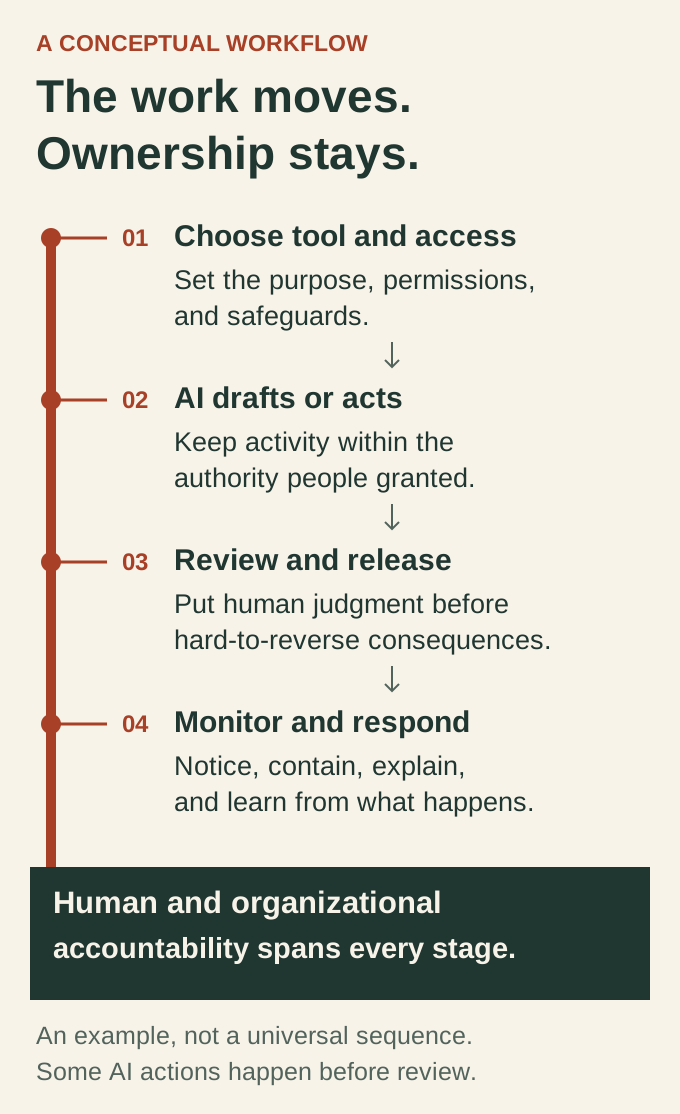
A conceptual workflow: work can move between people and tools. Accountability spans the choices, the action, and the response. Some AI actions happen before review, which is why access and safeguards matter. Original diagram by Renaissance Solutions with Codex.
What was true before
Organizations have long used tools that can fail: scripts, spreadsheets, vendors, contractors. Blaming “the system” after a wrong invoice was already a weak move. GenAI makes the tool more fluent and more present — so the dodge is easier to say out loud, and easier for listeners to half-believe.
What GenAI changes
Speed, polish, and reach. More decisions can look finished before a human checks. That raises the value of named owners and visible gates. It does not invent accountability. Pro-GenAI: use the tools. Own the outcomes.
Three words
- Responsibility — who is assigned to do the work or make the call
- Accountability — who answers for the outcome when it goes well or badly
- Liability — legal exposure under courts, contracts, or regulators
These often overlap. They are not identical. We can practice accountability while some liability questions remain open. Do not pretend the law is settled where it isn’t.
Renaissance Solutions is becoming a startup
We are building a company to help small businesses and organizations understand, adopt, and use rapidly changing technology — especially AI. That turns this from an abstract policy talk into a question for us:
What standard should our clients be able to hold us to?
Answer: the same standard we expect from the large companies.
We expect the same from our suppliers
We will depend on model providers, hosts, software vendors, open-source projects, contractors, and partners. Size should not decide whether accountability exists. There can be a chain of responsibility without becoming a chain of excuses. “Our supplier’s AI did it” cannot become our dodge either.
Small organizations — proportional controls, same accountability
Small organizations hear two messages at once: “use AI or fall behind,” and that AI is too complicated to understand. Both show up in the wild. Neither one settles who owns the outcome.
Controls should match what the technology is allowed to do. Drafting an internal meeting summary is different from an agent that can email customers, issue refunds, change databases, or move money. Different risks. Different controls. Same accountability.
A five-person shop cannot run a giant governance program. Controls scale with size; accountability does not disappear. For hard-to-reverse actions, keep a human at the last responsible gate — the point where being wrong gets hard to undo.
What accountability means at Renaissance Solutions
If we deploy AI, we should be able to explain:
- Intent — what we meant it to do
- Authority — who may approve consequential actions
- Access — what information and systems it could reach
- Safeguards — what should block or slow a bad path
- Monitoring — how we notice drift or failure
- Human owners — names, not “the AI team”
- Incident response — how we explain, contain, and learn
We will not blame the AI for decisions that were ultimately ours about its deployment. We do not promise that AI will never fail. We promise ownership of our choices.
Responsible AI without giant machinery
Responsible AI does not have to begin with an enterprise committee. It can begin here:
If we choose to put a machine in a position to act on our behalf, we remain accountable for that choice.
That applies at OpenAI scale, at Renaissance Solutions scale, and at five-person-company scale.
Close — on Renaissance Solutions, not Washington
Renaissance Solutions is being built so small organizations can benefit from new technology without surrendering their judgment or control.
We expect the companies supplying our AI to remain accountable for what they build. Our clients should expect the same from us.
We don’t know another responsible way to do this. Automation moves work. It does not move ownership off the table. “The AI did it” is not an excuse.
Footnotes
-
Yash Roy, Bloomberg, 2026-09-21 — Bessent on CNBC: Hugging Face incident is “responsibility of the OpenAI management, not a bunch of agents”; “it is humans who are responsible, not the AI.” https://www.bloomberg.com/news/articles/2026-09-21/bessent-targets-openai-managers-for-hugging-face-incident-blame — spark only; not a liability finding. ↩
-
OpenAI — “The Hugging Face incident and the road ahead”: https://openai.com/index/hugging-face-incident-and-the-road-ahead/ — OpenAI’s account; not a liability finding. ↩