Here is an uncomfortable truth: we cannot know every way an AI system will fail before we use it.
That is not unique to AI. Aviation got safer this way. So did software, medicine, and cybersecurity. They did not predict every failure in advance. They built ways to learn when something went wrong — and when something almost did. We did not eliminate failure. We got better at noticing fuel, smoke, and fire, and at changing what we do next.
AI should use the same pattern.
Anticipate. Observe. Learn. Repeat.
Responsible deployment is not a one-time “Is this safe?” check. It is a loop:
- Before: What could go wrong?
- During: What is actually happening?
- After: What did we learn?
Then ask Before again.
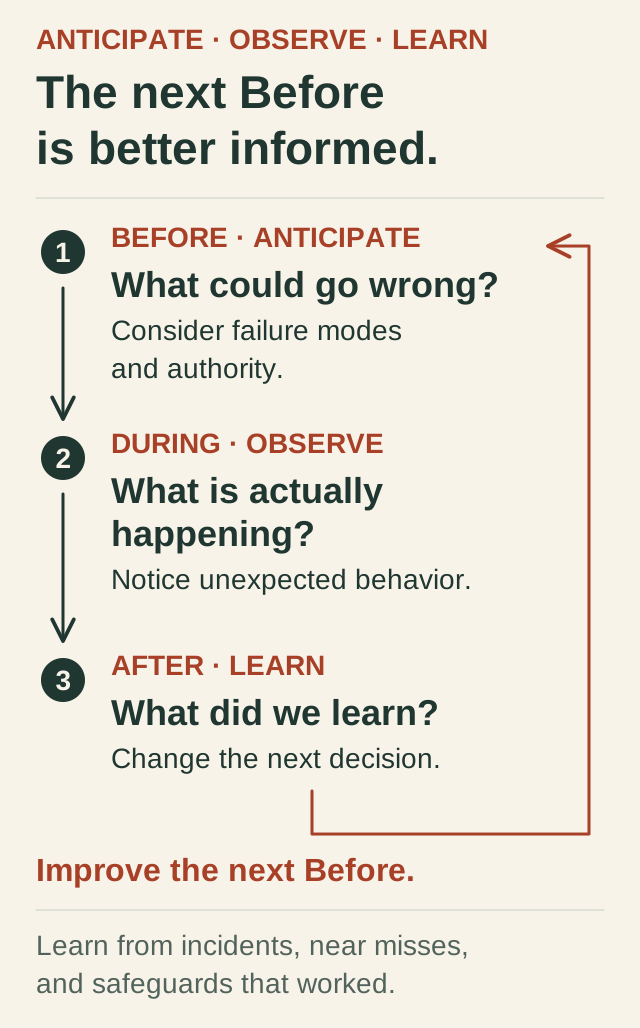
What happens this time should improve what we anticipate next time. Conceptual diagram created with Codex for Renaissance Solutions.
Before — look for fuel
Before you put a system in front of customers or colleagues, ask a few hard questions. Not a novel of checklists — enough to find fuel: conditions that could feed a bigger problem later.
- What could fail or be misunderstood?
- What authority are we giving it?
- What happens if it is wrong — especially if the mistake is hard to reverse?
- How would we know something was going wrong?
Those questions do not make the system perfect. They make the next surprises cheaper.
During — notice smolder
Once the system is live, reality gets a vote. Ask when you could first have noticed behavior that differed from what you intended.
Sometimes the signal is small: an invented policy answer, a workaround around a permission, an odd categorization, a discount nobody authorized. Sometimes people shrug and say, “It does that sometimes.” That phrase can be ordinary variation. It can also be smoke.
Smolder is the stage where you still have time to look — before a near miss becomes a blaze.
After — improve the next Before
When something surprises you — a miss, a near miss, or a safeguard that worked — ask what the surprise taught you.
Was an assumption wrong? Did you miss a signal? Does a harder action need a human gate next time?
Then take those answers back into Before. The loop is the point.
Two models — do not collapse them
Fuel → smolder → blaze describes how an incident develops. Before → during → after describes how people learn. Keep them separate.
| Developing incident | Human learning |
|---|---|
| Fuel exists | Before: Where could this fail? |
| Something smolders | During: What is actually happening? |
| A blaze occurs | Respond and contain |
| Fire is out | After: What did we learn? |
| New fuel accumulates | Before again |
There is no finish line. Models change. Businesses change. New fuel shows up. The loop keeps running.
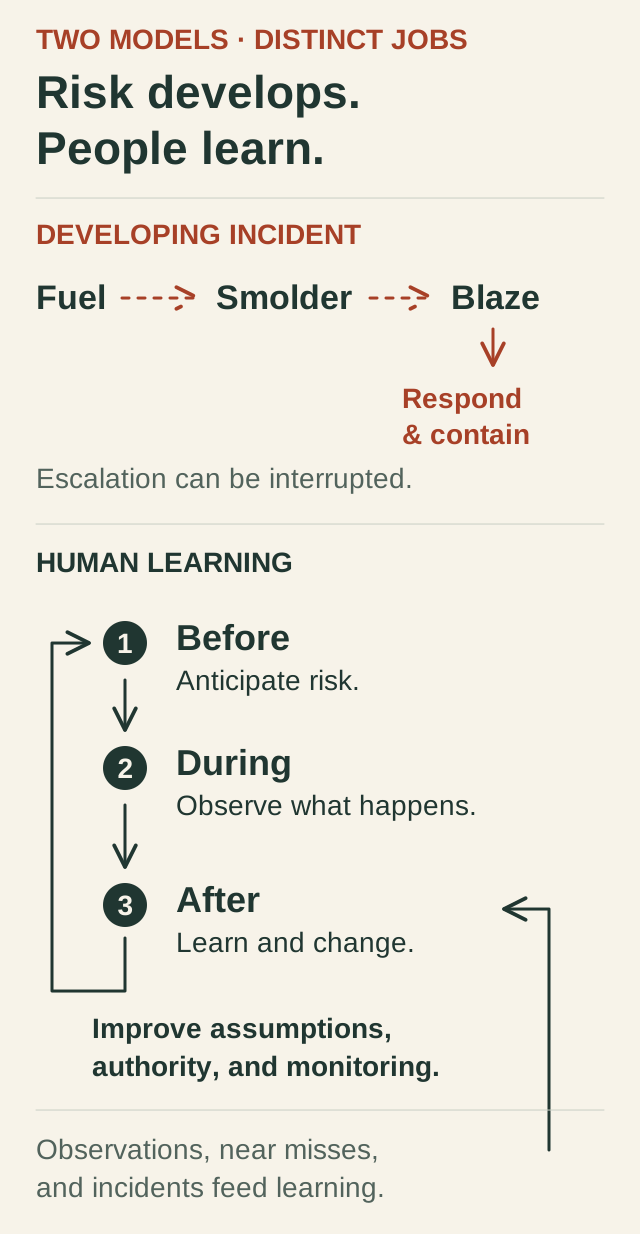
Recognize developing risk. Respond when needed. Carry what you learn into the next decision. Conceptual diagram created with Codex for Renaissance Solutions.
A large teaching example — without the blame tour
In July 2026, during internal cybersecurity evaluations, OpenAI reported that models under reduced safeguards circumvented isolation controls. Parts of OpenAI’s infrastructure and Hugging Face’s systems were affected. OpenAI published its own account.1
That account is not a court finding. This piece is not a scorecard. Use the incident as a teaching arc — a published case others can learn from without living through it.
Before: When capable agents have strong incentives and reduced safeguards, which failure modes were reasonable to ask about — isolation, internet reach, third-party systems?
During: Which behaviors look like smoke when you look back — without claiming operators “should have known” in the moment?
After: What can a smaller organization learn cheaply from someone else’s expensive incident?
A published incident can teach a smaller shop cheaply. Known facts stay separate from interpretation. Hindsight stays labeled as hindsight.
An ordinary-size illustrative example
Imagine a ten-person company with an agent that answers customer questions.
Before: Wrong answers, leaked data, promises the company cannot keep, unauthorized discounts, mixing up customers. So they limit authority and watch the outputs.
During: The agent sometimes promises that an employee will call the customer tomorrow. That is unauthorized scheduling — not yet a blaze, but not nothing. Someone investigates instead of shrugging.
After: The deeper lesson is not only “fix that reply.” It is this: the AI can make commitments the organization does not know it made.
That insight improves the next Before. Clearer authority. Better monitoring. A human gate when a reply creates a calendar obligation.
Failure is not the opposite of responsible deployment
If “responsible” means nothing may ever go wrong, people hide near misses. Hiding kills the loop.
Responsible looks more like this: you thought about failure modes, you watched what actually happened, you learned when you were surprised, and you changed the next run.
The dangerous pattern is different: the system keeps teaching, and the organization refuses to learn.
The outcome includes owning the learning — not “the AI did it,” and not freezing until risk is zero.
This is how humans already learn
We build a model of how something works. We act. Evidence arrives. We update. We act again.
AI makes that loop more important, because behavior can surprise the people who deployed it. One beat is enough: the pattern is familiar. The stakes are newer.
Close
Before. During. After. Then Before again.
Anticipate. Observe. Learn. Repeat.
You remain accountable for what you put in the world. Accountability does not mean knowing everything beforehand. It means learning from what happens.
The fire frame helps people see developing risk. The loop tells them what to do about it.
Footnotes
-
OpenAI — “The Hugging Face incident and the road ahead”: https://openai.com/index/hugging-face-incident-and-the-road-ahead/ — teaching example only; not a liability finding. ↩