01 / 07
What are you curious about?
- Our question
- Why do wombats poop cubes?
- What makes it puzzling
- A soft, round-bodied animal makes something with corners. How does that happen?
- Where we’ll start
- Start by finding research that can help explain how the shape forms. Whether the shape has a particular advantage is a further question to investigate.
Try it with AI
These are sample prompts you can use, not a record of our conversation. Choose the one that fits where you are. Copy it, paste it into your AI tool, and use the guidance below it to decide what to do next.
If you need help turning curiosity into a question
You can start with the wombat question below, or replace it with something you wonder about.
I’m curious about why wombats poop cubes. Help me turn this curiosity into a question I can research. Suggest three simple questions, explain the difference between them, and recommend one place to start. I’m a beginner, so use everyday words. Don’t answer the questions yet.
What to do with the response: Choose the question you most want answered. For this example, we’ll start with: “How does the cube shape form?” You can use that question without asking AI first.
Look at the process
This example starts with a curiosity, not a selection from the Atlas’s suggested questions. “Why” can lead in two directions: how the cubes form, and what purpose their shape might serve. We will start with how they form. We do not need an answer before we begin; we need a question worth following.
02 / 07
Where can we find authoritative sources?
- What we did
- We asked Codex to search the web using its built-in web-search tool, then followed a research paper to its full text.
- What we found or made
- The search surfaced a study in Soft Matter, published by the Royal Society of Chemistry, and related material at Georgia Tech. We opened the university-hosted copy of the paper and checked its title, authors and DOI.
- Why we took the next step
- Start with the original study: it gives us methods, results and limitations to inspect. University explainers can help us get our bearings; search results and AI summaries still need checking.
Where do I do an AI web search?
For our search, we used Codex, the OpenAI assistant helping build this example, with its built-in web-search tool. You can follow the same research approach in a tool you already use. Choose one:
- ChatGPT Search: Open a conversation, select View all tools → Search, then paste the source-finding prompt below. Open the citations in the answer to inspect the sources. OpenAI’s search instructions.
- Google Search — AI Mode: Enter your question in AI Mode, then use follow-up questions to refine it. This is the AI Mode feature in Google Search; you do not need to open the separate Gemini app. Open the web links alongside the answer. Google’s AI Mode instructions.
- Perplexity: Type or paste your question into its search box. Open the numbered citations to check the pages behind the answer. Perplexity’s getting-started guide.
If a tool or search option is unavailable, use another choice or ordinary Google/Bing search. You can paste either of our keyword queries into a search engine; AI is optional. In a query, site:gatech.edu asks for results from that university’s website, and site:pubs.rsc.org focuses on the journal publisher.
The longer sample prompt below asks an AI tool to find and explain possible sources. The shorter queries in “Look at the process” record the searches we ran. Whatever you use, open the original page before relying on a claim.
Tool instructions checked 17 September 2026. Menus and availability can vary.
Our sources for this step
Intestines of non-uniform stiffness mold the corners of wombat feces ↗
Soft Matter 17 (2021), pp. 475–488; Figures 1–4; discussion pp. 482–483.
Where to look: Start with the abstract on printed page 475 (PDF page 2).
This is the original corner-formation study we used. Open it here to follow our trail, or compare it with a source you found.
Try it with AI
These are sample prompts you can use, not a record of our conversation. Choose the one that fits where you are. Copy it, paste it into your AI tool, and use the guidance below it to decide what to do next.
Start here: find sources worth opening
Choose ChatGPT Search, Google AI Mode, or Perplexity from the links above. Paste this prompt into its question box. You can use it exactly as written.
I’m a beginner trying to understand why wombats poop cubes. Search the web for up to three authoritative sources. Start with original research papers and university research pages. For each source, give me its title, who wrote or published it, its date, a direct link, and one sentence about how it helps answer my question. Say whether it is an original study or an explanation of someone else’s work. Recommend one source to open first and tell me why. If you cannot search the web or open a source, say so. Do not guess or invent references.
What to do with the response: Open the recommended link. Check that the title and author or publisher match the AI’s answer. Look for the study’s methods and results, or a link to the original study. A convincing summary alone is not enough. If the tool cannot browse, try “wombat cubic feces research” in a search engine or PubMed.
If the paper feels difficult: work through a short passage
Copy the paper’s abstract (the short summary near the beginning), then replace the bracketed text below with it. Keep the paper open beside the conversation.
I’m new to this topic. Help me understand the passage below about wombat research. Using only this passage, explain in three short bullets: what question the researchers asked, what they did, and what they found. Explain unfamiliar words in everyday language. Point to the sentence that supports each bullet. If the passage does not tell us something, say “not stated here.” Finish with one question I should look for in the full paper.

Passage:
[paste the abstract here]
What to do with the response: Compare each bullet with the sentence it points to. Ask “Can you explain that one sentence more simply?” if needed. Treat an abstract as a starting point; the full paper is where we check the methods and limits.
Look at the process
The search we ran
On 17 September 2026, we used Codex’s built-in web-search tool with these queries:
wombat cube poop research intestines stiffness drying feces site:pubs.rsc.orgwombat cube poop research site:gatech.edu
The terms “feces” and “stiffness” help reach scientific writing; the domain filters focus the search on a journal publisher and a university. These are starting points, not a complete search of the literature.
What came back, and what we chose
- Original research: Intestines of non-uniform stiffness mold the corners of wombat feces, Soft Matter 17 (2021), 475–488. We chose it because it investigates the formation of corners and provides methods and results we can inspect. Read the full paper hosted by the research team.
- Research context: Georgia Tech’s “Studying Wombats’ Cubic Poop” appeared in the results. It is a route into the topic, rather than the evidence for our scientific claims. Its full page was not retrievable by our tool in this pass.
- An index record: PubMed 33289747 helps identify the study. PubMed indexes the paper; it did not conduct the research.
The publisher’s page returned a 403 to our retrieval tool. The research team’s PDF opened, and we checked the matching title, authors, journal details and DOI on page 475. The PubMed page returned no readable extracted text. Those access limits are part of the search record, not evidence against the paper.
The two papers in the original draft were supplied in advance. This search was performed during the revision; it is not a reconstructed history of how we first found them. The later drying paper remains below for the next part of the investigation.
03 / 07
Separate evidence from explanation
- What we did
- We read “Intestines of non-uniform stiffness mold the corners of wombat feces” (Soft Matter, 2021) and checked the observations, model and limitations against the claims shown here.
- What we found or made
- Observation, model, and uncertainty need different labels.
- Why we took the next step
- Keep the model boundary visible when explaining the mechanism.
Our sources for this step
Intestines of non-uniform stiffness mold the corners of wombat feces ↗
Soft Matter 17 (2021), pp. 475–488; Figures 1–4; discussion pp. 482–483.
Where to look: Printed pages 476–477: observations and Figures 1–2; page 479: Figure 4 and the model; pages 480 and 482–483: assumptions and limitations.
Start with section 2.1 on page 476. Then compare the observation with the model in Figure 4 on page 479. The claim cards below show what we took from this paper and where you can check it.
What we took from the source
- observation
Cube-like shapes were already present inside the distal colon of the studied bare-nosed wombats.
Intestines of non-uniform stiffness mold the corners of wombat feces ↗pp. 476–477, Figures 1–2
- model
A simplified two-dimensional model with alternating stiffness regions produced square-like cross sections during contractions.
Intestines of non-uniform stiffness mold the corners of wombat feces ↗pp. 478–480, section 2.3, Figure 4
- uncertainty
The model does not reproduce full three-dimensional biology; real contraction timing and intensity were unknown.
Intestines of non-uniform stiffness mold the corners of wombat feces ↗pp. 478–480 and 482–483, model assumptions and discussion
Look at the process
Open Intestines of non-uniform stiffness mold the corners of wombat feces. On printed pages 476–477, look for what the researchers observed inside the wombats. In Figure 4 on printed page 479, look for what they represented in a mathematical model. Ask: which statements come from observations, and which depend on the model? Compare your reading with our three claim cards in this step. For the limits, read the assumptions on printed page 480 and the discussion on pages 482–483. Use the page numbers printed on the paper; the PDF viewer also counts a cover page.
04 / 07
Follow the unfinished question
- What we did
- We read “Drying dynamics of pellet feces” (Soft Matter, 2023) to follow the question of how separate pellets form, then compared its conclusion with the corner-formation study.
- What we found or made
- A follow-up can refine a question without settling it.
- Why we took the next step
- Retain uncertainty in the final explanation.
Our sources for this step
Drying dynamics of pellet feces ↗
Soft Matter 19 (2023), pp. 723–732; Figure 4; discussion and conclusion p. 729.
Where to look: Printed page 723: introduction; page 728: Figure 4; page 729: results, discussion and conclusion.
Read what the drying study tested, then compare its results with its conclusion. What does it leave unresolved?
What we took from the source
- model
The follow-up explored drying-induced cracks as a possible explanation of pellet length, using a model and cornstarch experiments.
Drying dynamics of pellet feces ↗pp. 723, 728–729, Figure 4
- uncertainty
The predicted and experimental scaling differed; the study did not establish that drying-induced cracking explains pellet formation.
Drying dynamics of pellet feces ↗p. 729, results, discussion and conclusion
Look at the process
Open Drying dynamics of pellet feces. Start on printed page 723, then inspect Figure 4 on page 728 and the results, discussion and conclusion on page 729. Ask whether the experiments support the proposed explanation. Our two claim cards in this step record what we concluded. The paper cites Intestines of non-uniform stiffness mold the corners of wombat feces as reference 2. You can compare both papers yourself. An optional further search in OpenAlex is a new investigation, not something we have already done here.
05 / 07
Draft with an optional helper
- What we did
- We used a second AI drafting prompt to turn the five checked claim cards into four explanatory panels, preserving the first draft in the process record.
- What we found or made
- A recorded prompt and output make drafting choices inspectable.
- Why we took the next step
- Compare the draft with evidence before using it.
Our sources for this step
Intestines of non-uniform stiffness mold the corners of wombat feces ↗
Soft Matter 17 (2021), pp. 475–488; Figures 1–4; discussion pp. 482–483.
Where to look: Our observation, model and limitation claims: printed pages 476–480 and 482–483.
Use this paper to check the corner-formation statements in our draft and infographic.
Drying dynamics of pellet feces ↗
Soft Matter 19 (2023), pp. 723–732; Figure 4; discussion and conclusion p. 729.
Where to look: Printed page 723: introduction; page 728: Figure 4; page 729: results, discussion and conclusion.
Use this paper to check that our draft and infographic preserve the unresolved drying question.
Look at the process
The process panel preserves the actual second drafting prompt and its four-panel response. The agent compared the response with the five checked claim cards. This is an implementation-time drafting record, not a historical conversation or independent human fact-check. Without AI, arrange the same claim cards under four headings and write the explanation yourself.
06 / 07
Make an explanation
- What we did
- We generated a wombat illustration, composed the checked captions in an editable layout, and exported a first draft and a revised infographic.
- What we found or made
- The first export exposed a missing diagram and small panel text. The revised export restores the diagram and increases the text size.
- Why we took the next step
- Keep the draft and explain the changes before adapting the finished infographic into a video.
Our sources for this step
Intestines of non-uniform stiffness mold the corners of wombat feces ↗
Soft Matter 17 (2021), pp. 475–488; Figures 1–4; discussion pp. 482–483.
Where to look: Our observation, model and limitation claims: printed pages 476–480 and 482–483.
Use this paper to check the corner-formation statements in our draft and infographic.
Drying dynamics of pellet feces ↗
Soft Matter 19 (2023), pp. 723–732; Figure 4; discussion and conclusion p. 729.
Where to look: Printed page 723: introduction; page 728: Figure 4; page 729: results, discussion and conclusion.
Use this paper to check that our draft and infographic preserve the unresolved drying question.
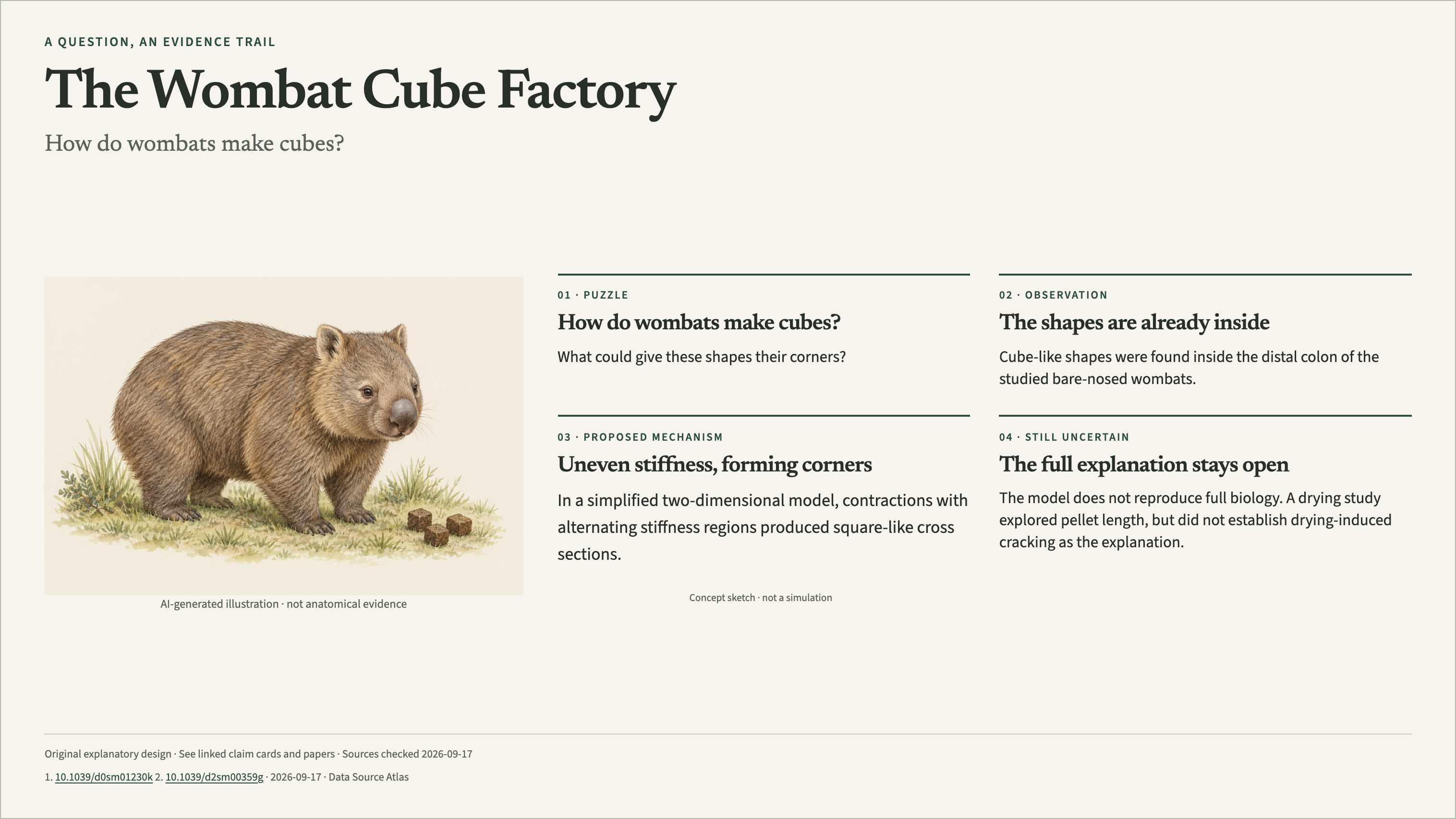
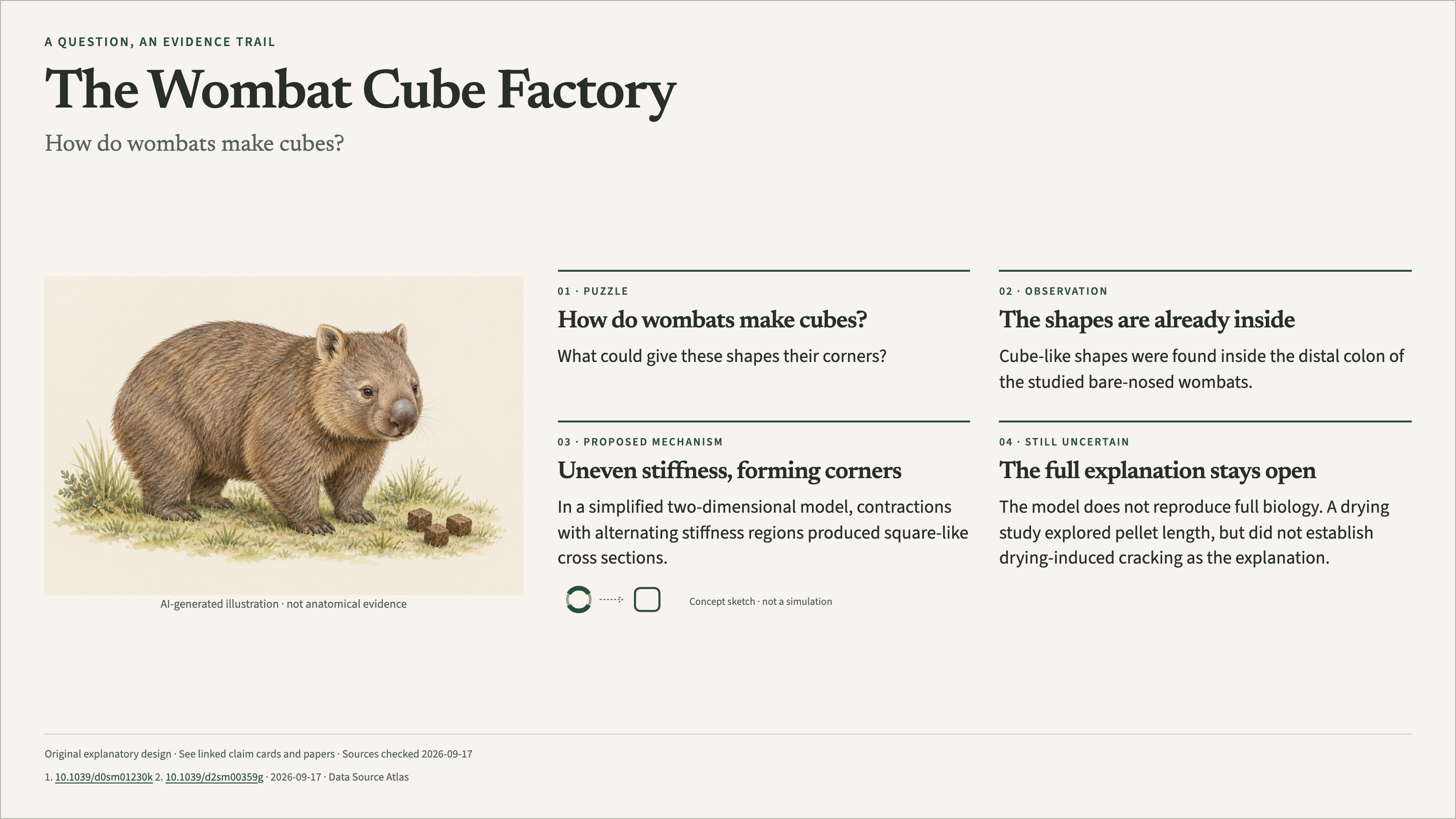
Look at the process
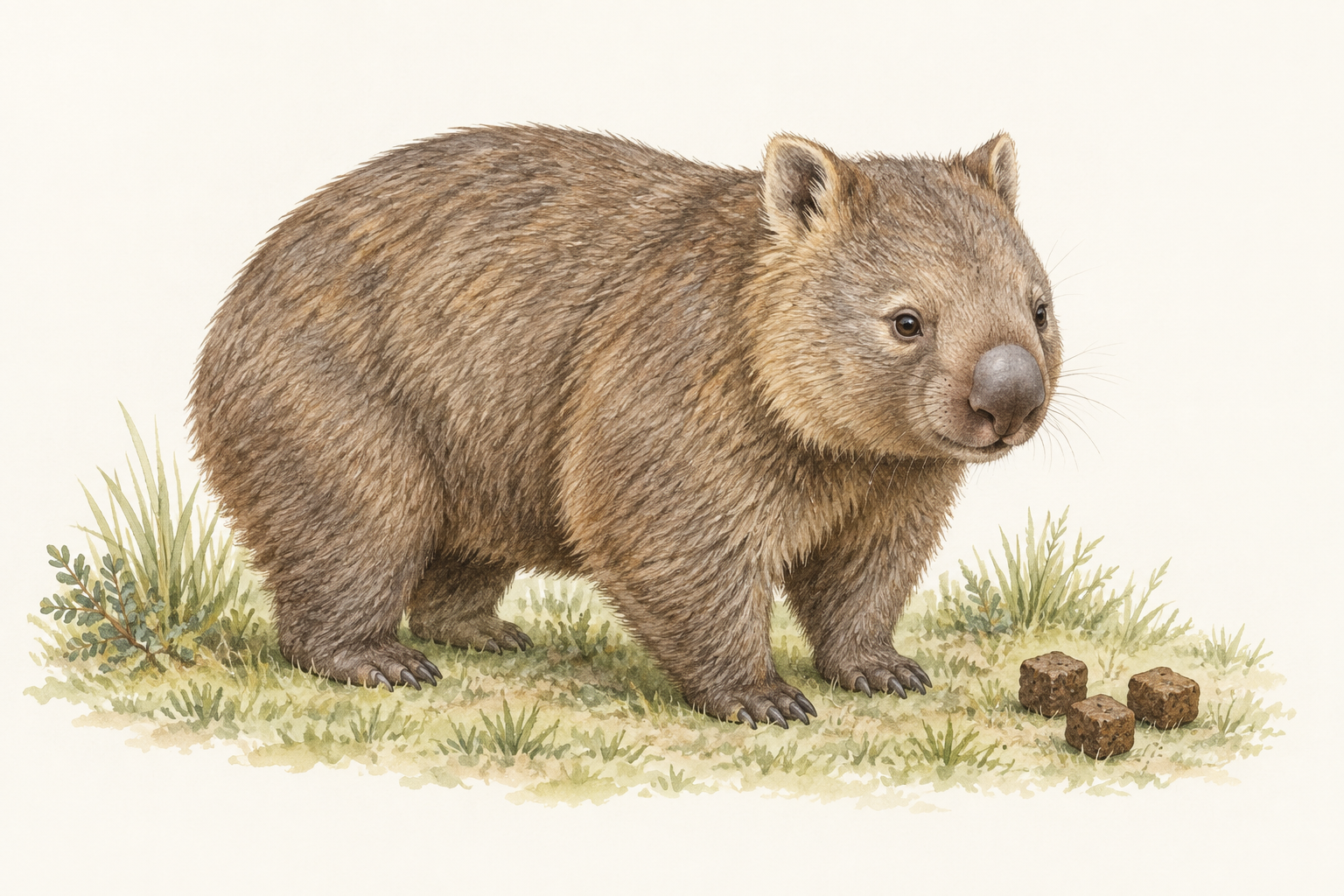
The first layout below is an actual export, not a staged error. We found that the page reset hid the diagram’s SVG geometry; fixing its styling restored the concept sketch. We also enlarged the panel text. The final PNG and text view share the same vault captions. The drawing is an AI-generated illustration, not an observation or an anatomical model.
Actual illustration prompt
Create a warm editorial natural-history illustration for a public learning infographic. One anatomically recognizable bare-nosed wombat, full body in three-quarter side view, facing right, standing calmly on a small patch of muted sage grass. Stocky low body, short sturdy legs, small rounded ears, broad bare nose, soft brown-gray fur. Friendly but not a cartoon mascot: no clothes, no human gestures. Beside it, three small irregular rounded cuboid brown droppings, discreet and non-graphic, clearly not perfect dice or manufactured cubes. Hand-painted watercolor and soft colored-pencil texture, restrained naturalist field-guide style, clean pale warm ivory background (#f7f4ed), muted forest green and ochre accents. Airy composition with generous margins around the animal; landscape aspect ratio. No text, no labels, no numbers, no diagram, no anatomy cutaway, no logos, no watermark. The illustration must remain readable at small size and suitable for curious adult beginners.
Tool: built-in image_gen; exact model identifier not exposed. Generated 2026-09-17. The selected original image, first layout, final PNG, and editable source are retained with this example.
07 / 07
Carry the method elsewhere
- What we did
- We prepared a reuse path and left additional formats as future work.
- What we found or made
- The transferable result is a way to keep explanation connected to evidence.
- Why we took the next step
- Choose a new question and repeat the checks.
Look at the process
Use the adaptation instructions below. A live demonstration, rendered video, learner test, and independent human review are not claimed by this record.
Evidence
Keep the trail back to the source.
- observation
Cube-like shapes were already present inside the distal colon of the studied bare-nosed wombats.
Intestines of non-uniform stiffness mold the corners of wombat feces · pp. 476–477, Figures 1–2 ↗ - model
A simplified two-dimensional model with alternating stiffness regions produced square-like cross sections during contractions.
Intestines of non-uniform stiffness mold the corners of wombat feces · pp. 478–480, section 2.3, Figure 4 ↗ - uncertainty
The model does not reproduce full three-dimensional biology; real contraction timing and intensity were unknown.
Intestines of non-uniform stiffness mold the corners of wombat feces · pp. 478–480 and 482–483, model assumptions and discussion ↗ - model
The follow-up explored drying-induced cracks as a possible explanation of pellet length, using a model and cornstarch experiments.
Drying dynamics of pellet feces · pp. 723, 728–729, Figure 4 ↗ - uncertainty
The predicted and experimental scaling differed; the study did not establish that drying-induced cracking explains pellet formation.
Drying dynamics of pellet feces · p. 729, results, discussion and conclusion ↗
Intestines of non-uniform stiffness mold the corners of wombat feces
10.1039/d0sm01230k · Soft Matter 17 (2021), pp. 475–488; Figures 1–4; discussion pp. 482–483.
Three dissections; simplified model. Passive tensile measurements and model assumptions are not interchangeable.
Read the full paper ↗Drying dynamics of pellet feces
10.1039/d2sm00359g · Soft Matter 19 (2023), pp. 723–732; Figure 4; discussion and conclusion p. 729.
Cross-species estimates and a cornstarch analogue; contractions and intestinal pressures were omitted.
Read the full paper ↗
Our drafting record
How this draft was made
This is the second AI drafting prompt used during this implementation, followed by an agent comparison with the five checked claim cards. It is not a historical exchange or an independent human fact-check.
Actual supplied drafting prompt
Using only the five checked claim cards in this example, write four short infographic panels for curious adults: the puzzle, the observation, the proposed mechanism, and what remains uncertain. Explain what we learned about wombats, not just how to research them. Keep observation and model distinct. Do not claim that drying explains pellet formation. Give every factual panel its claim IDs. Add no numbers, anatomy, or scientific claims that are absent from the cards.
Selected actual AI draft
01 · Puzzle
How do wombats make cubes?
What could give these shapes their corners?
Claim IDs: none; question only

02 · Observation
The shapes are already inside
Cube-like shapes were found inside the distal colon of the studied bare-nosed wombats.
Claim IDs: inside

03 · Proposed mechanism
Uneven stiffness, forming corners
In a simplified two-dimensional model, contractions with alternating stiffness regions produced square-like cross sections.
Claim IDs: model

04 · Still uncertain
The full explanation stays open
The model does not reproduce full biology. A drying study explored pellet length, but did not establish drying-induced cracking as the explanation.
Claim IDs: limits, drying, unresolved
The drafting agent compared every factual panel with its listed claim cards. Observation remains separate from the proposed mechanism; the uncertainty panel retains the model limit and unresolved drying hypothesis. The original draft is preserved in the project process record. No independent human verification or audience rehearsal is recorded.
What we made
- Four-panel evidence trail · complete
An editable four-panel infographic, a reviewed PNG export, and the preserved first layout.
- 75-second explainer prompt · prepared
Copyable production prompt and timed storyboard; no rendered video.
Prepared storyboard · not a rendered video
The Wombat Cube Factory
75 seconds
0–10 s · A question worth chasing
How do wombats make cubes? Start with a question, then find evidence you can inspect.
On screen: Friendly original wombat illustration beside a rounded geometric block; no anatomical imagery.
On-screen caption: How do wombats make cubes?
10–25 s · Look inside the evidence
Researchers found cube-like shapes inside the distal colon. That is an observation. Keep its source beside it.
On screen: Abstract evidence card with a source link; do not depict a dissection.
On-screen caption: Observation · Yang et al., Soft Matter (2021)
Evidence: inside
25–40 s · An explanatory model
A simplified model explored how uneven stiffness and contractions could shape corners. Label this animation as a model.
On screen: Abstract ring with labeled soft and stiff regions; illustrative deformation only, not an accurate simulation.
On-screen caption: Simplified model · illustrative motion
40–55 s · Keep the question open
The drying follow-up leaves an unresolved question. A tidy story must not erase that boundary.
On screen: Question card beside a paper icon; avoid depicting cracking as established wombat anatomy.
On-screen caption: Drying hypothesis remains unresolved
Evidence: drying · unresolved
55–75 s · Make something checkable
Build an explanation someone else can check. Link each claim, show its evidence label, and keep uncertainty visible. AI can help draft, or you can use paper cards. Choose your next question and take the method with you.
On screen: Four panels assemble, then hold an end card with both DOI links and source date.
On-screen caption: Ask → inspect → explain → check
Open the complete video prompt
Create a 75-second non-graphic educational explainer for curious adults titled The Wombat Cube Factory. Use a 16:9 landscape frame, large captions, high contrast, and gentle motion. Use the final infographic and wombat illustration supplied with this example as reference assets; preserve their visual identity and checked wording. Do not introduce new anatomical animation beyond the schematic model described below. Do not use copyrighted paper figures. Do not imply that an illustration is experimental footage. Preserve observation, model, and uncertainty labels. Use only the following narration and linked claims; add no scientific assertions. Include readable subtitles. Hold each end-card DOI for the final 8 seconds: 10.1039/d0sm01230k and 10.1039/d2sm00359g. Sources checked 2026-09-17. Do not use a cloned voice.

0–10 s — A question worth chasing
Narration: How do wombats make cubes? Start with a question, then find evidence you can inspect.
Visual: Friendly original wombat illustration beside a rounded geometric block; no anatomical imagery.
Caption: How do wombats make cubes?
Claim IDs: none; process guidance

10–25 s — Look inside the evidence
Narration: Researchers found cube-like shapes inside the distal colon. That is an observation. Keep its source beside it.
Visual: Abstract evidence card with a source link; do not depict a dissection.
Caption: Observation · Yang et al., Soft Matter (2021)
Claim IDs: inside

25–40 s — An explanatory model
Narration: A simplified model explored how uneven stiffness and contractions could shape corners. Label this animation as a model.
Visual: Abstract ring with labeled soft and stiff regions; illustrative deformation only, not an accurate simulation.
Caption: Simplified model · illustrative motion
Claim IDs: model, limits

40–55 s — Keep the question open
Narration: The drying follow-up leaves an unresolved question. A tidy story must not erase that boundary.
Visual: Question card beside a paper icon; avoid depicting cracking as established wombat anatomy.
Caption: Drying hypothesis remains unresolved
Claim IDs: drying, unresolved

55–75 s — Make something checkable
Narration: Build an explanation someone else can check. Link each claim, show its evidence label, and keep uncertainty visible. AI can help draft, or you can use paper cards. Choose your next question and take the method with you.
Visual: Four panels assemble, then hold an end card with both DOI links and source date.
Caption: Ask → inspect → explain → check
Claim IDs: none; process guidance

Source URLs for the end card and production notes:
https://hu.gatech.edu/wp-content/uploads/2021/01/Hu21-wombat.pdf
https://hu.gatech.edu/wp-content/uploads/2023/11/Hu23-pellet.pdf
https://pubmed.ncbi.nlm.nih.gov/33289747/
https://pubmed.ncbi.nlm.nih.gov/36606374/
Try the method with your own question
Choose something you want to understand. Find a source you can inspect, save its identifier and check date, and separate observations from explanations. Write one claim and its locator before choosing a format. Recheck any new source rather than carrying over this example’s date.
Without AI
Use four paper cards: question, observation, explanation, uncertainty. Put a source and page number on each factual card. Ask another person whether the explanation says more than its evidence supports. You can draw a poster or narrate a slide without a model or an account.
Other formats to try later
A narrated slide, classroom handout, interactive model, and finished video are possible next steps. They are not completed outputs of this record. A facilitator version will follow once the story is settled. Independent human source review remains a further check.