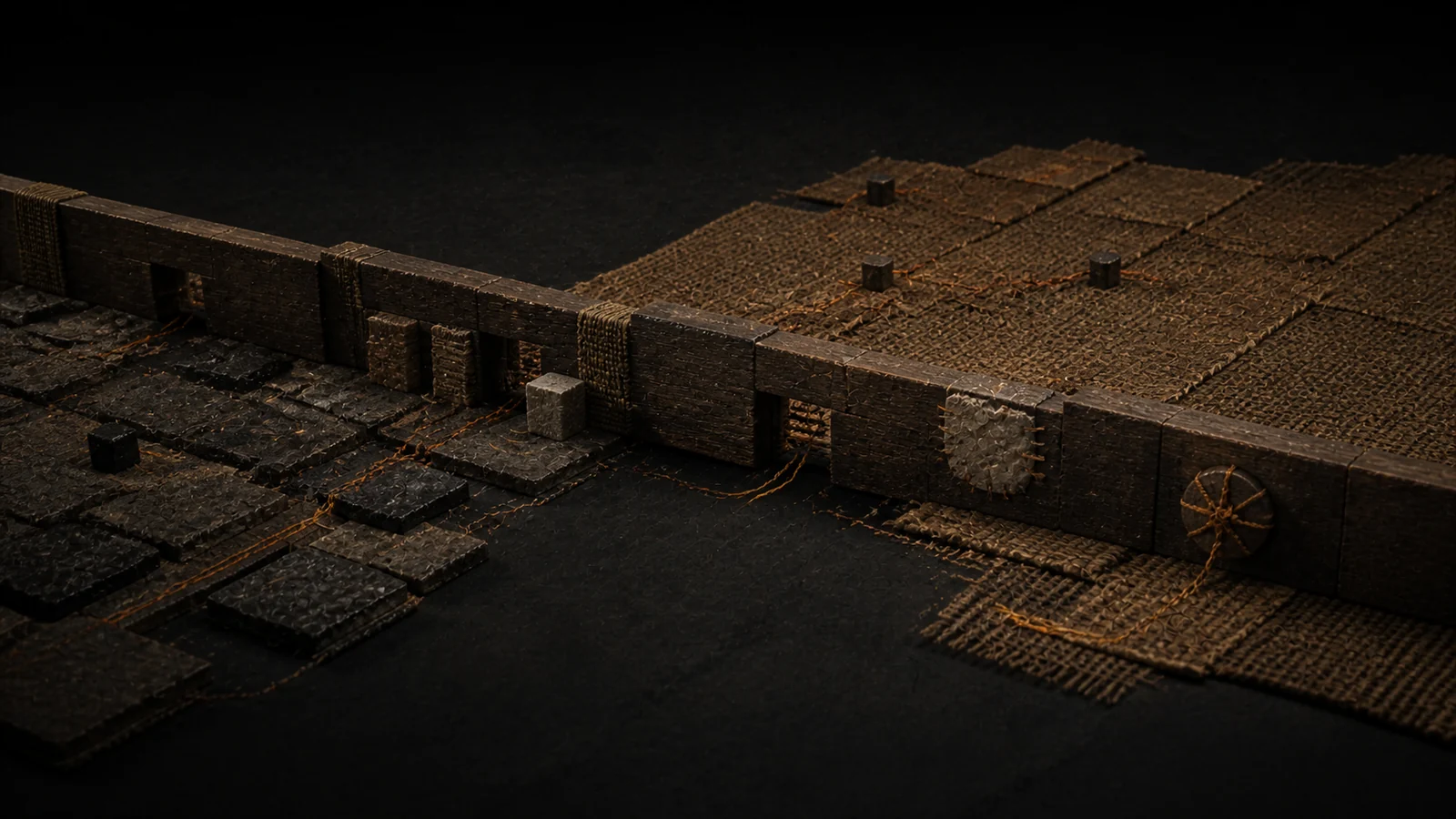
A concept constellation for seeing the systems we inhabit.
A boundary is maintained through crossings, permissions, records, and consequences—not by a line alone.
Boundary
A working distinction that decides what is included, excluded, protected, or allowed to cross.
Boundaries make action possible, but every boundary also distributes visibility, voice, risk, and belonging.
Inspect the boundary
Inclusion
Who and what is counted inside, and what disappears outside?
Crossing
What may cross the boundary, under whose conditions?
Permeability
Where does the boundary filter, leak, move, or harden?
Authority
Who can draw, enforce, challenge, and repair this distinction?
Four historical anchors
Comparison without a single march-of-progress story.
ca. 1156–1025 BCEA boundary preserved through record and authority
1918Every particular boundary can move
1969Boundaries persist through interaction
1987The border is also a lived, mixed terrain
These anchors form a comparative chronology, not a single lineage. Similar system patterns can arise independently, and each example remains situated in its own language, purpose, and culture.
Chronology
application
A boundary preserved through record and authority
Babylonia
Historical context: Kudurrus or narus recorded land grants through inscriptions and divine symbols in the political and temple institutions of Kassite and post-Kassite Babylonia.
Anchor caveat: These stones were probably kept in temples rather than planted along field edges, correcting the older label “boundary stone.”
Relationship to concept: The effective boundary was not only a line in land; it was sustained by a record, recognized authority, custody, and consequences for violation.
Babylonian kudurrus recorded grants of land and used divine symbols to protect and guarantee the gift, with surviving monuments likely preserved in temples.
Status:Supported
Uncertainty: The exact legal and ritual use varies across monuments, and the surviving fragment is incomplete.
Counterinterpretation: The monuments are evidence of land tenure and royal-religious authority more directly than of an abstract boundary theory.
Cultural context: The objects belong to Mesopotamian legal, religious, and political practice; modern property and mapping categories only partly fit.
Historical context: Simmel’s philosophy examined how social and cultural forms both organize life and are exceeded by it.
Anchor caveat: His claim is philosophical, not an operational method for deciding a system’s scope.
Relationship to concept: A boundary can be necessary for distinction while remaining contingent, crossable, and capable of generating another boundary when it moves.
Simmel argued that although boundary as such is necessary, every particular boundary can be crossed, displaced, or broken, creating a new boundary.
Status:Supported
Uncertainty: Translation choices affect the phrasing, and the passage appears within a wider metaphysics of life and form.
Counterinterpretation: Some boundaries are materially enforced and cannot be understood through philosophical transcendence alone.
Cultural context: The account emerged from early twentieth-century German philosophy and should not erase boundaries maintained through colonial or state violence.
Historical context: Barth’s edited volume compared cases across several regions while redirecting anthropology from inventories of cultural traits toward social organization and interaction.
Anchor caveat: Its case language and categories require critical reading, and ethnic identity is not a neutral systems variable.
Relationship to concept: A boundary can persist even while people, practices, and information cross it; maintenance depends on ongoing categorization and interaction.
Ethnic Groups and Boundaries shifted attention toward the social processes that maintain distinctions despite exchange and interaction across them.
Status:Supported
Uncertainty: The volume includes varied cases and contributors rather than a single mechanism of boundary maintenance.
Counterinterpretation: Later scholarship has challenged how its categories handle power, colonial histories, gender, and internal diversity.
Cultural context: The comparative project used mid-century anthropological terms, some of which communities represented in the studies would not choose for themselves.
Historical context: Anzaldúa wrote through Chicana, feminist, queer, multilingual, spiritual, geographic, and autobiographical experience.
Anchor caveat: Borderlands/La Frontera cannot be reduced to the design slogan that boundaries are porous.
Relationship to concept: A boundary acts on bodies, language, identity, and memory while also producing crossings, mixtures, exclusions, and new forms of belonging.
Anzaldúa presents borderlands as geographic, linguistic, psychic, social, and cultural terrains that divide, join, and transform those who inhabit them.
Status:Supported
Uncertainty: The book’s hybrid prose, poetry, memoir, history, and theory resists compression into one analytic proposition.
Counterinterpretation: A purely celebratory account of hybridity can obscure the violence and unequal power that make borderlands.
Cultural context: The work is grounded in Tejas and Chicana experience while drawing on contested Indigenous, Mexican, U.S., and spiritual histories.
Babylonian kudurrus recorded grants of land and used divine symbols to protect and guarantee the gift, with surviving monuments likely preserved in temples.
Status:Supported
Uncertainty: The exact legal and ritual use varies across monuments, and the surviving fragment is incomplete.
Counterinterpretation: The monuments are evidence of land tenure and royal-religious authority more directly than of an abstract boundary theory.
Cultural context: The objects belong to Mesopotamian legal, religious, and political practice; modern property and mapping categories only partly fit.
Simmel argued that although boundary as such is necessary, every particular boundary can be crossed, displaced, or broken, creating a new boundary.
Status:Supported
Uncertainty: Translation choices affect the phrasing, and the passage appears within a wider metaphysics of life and form.
Counterinterpretation: Some boundaries are materially enforced and cannot be understood through philosophical transcendence alone.
Cultural context: The account emerged from early twentieth-century German philosophy and should not erase boundaries maintained through colonial or state violence.
Ethnic Groups and Boundaries shifted attention toward the social processes that maintain distinctions despite exchange and interaction across them.
Status:Supported
Uncertainty: The volume includes varied cases and contributors rather than a single mechanism of boundary maintenance.
Counterinterpretation: Later scholarship has challenged how its categories handle power, colonial histories, gender, and internal diversity.
Cultural context: The comparative project used mid-century anthropological terms, some of which communities represented in the studies would not choose for themselves.
Anzaldúa presents borderlands as geographic, linguistic, psychic, social, and cultural terrains that divide, join, and transform those who inhabit them.
Status:Supported
Uncertainty: The book’s hybrid prose, poetry, memoir, history, and theory resists compression into one analytic proposition.
Counterinterpretation: A purely celebratory account of hybridity can obscure the violence and unequal power that make borderlands.
Cultural context: The work is grounded in Tejas and Chicana experience while drawing on contested Indigenous, Mexican, U.S., and spiritual histories.
Aunt Lute Books; official author archive, First published 1987
Locator: Official book overview on geographic, linguistic, psychic, social, and cultural borderlands
Limitations: Anzaldúa’s hybrid work is grounded in the U.S.–Mexico borderlands and Chicana experience; “porous boundary” is only a partial systems analogy.
Relationships
Boundary becomes clearer when its neighboring concepts remain visible.
Relationship → Boundary
Relationships help determine where practical boundaries are drawn.
Boundary → Purpose
A boundary frames whose purposes and consequences count.
Boundary ↔ Trust
Boundaries distribute reliance, and trust can legitimate or contest those boundaries.