Skip to content
Get in touch

Systems Grammar

A concept constellation for seeing the systems we inhabit.

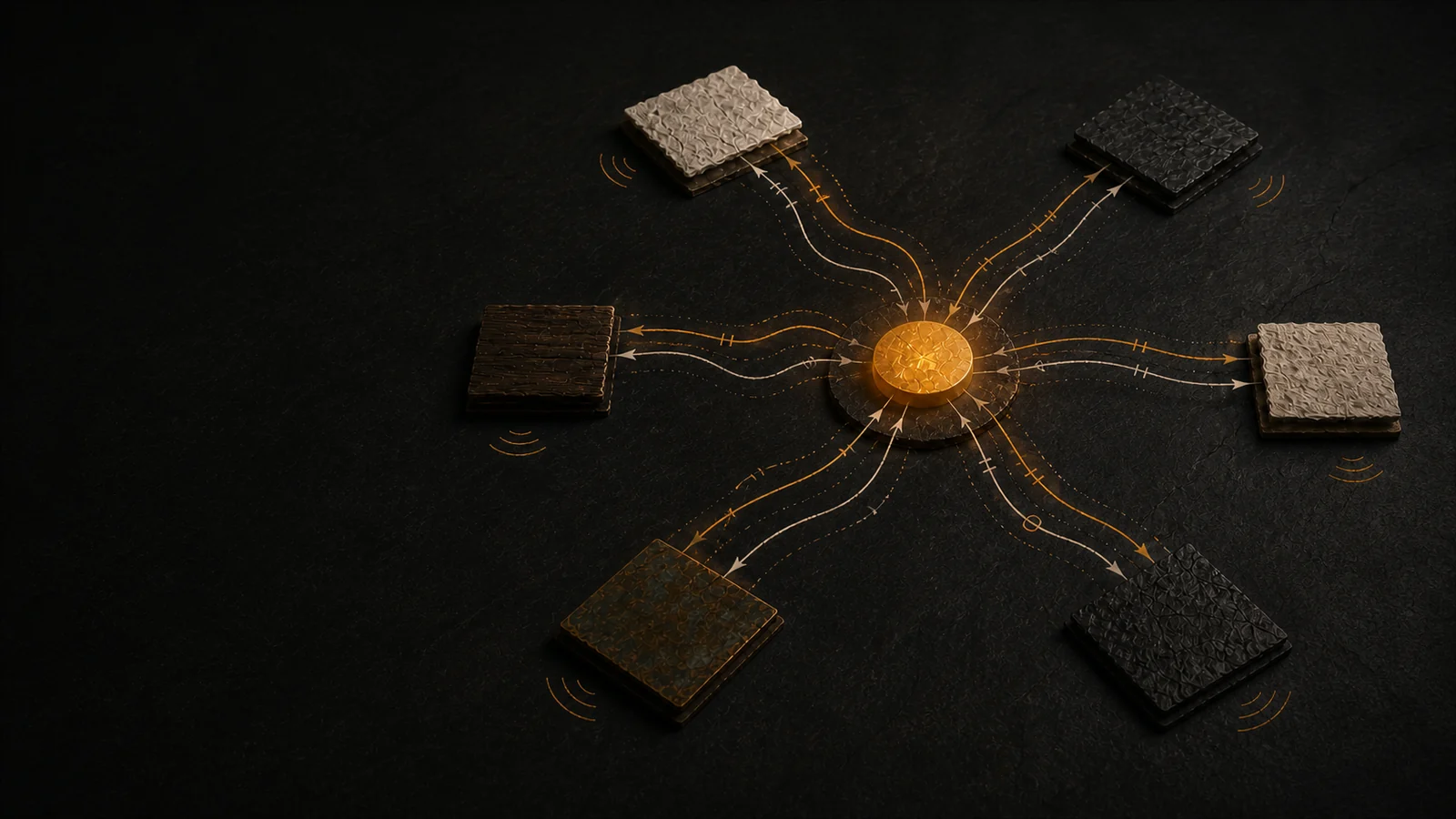
Six textured material plates exchange paired amber and ivory paths with a compact central hub, showing outward action and returning response.
A return path matters only when the signal can alter what the system does next.

Feedback

Information, consequence, or response that returns through a system and can redirect what happens next.

Feedback is not merely data. Its force depends on who can hear it, answer it, and act.

Trace the return

Signal
What consequence or change becomes observable?
Delay
How long passes between an action and its return signal?
Interpretation
Who decides what the signal means?
Correction
What can the system change in response?

Four historical anchors

Comparison without a single march-of-progress story.

  1. 3rd century BCEA water clock regulates its own flow
  2. ca. 850 CEAutomatic valves, timing, and delayed response
  3. 1868Stability becomes a mathematical question
  4. 1948Feedback crosses disciplinary boundaries

These anchors form a comparative chronology, not a single lineage. Similar system patterns can arise independently, and each example remains situated in its own language, purpose, and culture.

Chronology

  1. antecedent

    A water clock regulates its own flow

    Ptolemaic Alexandria

    Historical context: Hellenistic mechanics developed within Alexandria’s multilingual scholarly and craft traditions, drawing on longer Egyptian and Mediterranean histories of water clocks.

    Anchor caveat: The surviving evidence is indirect and reconstructed; “feedback control” is modern terminology applied to an ancient mechanism.

    Relationship to concept: A change in water level acts back on the inlet, making consequence part of the mechanism’s next action.

    • Accounts of Ctesibius’s inflow water clock describe float and valve regulation used to keep water flow more uniform despite changing conditions.

      Status: Supported

      Uncertainty: Ancient descriptions are incomplete, and modern reconstructions differ in mechanical detail.

      Counterinterpretation: The device may be understood as practical regulation without attributing a general theory of feedback to its maker.

      Cultural context: The mechanism belongs to a longer, culturally mixed history of water measurement rather than an isolated Greek invention story.

      Sources: Historical development of water-powered mechanical clocks

  2. application

    Automatic valves, timing, and delayed response

    Abbasid Baghdad

    Historical context: The Banū Mūsā worked in the scholarly environment associated with Baghdad’s House of Wisdom, where translation, mathematics, craft, and court patronage met.

    Anchor caveat: Modern engineering categories help compare the devices but can flatten the purposes and language of the original manuscript.

    Relationship to concept: The devices show returned physical conditions governing valves, flow, timing, and subsequent action across a varied engineering repertoire.

    • The Kitab al-Hiyal describes automatic controls using hydrostatic and aerostatic pressure, self-operating valves, and timing or delay mechanisms.

      Status: Supported

      Uncertainty: Different surviving devices use different control arrangements, so no single diagram represents the whole work.

      Counterinterpretation: The collection can also be read through performance, wonder, courtly display, and experimental craft—not only control engineering.

      Cultural context: The work is part of Abbasid scientific and technical culture and should not be framed merely as a bridge toward European modernity.

      Sources: Ingenious Devices

  3. formalization

    Stability becomes a mathematical question

    Britain

    Historical context: Maxwell addressed engineers and mathematicians working with governors in an industrial setting shaped by steam power and mechanical regulation.

    Anchor caveat: This is a mathematical treatment of mechanical governors, not a general account of learning, organizations, or society.

    Relationship to concept: Feedback is no longer only a device pattern: the return action can be analyzed for decay, persistence, or growing oscillation.

    • Maxwell analyzed how a governor acts when speed departs from normal and distinguished disturbances that diminish, persist, or grow through oscillation.

      Status: Supported

      Uncertainty: The paper’s notation and categories belong to nineteenth-century dynamics and later control terminology is not identical.

      Counterinterpretation: Practical governor makers developed mechanisms before mathematical analysis captured their behavior.

      Cultural context: The paper reflects British industrial mechanics; it does not supersede earlier control practices developed elsewhere.

      Sources: On Governors

  4. formalization

    Feedback crosses disciplinary boundaries

    United States and transatlantic research networks

    Historical context: Cybernetics emerged from wartime and postwar exchanges among mathematics, engineering, physiology, communication research, and social inquiry.

    Anchor caveat: Shared language across organisms, machines, and societies can reveal patterns, but it can also hide differences in agency, power, and meaning.

    Relationship to concept: Feedback becomes a general language for messages returned and answered across mechanical, biological, cognitive, and social systems.

    • Wiener’s Cybernetics framed control and communication through information sent, returned, and answered in systems ranging from machines to organisms.

      Status: Supported

      Uncertainty: Cybernetics contained multiple programs and was never one settled theory shared by every participant.

      Counterinterpretation: Later second-order approaches challenged the assumption that an observer could stand outside and control the system being described.

      Cultural context: Its universalizing ambitions should be read alongside the military, institutional, and political conditions of postwar research.

      Sources: Cybernetics: or Control and Communication in the Animal and the Machine

Evidence and sources

Claim qualifications

  • Accounts of Ctesibius’s inflow water clock describe float and valve regulation used to keep water flow more uniform despite changing conditions.

    Status: Supported

    Uncertainty: Ancient descriptions are incomplete, and modern reconstructions differ in mechanical detail.

    Counterinterpretation: The device may be understood as practical regulation without attributing a general theory of feedback to its maker.

    Cultural context: The mechanism belongs to a longer, culturally mixed history of water measurement rather than an isolated Greek invention story.

  • The Kitab al-Hiyal describes automatic controls using hydrostatic and aerostatic pressure, self-operating valves, and timing or delay mechanisms.

    Status: Supported

    Uncertainty: Different surviving devices use different control arrangements, so no single diagram represents the whole work.

    Counterinterpretation: The collection can also be read through performance, wonder, courtly display, and experimental craft—not only control engineering.

    Cultural context: The work is part of Abbasid scientific and technical culture and should not be framed merely as a bridge toward European modernity.

  • Maxwell analyzed how a governor acts when speed departs from normal and distinguished disturbances that diminish, persist, or grow through oscillation.

    Status: Supported

    Uncertainty: The paper’s notation and categories belong to nineteenth-century dynamics and later control terminology is not identical.

    Counterinterpretation: Practical governor makers developed mechanisms before mathematical analysis captured their behavior.

    Cultural context: The paper reflects British industrial mechanics; it does not supersede earlier control practices developed elsewhere.

  • Wiener’s Cybernetics framed control and communication through information sent, returned, and answered in systems ranging from machines to organisms.

    Status: Supported

    Uncertainty: Cybernetics contained multiple programs and was never one settled theory shared by every participant.

    Counterinterpretation: Later second-order approaches challenged the assumption that an observer could stand outside and control the system being described.

    Cultural context: Its universalizing ambitions should be read alongside the military, institutional, and political conditions of postwar research.

Sources

  1. Historical development of water-powered mechanical clocks

    Zeng-Hui Hwang, Hong-Sen Yan, and Tsung-Yi Lin

    Mechanical Sciences, 2021

    Locator: Sections 1 and 3.1 on Ctesibius, flow regulation, and early feedback mechanisms

    Limitations: Ancient descriptions are scattered and later reconstructions sometimes use modern control vocabulary for mechanisms whose makers used different concepts.

  2. Ingenious Devices

    Lemelson Center for the Study of Invention and Innovation

    Smithsonian Institution, 2020

    Locator: Account of the Kitab al-Hiyal and its automatic controls, valves, timing, and delay systems

    Limitations: This modern overview interprets historical devices through current engineering language and is not a substitute for the surviving manuscript tradition.

  3. On Governors

    James Clerk Maxwell

    Proceedings of the Royal Society of London, 1868

    Locator: Pages 270–283; dynamical theory of governors and disturbance behavior

    Limitations: The paper analyzes mechanical governors; applying its stability vocabulary to social systems requires additional argument.

  4. Cybernetics: or Control and Communication in the Animal and the Machine

    Norbert Wiener

    The MIT Press, First published 1948; second edition reissued 2019

    Locator: Publisher description and open-access edition

    Limitations: Cybernetics joins biological, mechanical, and social analogies; those analogies can illuminate patterns without making the domains equivalent.

Relationships

Feedback becomes clearer when its neighboring concepts remain visible.

Feedback ↔ Trust

Credible feedback can support trust, while trust determines whether signals are heard and acted on.

Feedback ↔ Adaptation

Feedback prompts adaptation, and adaptation changes the next signal.

Feedback ↔ Boundary

Boundaries filter feedback, while feedback pressures boundaries to move.