RS Glossary
Compute
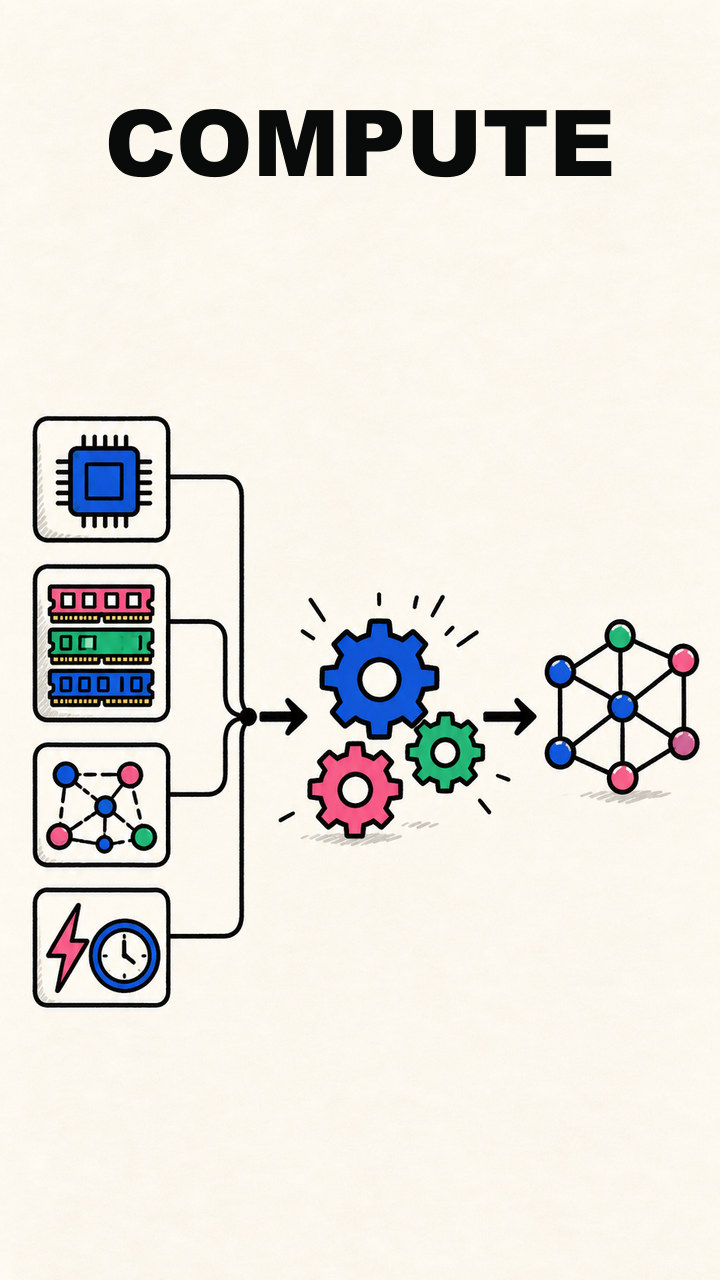
Compute is the processing capacity and associated work performed by computer hardware to train, evaluate, or run models and other software.
- Review state
- Reviewed in POC
- Freshness
- Current
- Version
- 2
- Compute
- Computing Power
Remember it this wayCompute is the processing work and capacity behind the model.
In plain language
AI compute depends on hardware, memory, networks, software efficiency, energy, time, and availability. A raw chip count does not describe the usable capacity of the whole system.
Why it matters
Compute affects cost, latency, model development, deployment location, environmental load, and who can build or operate certain systems.
Example
Training a large model uses many accelerators for weeks, while each deployed request consumes a smaller amount of inference compute.
Common misconception
Compute is not a single fixed measure of intelligence or capability, and more hardware does not compensate for every data, design, or evaluation problem.
Related terms
Sources
- U.S. Department of Energy, “Supercomputing”official explanation of high-performance computing as multiple computer systems working in parallel on work that less powerful systems cannot perform.
- Roy Schwartz and colleagues, “Green AI”connects machine-learning computation to financial cost, access, and energy use, and argues that efficiency should be evaluated alongside accuracy.
Learn more
- Connect processing demand to specialized hardware in [[gpu-tpu|GPU and TPU]].
Public history
26 recorded events · 26 public summaries
A potential shared concept was discussed and selected for initial glossary drafting.
The captured candidate received a complete initial draft and entered section-level human review.
Radar reviewed the initial definition draft for human consideration.
Radar reviewed the initial plain-language-explanation draft for human consideration.
Radar reviewed the initial why-it-matters draft for human consideration.
Radar reviewed the initial example draft for human consideration.
Radar reviewed the initial common-misconception draft for human consideration.
Radar reviewed the initial remember-it-this-way draft for human consideration.
Radar reviewed the initial related-terms draft for human consideration.
Radar reviewed the initial sources draft for human consideration.
Radar reviewed the initial learn-more draft for human consideration.
A proposal was opened for section-level human review while preserving the current version.
A human reviewer opened a proposed revision while preserving the current approved or captured version.
definition approved by a human reviewer.
plain-language-explanation approved by a human reviewer.
why-it-matters approved by a human reviewer.
example approved by a human reviewer.
common-misconception approved by a human reviewer.
remember-it-this-way approved by a human reviewer.
related-terms approved by a human reviewer.
sources review state changed.
learn-more approved by a human reviewer.
sources approved by a human reviewer.
Radar issue compute-authoritative-source was accepted-as-is by the human section decision.
All section gates are approved; content version 1 is now a fully approved term.
Sources review recorded as approve-proposed.
Source: vault/Glossary/terms/compute/term.md · sha256:fc4e9b0bef0c3704edebd6ac0e6a9a97b82123df530cf6bfba5477bb235c0f04 · Release: rs-glossary-glossary-team-poc-0.5.5-2026-09-02