RS Glossary
Scaling Laws
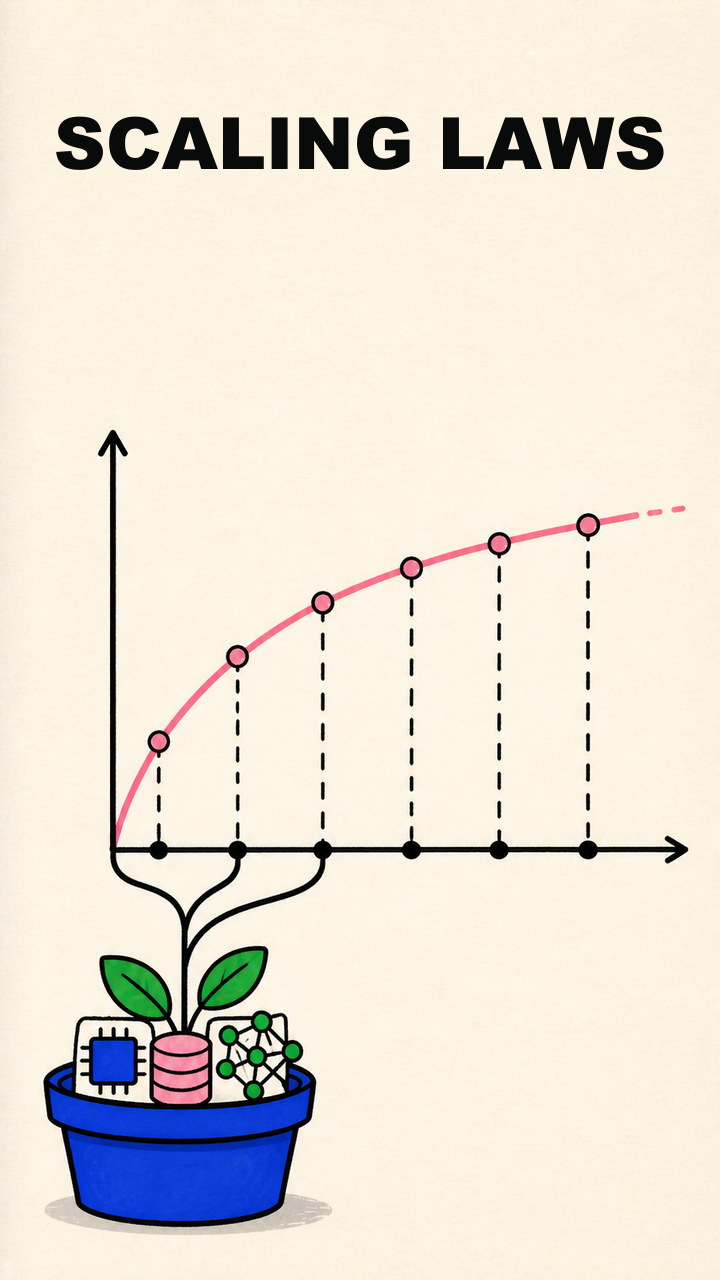
Scaling laws are empirical relationships that describe how selected measures of model performance or training behavior change as factors such as compute, data, and model size increase under specified conditions.
- Review state
- Reviewed in POC
- Freshness
- Current
- Version
- 2
- Scaling Laws
- Neural Scaling Laws
Remember it this wayScaling laws describe observed trends under stated conditions.
In plain language
Researchers fit patterns to results from multiple training runs and use them to estimate tradeoffs or expected improvement. The relationship depends on the metric, architecture, data, and range studied.
Why it matters
Scaling laws influence training plans and investment, but extrapolation can fail when methods, data quality, bottlenecks, or evaluation targets change.
Example
A team estimates how validation loss may change when training compute and dataset size increase together according to an observed relationship.
Common misconception
A scaling law is not a universal law guaranteeing that every useful capability improves predictably with more parameters or money.
Related terms
Sources
- Kaplan et al., Scaling Laws for Neural Language Modelsprimary empirical paper describing language-model scaling relationships.
Learn more
- Read any scaling claim with its metric, range, assumptions, and supporting evidence.
Public history
45 recorded events · 45 public summaries
A potential shared concept was discussed and selected for initial glossary drafting.
The captured candidate received a complete initial draft and entered section-level human review.
Radar reviewed the initial definition draft for human consideration.
Radar reviewed the initial plain-language-explanation draft for human consideration.
Radar reviewed the initial why-it-matters draft for human consideration.
Radar reviewed the initial example draft for human consideration.
Radar reviewed the initial common-misconception draft for human consideration.
Radar reviewed the initial remember-it-this-way draft for human consideration.
Radar reviewed the initial related-terms draft for human consideration.
Radar reviewed the initial sources draft for human consideration.
Radar reviewed the initial learn-more draft for human consideration.
A proposal was opened for section-level human review while preserving the current version.
A human reviewer opened a proposed revision while preserving the current approved or captured version.
definition approved by a human reviewer.
plain-language-explanation approved by a human reviewer.
why-it-matters approved by a human reviewer.
example approved by a human reviewer.
common-misconception approved by a human reviewer.
remember-it-this-way approved by a human reviewer.
related-terms approved by a human reviewer.
sources returned for revision.
learn-more approved by a human reviewer.
Requested wording was prepared without changing approved or existing sections.
Radar reviewed the pending sources section for human consideration.
Radar must rereview the complete scaling-laws term after an accepted text change.
Radar must rereview the complete scaling-laws term after an accepted text change.
Radar must rereview the complete scaling-laws term after an accepted text change.
Radar must rereview the complete scaling-laws term after an accepted text change.
Radar must rereview the complete scaling-laws term after an accepted text change.
Radar must rereview the complete scaling-laws term after an accepted text change.
Radar must rereview the complete scaling-laws term after an accepted text change.
Radar must rereview the complete scaling-laws term after an accepted text change.
Radar must rereview the complete scaling-laws term after an accepted text change.
sources approved by a human reviewer.
sources approved wording became the current section text.
All section gates are approved; content version 2 is now a fully approved term.
Radar rereviewed the human-approved definition wording for this exact version.
Radar rereviewed the human-approved plain-language-explanation wording for this exact version.
Radar rereviewed the human-approved why-it-matters wording for this exact version.
Radar rereviewed the human-approved example wording for this exact version.
Radar rereviewed the human-approved common-misconception wording for this exact version.
Radar rereviewed the human-approved remember-it-this-way wording for this exact version.
Radar rereviewed the human-approved related-terms wording for this exact version.
Radar rereviewed the human-approved sources wording for this exact version.
Radar rereviewed the human-approved learn-more wording for this exact version.
Source: vault/Glossary/terms/scaling-laws/term.md · sha256:51c9ec8c7659268bb65b374386efaa4d085120390990285163d1bf625d21608b · Release: rs-glossary-glossary-team-poc-0.5.5-2026-09-02