RS Glossary
Large Language Model
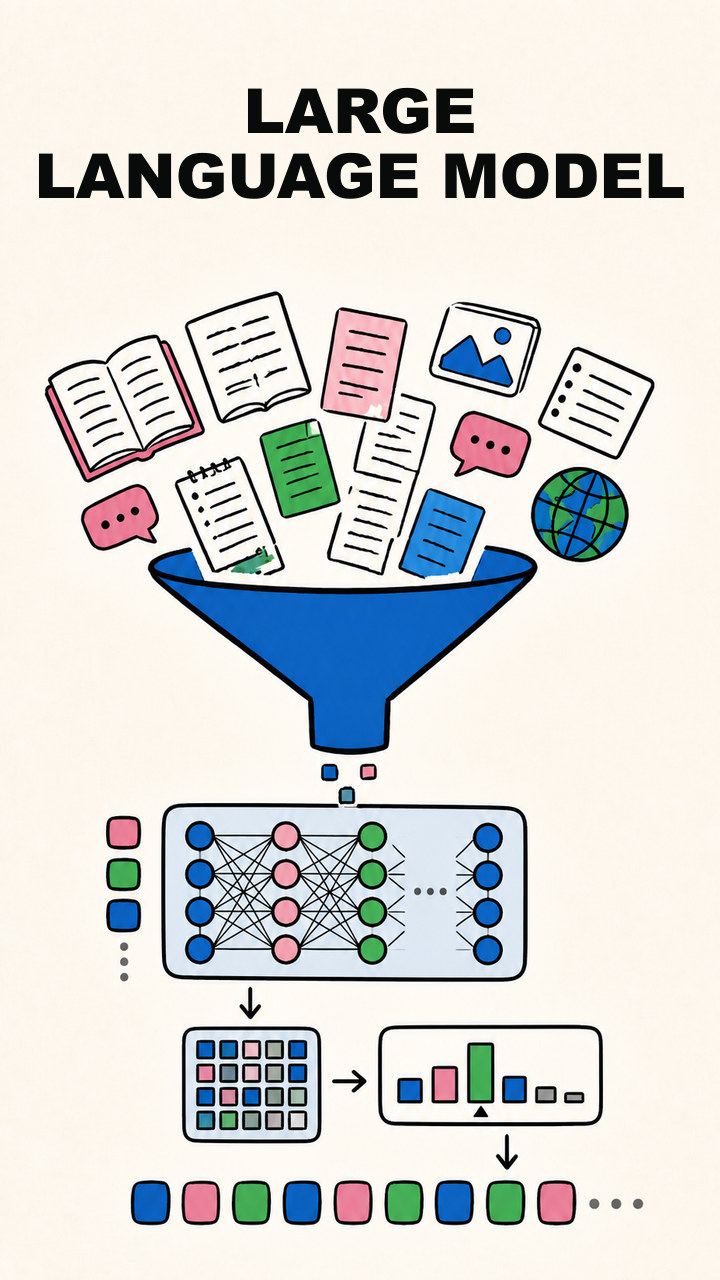
A large language model is a system trained on very large amounts of text — and often images, code and other data — to predict what piece of language should come next. Doing that well turns out to be enough to write, summarize, translate, answer questions and handle many other language tasks.
- Review state
- Reviewed in POC
- Freshness
- Current
- Version
- 3
- Large Language Model
- LLM
Remember it this wayThe LLM generates language; the product supplies the surrounding system.
In plain language
An LLM learns statistical patterns in language and uses the conversation, instructions, and available context to produce its next pieces of text. Tools may add retrieval, memory, or actions around the model.
Why it matters
People often confuse the model with the entire product. Separating the LLM from its interface, data sources, tools, and guardrails makes capability and risk easier to evaluate.
Example
A workplace assistant sends a user's prompt and selected documents to an LLM, then displays the generated response inside a chat interface.
Common misconception
An LLM is not the same thing as a chatbot, and fluent output does not guarantee factual accuracy, current knowledge, or understanding.
Related terms
Sources
- NIST, *Adversarial Machine Learning: A Taxonomy and Terminology of Attacks and Mitigations* (NIST AI 100-2 E2025)current NIST terminology for large language models and their security context.
- Stanford CRFM, *On the Opportunities and Risks of Foundation Models*primary technical and sociotechnical context for language models within the foundation-model paradigm.
Learn more
- Distinguish the model from its interface with [[chatbot|Chatbot]] and its working input limit with [[context-window|Context Window]].
Public history
46 recorded events · 46 public summaries
A potential shared concept was discussed and selected for initial glossary drafting.
The captured candidate received a complete initial draft and entered section-level human review.
Radar reviewed the initial definition draft for human consideration.
Radar reviewed the initial plain-language-explanation draft for human consideration.
Radar reviewed the initial why-it-matters draft for human consideration.
Radar reviewed the initial example draft for human consideration.
Radar reviewed the initial common-misconception draft for human consideration.
Radar reviewed the initial remember-it-this-way draft for human consideration.
Radar reviewed the initial related-terms draft for human consideration.
Radar reviewed the initial sources draft for human consideration.
Radar reviewed the initial learn-more draft for human consideration.
A proposal was opened for section-level human review while preserving the current version.
A human reviewer opened a proposed revision while preserving the current approved or captured version.
definition approved by a human reviewer.
plain-language-explanation approved by a human reviewer.
why-it-matters approved by a human reviewer.
example approved by a human reviewer.
common-misconception approved by a human reviewer.
remember-it-this-way approved by a human reviewer.
related-terms approved by a human reviewer.
sources returned for revision.
learn-more approved by a human reviewer.
Requested wording was prepared without changing approved or existing sections.
Radar reviewed the pending sources section for human consideration.
Radar must rereview the complete large-language-model term after an accepted text change.
Radar must rereview the complete large-language-model term after an accepted text change.
Radar must rereview the complete large-language-model term after an accepted text change.
Radar must rereview the complete large-language-model term after an accepted text change.
Radar must rereview the complete large-language-model term after an accepted text change.
Radar must rereview the complete large-language-model term after an accepted text change.
Radar must rereview the complete large-language-model term after an accepted text change.
Radar must rereview the complete large-language-model term after an accepted text change.
Radar must rereview the complete large-language-model term after an accepted text change.
sources approved by a human reviewer.
sources approved wording became the current section text.
All section gates are approved; content version 2 is now a fully approved term.
Radar rereviewed the human-approved definition wording for this exact version.
Radar rereviewed the human-approved plain-language-explanation wording for this exact version.
Radar rereviewed the human-approved why-it-matters wording for this exact version.
Radar rereviewed the human-approved example wording for this exact version.
Radar rereviewed the human-approved common-misconception wording for this exact version.
Radar rereviewed the human-approved remember-it-this-way wording for this exact version.
Radar rereviewed the human-approved related-terms wording for this exact version.
Radar rereviewed the human-approved sources wording for this exact version.
Radar rereviewed the human-approved learn-more wording for this exact version.
Definition review recorded as replace.
Source: vault/Glossary/terms/large-language-model/term.md · sha256:b2c58113049f37a06016323d5ad780cd6c52a79a1ac8a2f69216b04f251e6738 · Release: rs-glossary-glossary-team-poc-0.5.5-2026-09-02