RS Glossary
MCP Server
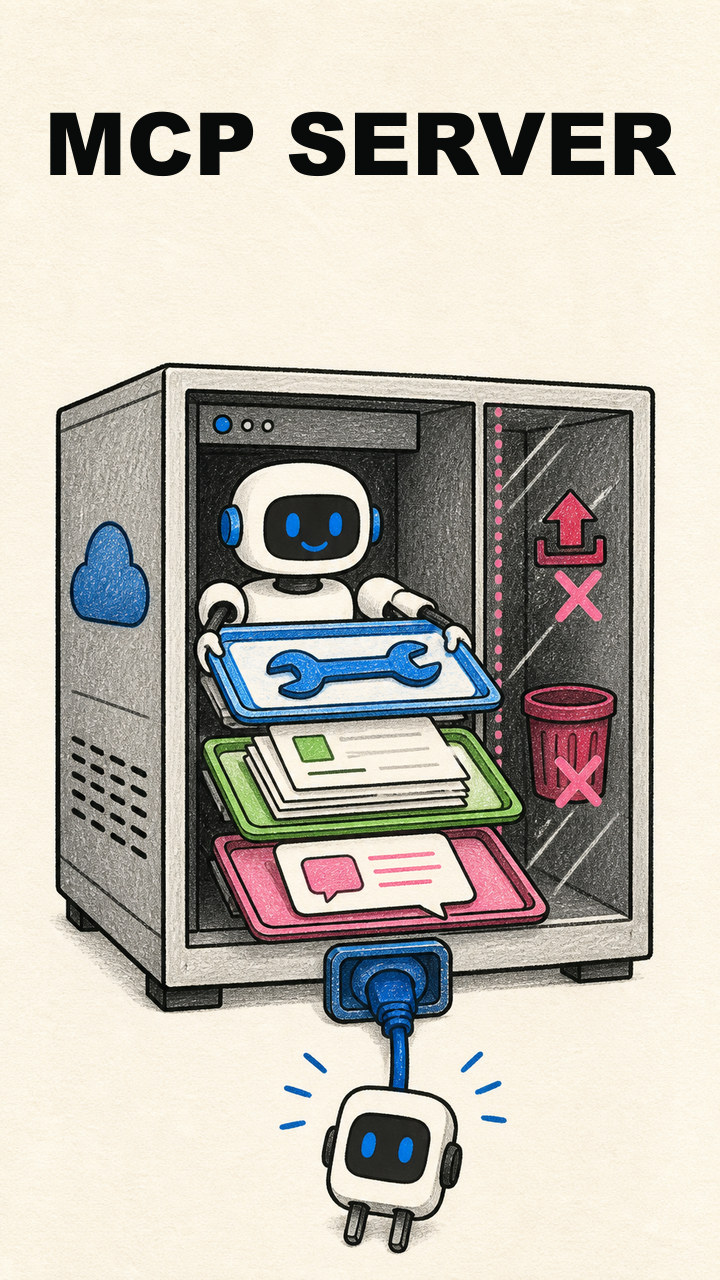
An MCP server is a local program or remote service that implements the Model Context Protocol server role and exposes selected tools, resources, or prompts to an AI application's MCP client.
- Review state
- Reviewed in POC
- Freshness
- Current
- Version
- 1
- MCP Server
- MCP Servers
- Model Context Protocol Server
Remember it this wayThe protocol supplies the rules; the server offers capabilities through them.
In plain language
The server is the concrete endpoint on one side of an MCP connection. It advertises the capabilities it supports and responds to protocol requests. It might wrap local files, a company database, a cloud API, or a specialized workflow.
Why it matters
Each MCP server creates a distinct capability and trust boundary. Learners need to know what it exposes, where it runs, which data it can reach, who operates it, and what the host will allow before treating the connection as safe.
Example
A company builds an MCP server for its customer system. It exposes read-only tools for finding an account and retrieving approved support history, while omitting deletion and export actions. An AI application's MCP client connects to that server under the host's permission controls.
Common misconception
An MCP server is not the AI model and connecting one does not automatically grant every possible action. Servers can be local or remote, capabilities can be narrow, and server-provided descriptions or content should not be trusted merely because they arrived through MCP.
Related terms
Sources
- Model Context Protocol, “Architecture”defines MCP servers as local processes or remote services that expose focused context and capabilities to clients.
- Model Context Protocol, “Server features overview”describes the tools, resources, and prompts a server can provide.
Learn more
- Start with [[model-context-protocol|Model Context Protocol (MCP)]] to understand the full host-client-server relationship.
- Apply [[runtime-governance|Runtime Governance]] and [[prompt-injection|Prompt Injection]] controls at the capability boundary.
Public history
30 recorded events · 30 public summaries
A potential shared concept was discussed and selected for initial glossary drafting.
The captured candidate received a complete initial draft and entered section-level human review.
Radar reviewed the initial definition draft for human consideration.
Radar reviewed the initial plain-language-explanation draft for human consideration.
Radar reviewed the initial why-it-matters draft for human consideration.
Radar reviewed the initial example draft for human consideration.
Radar reviewed the initial common-misconception draft for human consideration.
Radar reviewed the initial remember-it-this-way draft for human consideration.
Radar reviewed the initial related-terms draft for human consideration.
Radar reviewed the initial sources draft for human consideration.
Radar reviewed the initial learn-more draft for human consideration.
Definition review recorded as approve.
Plain-Language Explanation review recorded as approve.
Why It Matters review recorded as approve.
Example review recorded as approve.
Common Misconception review recorded as approve.
Remember It This Way review recorded as approve.
Related Terms review recorded as approve.
Sources review recorded as approve.
Learn More review recorded as approve.
All wording and media review gates are approved; the term is now canonical.
Definition review recorded as approve.
Plain-Language Explanation review recorded as approve.
Why It Matters review recorded as approve.
Example review recorded as approve.
Common Misconception review recorded as approve.
Remember It This Way review recorded as approve.
Related Terms review recorded as approve.
Sources review recorded as approve.
Learn More review recorded as approve.
Source: vault/Glossary/terms/mcp-server/term.md · sha256:81cafdacc783ea2531bea8af4d663b533789fc795c07613cb7d510e5f369f0f2 · Release: rs-glossary-glossary-team-poc-0.5.5-2026-09-02