RS Glossary
Orchestration
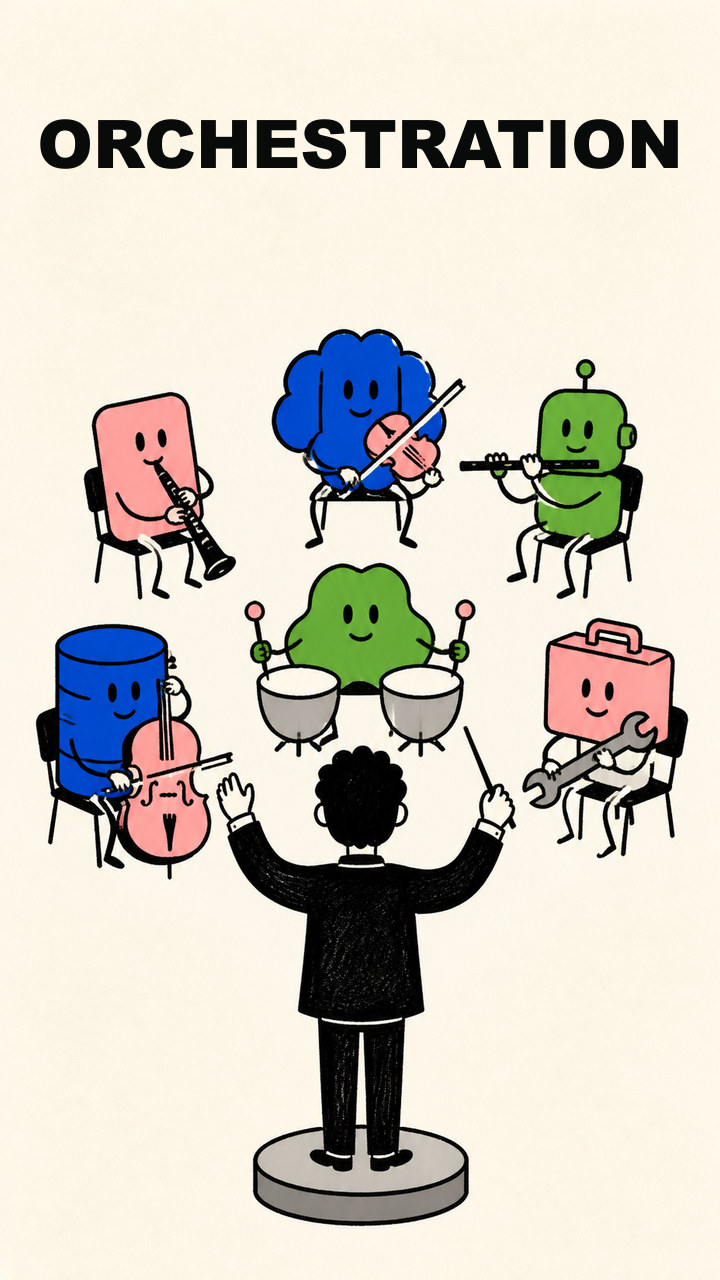
Orchestration is the coordination of models, agents, tools, data, state, and control flow so that they operate as one larger workflow.
- Review state
- Reviewed in POC
- Freshness
- Current
- Version
- 2
- Orchestration
- AI Orchestration
Remember it this wayOrchestration conducts the parts and controls the handoffs.
In plain language
The orchestration layer decides what happens next, which component receives which information, how results are checked, and when the system stops or asks for help.
Why it matters
Many failures attributed to a model actually arise from routing, permissions, stale state, tool errors, or missing checks in the surrounding orchestration.
Example
An orchestrator sends a request to a retrieval service, passes selected documents to a model, validates the response format, and routes exceptions to a person.
Common misconception
Orchestration is not merely running several tools in sequence. It includes state, branching, error handling, permissions, and ownership of transitions.
Related terms
Sources
- Kubernetes Documentation, *Overview*authoritative systems documentation distinguishing orchestration workflows from ongoing state reconciliation.
- NIST, *Accelerating the Adoption of Software and AI Agent Identity and Authorization*current official context for coordinating AI agents, tools, identities, permissions, and actions.
Learn more
- Map orchestration as a [[workflow|Workflow]] with explicit [[handoff|Handoffs]].
Public history
45 recorded events · 45 public summaries
A potential shared concept was discussed and selected for initial glossary drafting.
The captured candidate received a complete initial draft and entered section-level human review.
Radar reviewed the initial definition draft for human consideration.
Radar reviewed the initial plain-language-explanation draft for human consideration.
Radar reviewed the initial why-it-matters draft for human consideration.
Radar reviewed the initial example draft for human consideration.
Radar reviewed the initial common-misconception draft for human consideration.
Radar reviewed the initial remember-it-this-way draft for human consideration.
Radar reviewed the initial related-terms draft for human consideration.
Radar reviewed the initial sources draft for human consideration.
Radar reviewed the initial learn-more draft for human consideration.
A proposal was opened for section-level human review while preserving the current version.
A human reviewer opened a proposed revision while preserving the current approved or captured version.
definition approved by a human reviewer.
plain-language-explanation approved by a human reviewer.
why-it-matters approved by a human reviewer.
example approved by a human reviewer.
common-misconception approved by a human reviewer.
remember-it-this-way approved by a human reviewer.
related-terms approved by a human reviewer.
sources returned for revision.
learn-more approved by a human reviewer.
Requested wording was prepared without changing approved or existing sections.
Radar reviewed the pending sources section for human consideration.
Radar must rereview the complete orchestration term after an accepted text change.
Radar must rereview the complete orchestration term after an accepted text change.
Radar must rereview the complete orchestration term after an accepted text change.
Radar must rereview the complete orchestration term after an accepted text change.
Radar must rereview the complete orchestration term after an accepted text change.
Radar must rereview the complete orchestration term after an accepted text change.
Radar must rereview the complete orchestration term after an accepted text change.
Radar must rereview the complete orchestration term after an accepted text change.
Radar must rereview the complete orchestration term after an accepted text change.
sources approved by a human reviewer.
sources approved wording became the current section text.
All section gates are approved; content version 2 is now a fully approved term.
Radar rereviewed the human-approved definition wording for this exact version.
Radar rereviewed the human-approved plain-language-explanation wording for this exact version.
Radar rereviewed the human-approved why-it-matters wording for this exact version.
Radar rereviewed the human-approved example wording for this exact version.
Radar rereviewed the human-approved common-misconception wording for this exact version.
Radar rereviewed the human-approved remember-it-this-way wording for this exact version.
Radar rereviewed the human-approved related-terms wording for this exact version.
Radar rereviewed the human-approved sources wording for this exact version.
Radar rereviewed the human-approved learn-more wording for this exact version.
Source: vault/Glossary/terms/orchestration/term.md · sha256:afa90488c9c56df3b063026d38f64558207f1a31a7ac18c9a6e573d9864bacda · Release: rs-glossary-glossary-team-poc-0.5.5-2026-09-02