RS Glossary
Model Poisoning
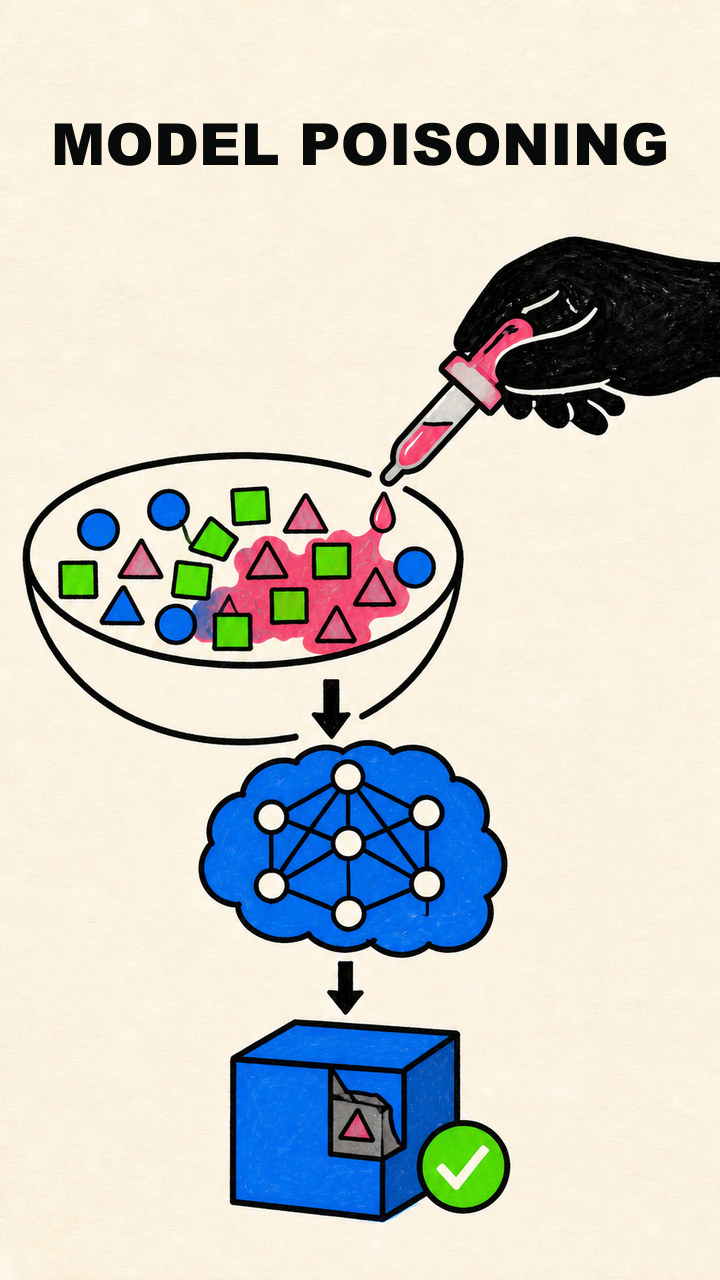
Model poisoning is a deliberate attack that corrupts training data, learning processes, model updates, or model artifacts to alter behavior or introduce hidden weaknesses.
- Review state
- Needs review
- Freshness
- Current
- Version
- 2
- Model Poisoning
- Data Poisoning
Remember it this wayPoisoning changes what the model learned or carries.
In plain language
The attacker interferes before or during model development rather than only at the moment a user sends a request. The effect may be broad degradation or a targeted behavior triggered under specific conditions.
Why it matters
A compromised model can pass ordinary tests while retaining a hidden failure path. Supply-chain controls, provenance, access restrictions, and targeted evaluation matter.
Example
An attacker inserts manipulated examples into a training pipeline so a particular visual pattern causes the model to assign a chosen label.
Common misconception
Model poisoning is different from prompt injection. Poisoning alters training or model integrity; injection attacks a deployed system through processed instructions.
Related terms
Sources
- NIST AI 100-2 E2025, Adversarial Machine Learningauthoritative taxonomy of poisoning attacks and mitigations.
Learn more
- Use [[data-provenance|Data Provenance]] to examine the training supply chain.
Public history
36 recorded events · 36 public summaries
A potential shared concept was discussed and selected for initial glossary drafting.
The captured candidate received a complete initial draft and entered section-level human review.
Radar reviewed the initial definition draft for human consideration.
Radar reviewed the initial plain-language-explanation draft for human consideration.
Radar reviewed the initial why-it-matters draft for human consideration.
Radar reviewed the initial example draft for human consideration.
Radar reviewed the initial common-misconception draft for human consideration.
Radar reviewed the initial remember-it-this-way draft for human consideration.
Radar reviewed the initial related-terms draft for human consideration.
Radar reviewed the initial sources draft for human consideration.
Radar reviewed the initial learn-more draft for human consideration.
A proposal was opened for section-level human review while preserving the current version.
A human reviewer opened a proposed revision while preserving the current approved or captured version.
definition approved by a human reviewer.
plain-language-explanation approved by a human reviewer.
why-it-matters approved by a human reviewer.
example approved by a human reviewer.
common-misconception approved by a human reviewer.
remember-it-this-way approved by a human reviewer.
related-terms approved by a human reviewer.
sources returned for revision.
learn-more approved by a human reviewer.
Requested wording was prepared without changing approved or existing sections.
Radar reviewed the pending sources section for human consideration.
Radar must rereview the complete model-poisoning term after an accepted text change.
Radar must rereview the complete model-poisoning term after an accepted text change.
Radar must rereview the complete model-poisoning term after an accepted text change.
Radar must rereview the complete model-poisoning term after an accepted text change.
Radar must rereview the complete model-poisoning term after an accepted text change.
Radar must rereview the complete model-poisoning term after an accepted text change.
Radar must rereview the complete model-poisoning term after an accepted text change.
Radar must rereview the complete model-poisoning term after an accepted text change.
Radar must rereview the complete model-poisoning term after an accepted text change.
sources approved by a human reviewer.
sources approved wording became the current section text.
All section gates are approved; content version 2 is now a fully approved term.
Source: vault/Glossary/terms/model-poisoning/term.md · sha256:c06e30561215ada972a3ae2c62def685b762593c97baaf0240d47ed946cdd557 · Release: rs-glossary-glossary-team-poc-0.5.5-2026-09-02