RS Glossary
Multitask Learning
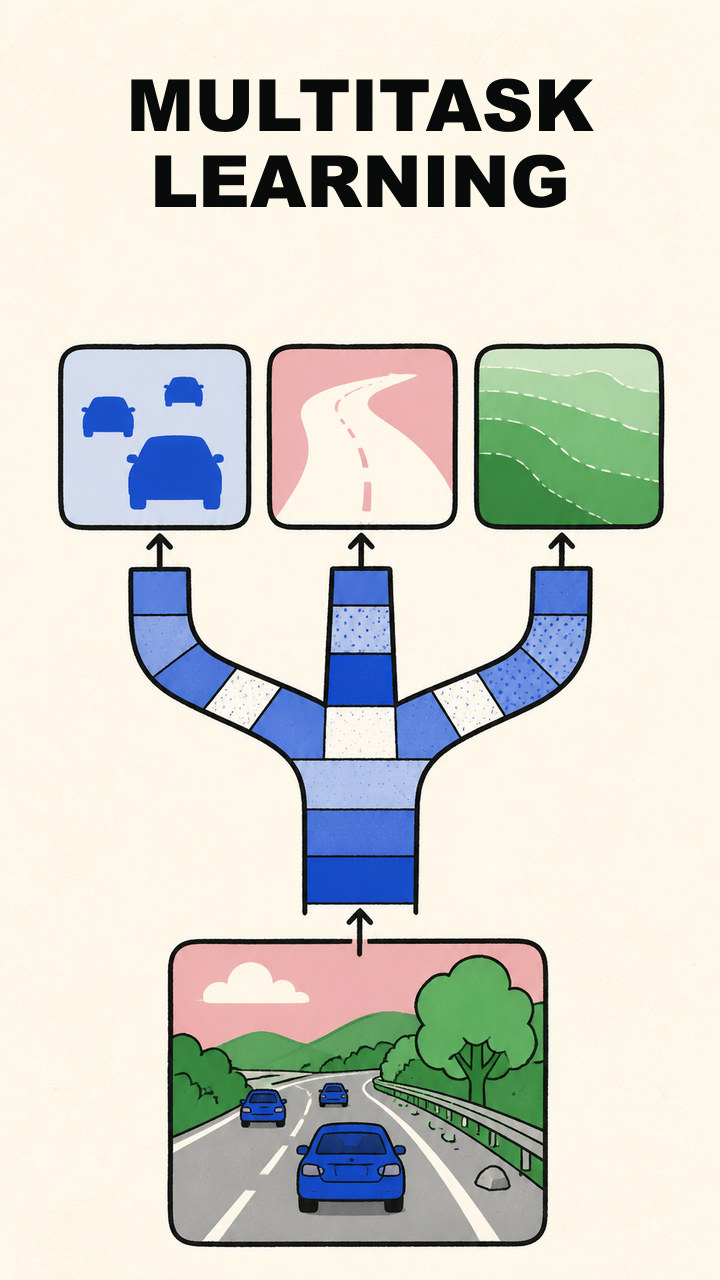
Multitask training is a method where one model is trained across several tasks so it can learn shared patterns instead of specializing in only one job.
- Review state
- Reviewed in POC
- Freshness
- Current
- Version
- 2
- Multitask Learning
- Multi-Task Learning
Remember it this waySeveral tasks learn through shared model structure.
In plain language
Multitask learning trains one model on several tasks together so the tasks can share useful representations. It may use shared layers with separate outputs or another shared-parameter design.
Why it matters
Related tasks can strengthen one another, especially when data is limited. Unrelated or competing tasks can interfere, so the task mix and evaluation must be explicit.
Example
A model learns object detection, road segmentation, and distance estimation through a shared visual encoder with a separate output head for each task.
Common misconception
Multitask learning is not the same as a user asking a general-purpose model to do several things. It describes a training setup with shared learning across tasks.
Related terms
Sources
- Rich Caruana, “Multitask Learning”formalizes learning multiple related tasks through shared representations.
Learn more
- Compare [[training|Training]], [[foundation-model|Foundation Model]], [[latent-representation|Latent Representation]], and [[evaluation-metric|Evaluation Metric]] to place Multitask Learning in the surrounding system.
- Follow the cited source material above for the method, standard, or research context behind this draft.
Public history
23 recorded events · 23 public summaries
A potential shared concept was discussed and selected for initial glossary drafting.
The captured candidate received a complete initial draft and entered section-level human review.
Radar reviewed the initial definition draft for human consideration.
Radar reviewed the initial plain-language-explanation draft for human consideration.
Radar reviewed the initial why-it-matters draft for human consideration.
Radar reviewed the initial example draft for human consideration.
Radar reviewed the initial common-misconception draft for human consideration.
Radar reviewed the initial remember-it-this-way draft for human consideration.
Radar reviewed the initial related-terms draft for human consideration.
Radar reviewed the initial sources draft for human consideration.
Radar reviewed the initial learn-more draft for human consideration.
Definition review recorded as approve.
Plain-Language Explanation review recorded as approve.
Why It Matters review recorded as approve.
Example review recorded as approve.
Common Misconception review recorded as approve.
Remember It This Way review recorded as approve.
Related Terms review recorded as approve.
Sources review recorded as approve.
Learn More review recorded as approve.
Sources review recorded as replace.
Radar verified the learner-facing sources after personal origin provenance was removed.
All nine current wording approvals were reconciled to Approved term status.
Source: vault/Glossary/terms/multitask-learning/term.md · sha256:2513063eb7067194d5b2d387e5fe9351f7680324b2a7ef2108b26f988aecdee4 · Release: rs-glossary-glossary-team-poc-0.5.5-2026-09-02