RS Glossary
Open Weights vs. Closed Weights
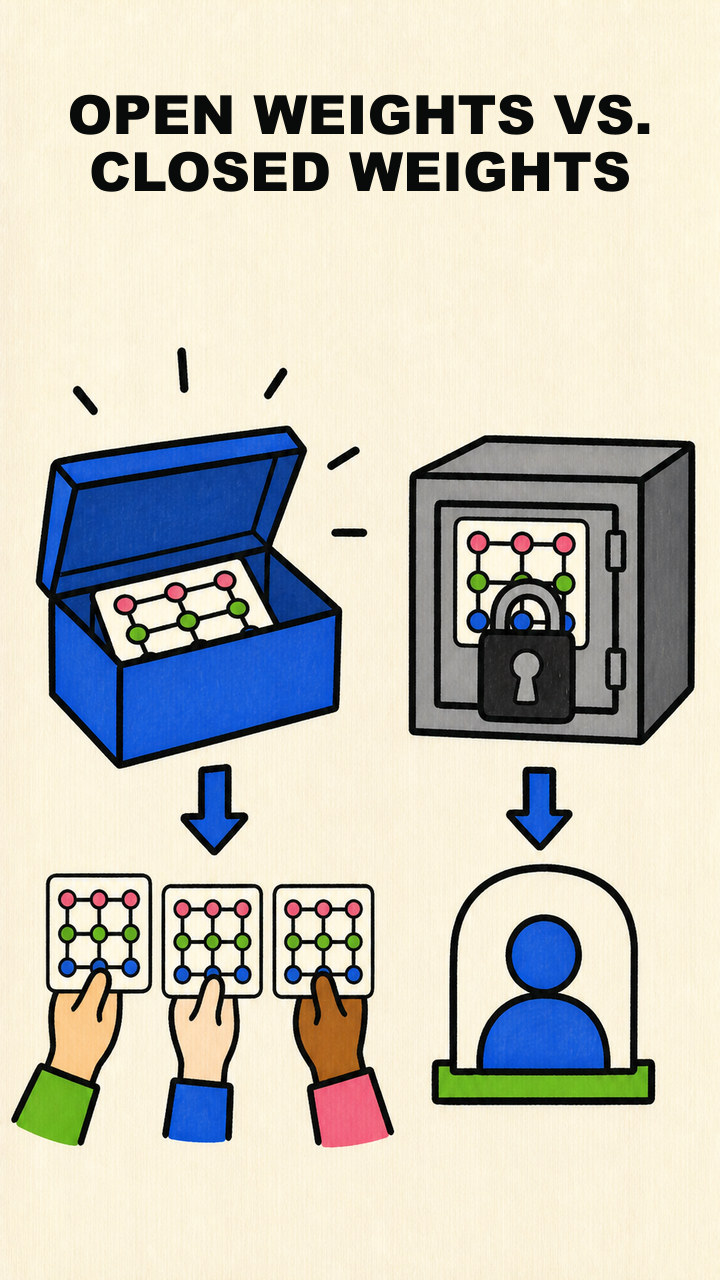
Open weights and closed weights describe whether a trained model's parameter values are released for others to obtain and run or remain controlled by the developer and accessible only through approved products or services.
- Review state
- Reviewed in POC
- Freshness
- Current
- Version
- 2
- Open Weights vs. Closed Weights
- Open Weights
- Closed Weights
Remember it this wayOpen weights grant access to learned parameters, not necessarily the whole recipe or every right.
In plain language
Open-weight models can often be hosted, inspected, modified, or fine-tuned under their license. Closed-weight models are usually accessed through a vendor interface or API without receiving the underlying parameter files.
Why it matters
Weight access affects deployment control, privacy options, customization, verification, cost, security, and dependency, but licenses and missing training materials can still limit practical openness.
Example
A company compares running an open-weight model in its own environment with sending requests to a closed-weight model through a vendor API.
Common misconception
Open weights do not automatically mean open source, unrestricted use, transparent training data, or safer behavior.
Related terms
Sources
- Stanford CRFM, The Foundation Model Transparency Index: Open Foundation Modelsresearch-based treatment of openness dimensions, including weights and access.
- Bommasani et al., Considerations for Governing Open Foundation Modelsprimary research on distinctions and governance considerations for open foundation models.
Learn more
- Evaluate access, licenses, infrastructure, and data separately through [[layered-sovereignty|Layered Sovereignty]].
Public history
45 recorded events · 45 public summaries
A potential shared concept was discussed and selected for initial glossary drafting.
The captured candidate received a complete initial draft and entered section-level human review.
Radar reviewed the initial definition draft for human consideration.
Radar reviewed the initial plain-language-explanation draft for human consideration.
Radar reviewed the initial why-it-matters draft for human consideration.
Radar reviewed the initial example draft for human consideration.
Radar reviewed the initial common-misconception draft for human consideration.
Radar reviewed the initial remember-it-this-way draft for human consideration.
Radar reviewed the initial related-terms draft for human consideration.
Radar reviewed the initial sources draft for human consideration.
Radar reviewed the initial learn-more draft for human consideration.
A proposal was opened for section-level human review while preserving the current version.
A human reviewer opened a proposed revision while preserving the current approved or captured version.
definition approved by a human reviewer.
plain-language-explanation approved by a human reviewer.
why-it-matters approved by a human reviewer.
example approved by a human reviewer.
common-misconception approved by a human reviewer.
remember-it-this-way approved by a human reviewer.
related-terms approved by a human reviewer.
sources returned for revision.
learn-more approved by a human reviewer.
Requested wording was prepared without changing approved or existing sections.
Radar reviewed the pending sources section for human consideration.
Radar must rereview the complete open-weights-vs-closed-weights term after an accepted text change.
Radar must rereview the complete open-weights-vs-closed-weights term after an accepted text change.
Radar must rereview the complete open-weights-vs-closed-weights term after an accepted text change.
Radar must rereview the complete open-weights-vs-closed-weights term after an accepted text change.
Radar must rereview the complete open-weights-vs-closed-weights term after an accepted text change.
Radar must rereview the complete open-weights-vs-closed-weights term after an accepted text change.
Radar must rereview the complete open-weights-vs-closed-weights term after an accepted text change.
Radar must rereview the complete open-weights-vs-closed-weights term after an accepted text change.
Radar must rereview the complete open-weights-vs-closed-weights term after an accepted text change.
sources approved by a human reviewer.
sources approved wording became the current section text.
All section gates are approved; content version 2 is now a fully approved term.
Radar rereviewed the human-approved definition wording for this exact version.
Radar rereviewed the human-approved plain-language-explanation wording for this exact version.
Radar rereviewed the human-approved why-it-matters wording for this exact version.
Radar rereviewed the human-approved example wording for this exact version.
Radar rereviewed the human-approved common-misconception wording for this exact version.
Radar rereviewed the human-approved remember-it-this-way wording for this exact version.
Radar rereviewed the human-approved related-terms wording for this exact version.
Radar rereviewed the human-approved sources wording for this exact version.
Radar rereviewed the human-approved learn-more wording for this exact version.
Source: vault/Glossary/terms/open-weights-vs-closed-weights/term.md · sha256:1e11162da4e0782aba3ed3fc5f78e8699b168693c51b8ce2e13184b654490eba · Release: rs-glossary-glossary-team-poc-0.5.5-2026-09-02