RS Glossary
Root-Cause Hypothesis
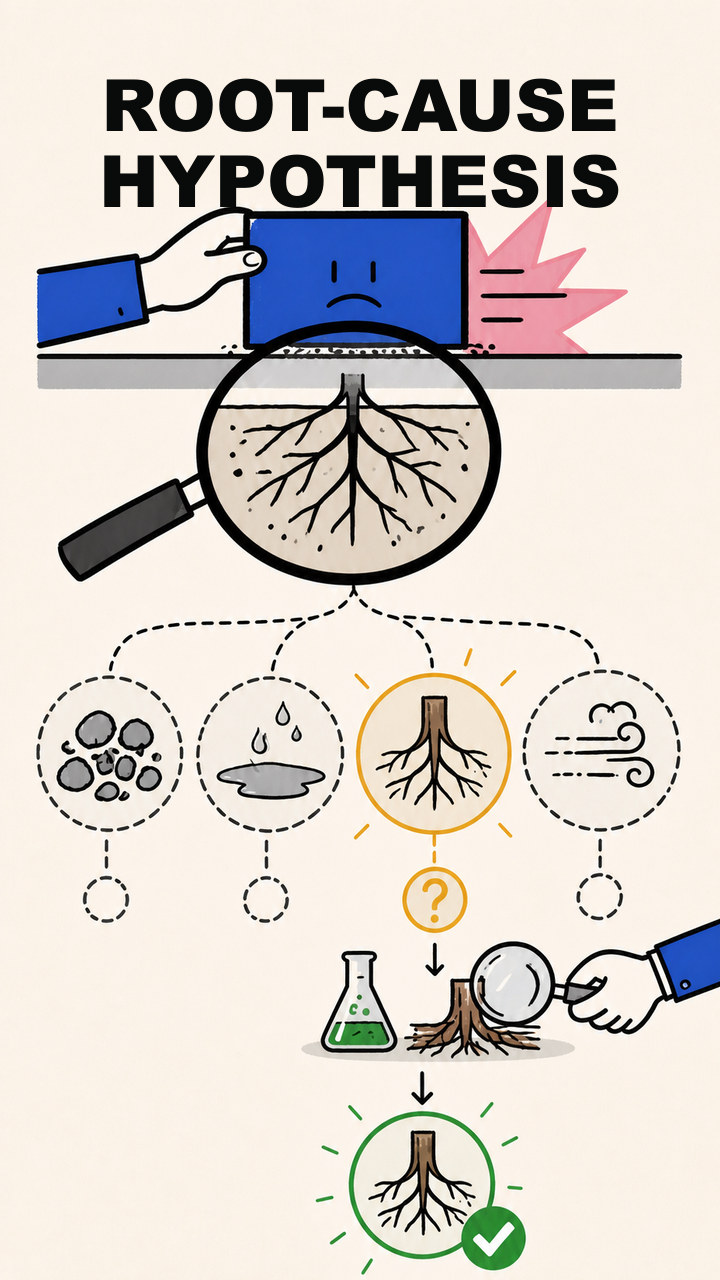
A root-cause hypothesis is a proposed explanation for what is actually producing an observed problem, stated in a form that can be tested. Until evidence supports it over the competing explanations, it stays a hypothesis, not a finding.
- Review state
- Reviewed in POC
- Freshness
- Current
- Version
- 3
- root-cause-hypothesis
Remember it this wayA cause is a hypothesis until evidence holds it up.
In plain language
A root-cause hypothesis is an evidence-seeking guess about what is producing a problem. The team tests it against observations and other possible explanations before treating it as the cause.
Why it matters
Friction mapping should not treat every first explanation as fact.
Good discovery separates what was observed from what may be causing it.
Example
Observation: The team keeps a spreadsheet outside the CRM.
Hypothesis: The CRM does not provide a scheduling view that the team trusts.
Common misconception
A plausible explanation is not automatically the root cause. The first explanation may describe a symptom, omit contributing factors, or fail when tested against the evidence.
Related terms
Not connected yet.
Sources
- ASQ, "What is Root Cause Analysis?"approaches for uncovering causes and connecting them to corrective action.
- ASQ, "What is Problem Solving?"diagnosing and verifying causes before selecting a solution.
Learn more
Public history
28 recorded events · 28 public summaries
Existing glossary content was moved into the unified source-of-truth structure without changing its learner-facing body.
A captured draft entered section-level human review without changing its existing wording.
Missing required wording was proposed while preserving the captured draft.
Radar reviewed the definition section for human consideration.
Radar reviewed the plain-language-explanation section for human consideration.
Radar reviewed the why-it-matters section for human consideration.
Radar reviewed the example section for human consideration.
Radar reviewed the common-misconception section for human consideration.
Radar reviewed the remember-it-this-way section for human consideration.
Radar reviewed the related-terms section for human consideration.
Radar reviewed the sources section for human consideration.
Radar reviewed the learn-more section for human consideration.
definition approved by a human reviewer.
plain-language-explanation approved by a human reviewer.
why-it-matters approved by a human reviewer.
example approved by a human reviewer.
common-misconception approved by a human reviewer.
remember-it-this-way approved by a human reviewer.
related-terms approved by a human reviewer.
sources approved by a human reviewer.
learn-more approved by a human reviewer.
plain-language-explanation approved wording became the current section text.
common-misconception approved wording became the current section text.
remember-it-this-way approved wording became the current section text.
sources approved wording became the current section text.
learn-more approved wording became the current section text.
All section gates are approved; content version 2 is now a fully approved term.
Definition review recorded as replace.
Source: vault/Glossary/terms/root-cause-hypothesis/term.md · sha256:8edb7020363a23e5bc070e6dab55c11f6c3deac34836a7cc367b80fe004459ca · Release: rs-glossary-glossary-team-poc-0.5.5-2026-09-02