RS Glossary
Self-Supervised Learning
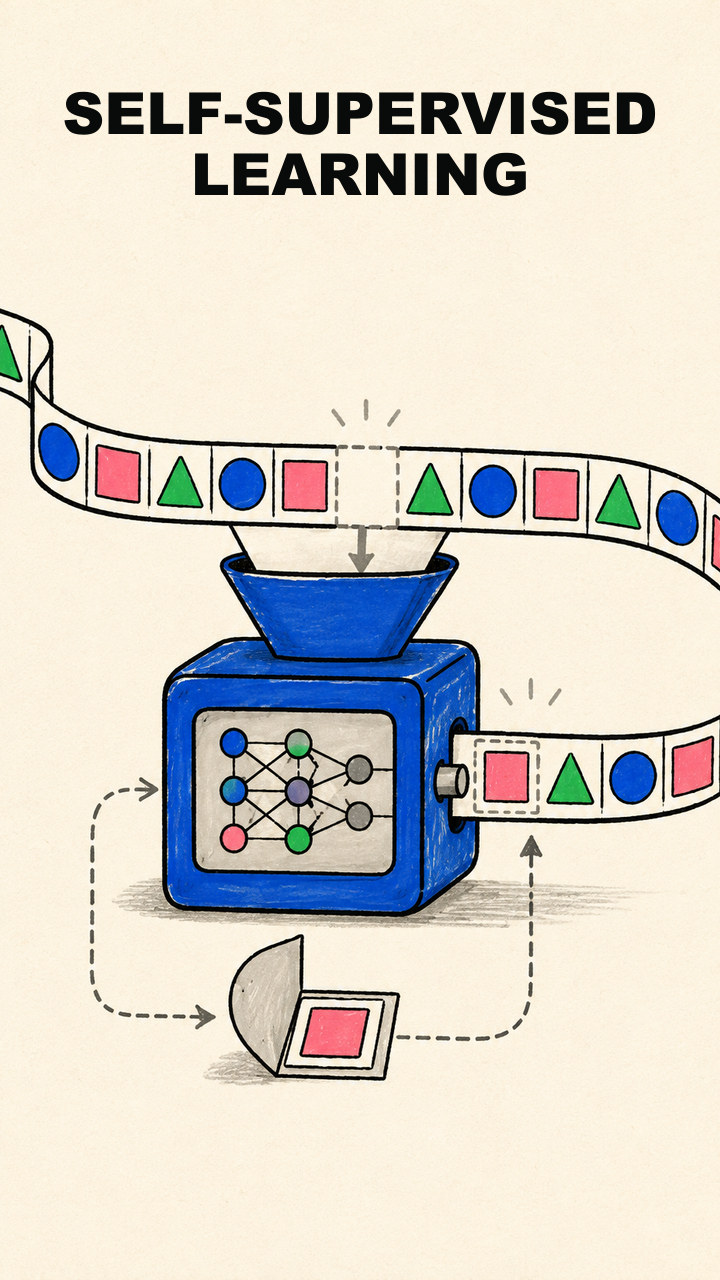
Self-supervised training is a method where the training signal is derived from the data itself, rather than from human-provided labels.
- Review state
- Reviewed in POC
- Freshness
- Current
- Version
- 2
- Self-Supervised Learning
- Self-Supervised Training
Remember it this wayThe data supplies the training signal.
In plain language
Self-supervised learning creates a training signal from the structure of the data itself. The system may hide, transform, or relate parts of an example and learn by predicting the missing or connected information.
Why it matters
It can use large amounts of unlabeled data, reducing the need for manual annotation. The task design still determines what patterns the model is encouraged to learn.
Example
A language model learns by predicting masked or next tokens drawn from the surrounding text rather than from labels written by a human for each sentence.
Common misconception
Self-supervised does not mean the model sets its own goals or evaluates itself. People still choose the data, objective, architecture, and training process.
Related terms
Sources
- Linus Ericsson and colleagues, “Self-Supervised Representation Learning: Introduction, Advances and Challenges”surveys methods that learn representations without manually annotated labels across several modalities.
Learn more
- Compare [[pretraining|Pretraining]], [[contrastive-learning|Contrastive Learning]], [[unsupervised-learning|Unsupervised Learning]], and [[training-data|Training Data]] to place Self-Supervised Learning in the surrounding system.
- Follow the cited source material above for the method, standard, or research context behind this draft.
Public history
23 recorded events · 23 public summaries
A potential shared concept was discussed and selected for initial glossary drafting.
The captured candidate received a complete initial draft and entered section-level human review.
Radar reviewed the initial definition draft for human consideration.
Radar reviewed the initial plain-language-explanation draft for human consideration.
Radar reviewed the initial why-it-matters draft for human consideration.
Radar reviewed the initial example draft for human consideration.
Radar reviewed the initial common-misconception draft for human consideration.
Radar reviewed the initial remember-it-this-way draft for human consideration.
Radar reviewed the initial related-terms draft for human consideration.
Radar reviewed the initial sources draft for human consideration.
Radar reviewed the initial learn-more draft for human consideration.
Definition review recorded as approve.
Plain-Language Explanation review recorded as approve.
Why It Matters review recorded as approve.
Example review recorded as approve.
Common Misconception review recorded as approve.
Remember It This Way review recorded as approve.
Related Terms review recorded as approve.
Sources review recorded as approve.
Learn More review recorded as approve.
Sources review recorded as replace.
Radar verified the learner-facing sources after personal origin provenance was removed.
All nine current wording approvals were reconciled to Approved term status.
Source: vault/Glossary/terms/self-supervised-learning/term.md · sha256:0b65819babd155c35839adb1fcf87ffd6d601ae79a5be0a76a53b7b086ab83e8 · Release: rs-glossary-glossary-team-poc-0.5.5-2026-09-02