RS Glossary
Contrastive Learning
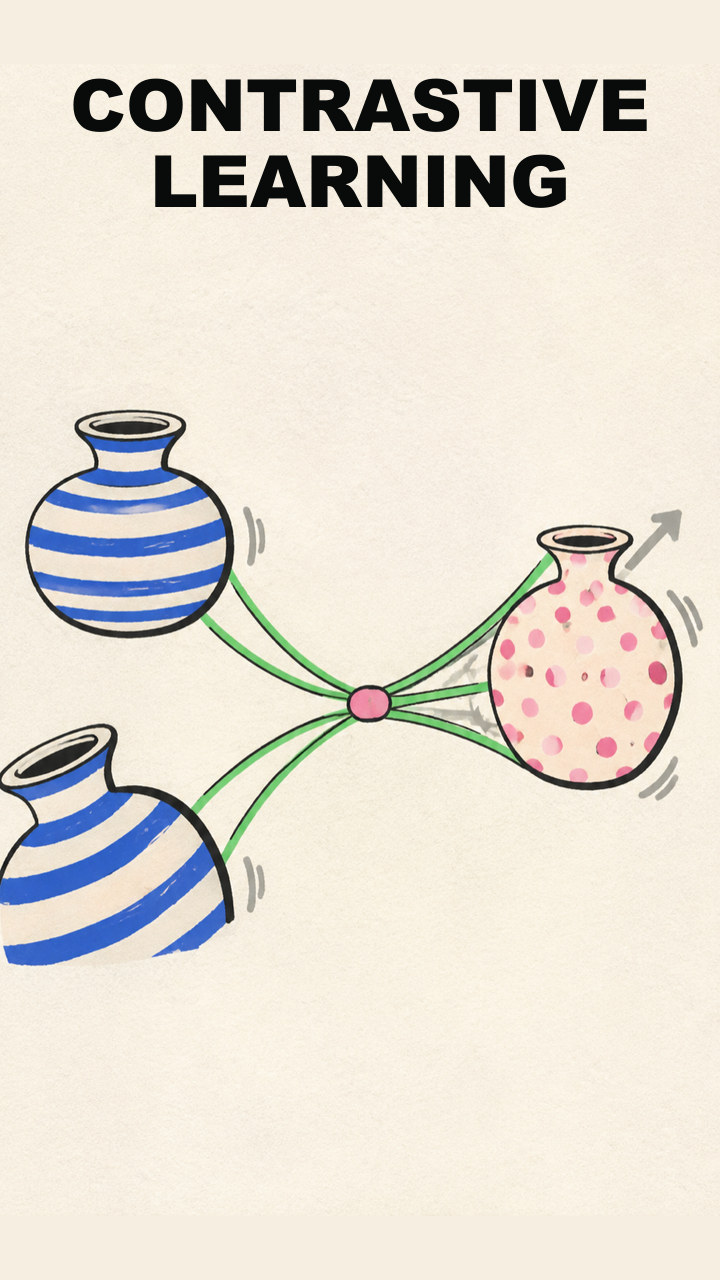
Contrastive training is a method where a model learns by pulling related examples closer together and pushing unrelated examples farther apart.
- Review state
- Reviewed in POC
- Freshness
- Current
- Version
- 2
- Contrastive Learning
- Contrastive Training
Remember it this wayBring related examples together; separate the rest.
In plain language
Contrastive learning teaches a model by comparing examples. Representations of related examples are pulled closer together, while representations of unrelated examples are pushed apart.
Why it matters
The method can learn useful representations without a manually written label for every example. Its behavior still depends on how positive and negative pairs are created.
Example
Two altered views of the same photograph are treated as a positive pair, while views from different photographs are treated as negatives.
Common misconception
Contrastive learning is not automatically unbiased or label-free. The pairing rules act as supervision and can encode assumptions about what should count as similar.
Related terms
Sources
- Ting Chen and colleagues, “A Simple Framework for Contrastive Learning of Visual Representations”demonstrates a contrastive objective that aligns two augmented views of an example.
Learn more
- Compare [[self-supervised-learning|Self-Supervised Learning]], [[embedding|Embedding]], [[latent-representation|Latent Representation]], and [[training-data|Training Data]] to place Contrastive Learning in the surrounding system.
- Follow the cited source material above for the method, standard, or research context behind this draft.
Public history
23 recorded events · 23 public summaries
A potential shared concept was discussed and selected for initial glossary drafting.
The captured candidate received a complete initial draft and entered section-level human review.
Radar reviewed the initial definition draft for human consideration.
Radar reviewed the initial plain-language-explanation draft for human consideration.
Radar reviewed the initial why-it-matters draft for human consideration.
Radar reviewed the initial example draft for human consideration.
Radar reviewed the initial common-misconception draft for human consideration.
Radar reviewed the initial remember-it-this-way draft for human consideration.
Radar reviewed the initial related-terms draft for human consideration.
Radar reviewed the initial sources draft for human consideration.
Radar reviewed the initial learn-more draft for human consideration.
Definition review recorded as approve.
Plain-Language Explanation review recorded as approve.
Why It Matters review recorded as approve.
Example review recorded as approve.
Common Misconception review recorded as approve.
Remember It This Way review recorded as approve.
Related Terms review recorded as approve.
Sources review recorded as approve.
Learn More review recorded as approve.
Sources review recorded as replace.
Radar verified the learner-facing sources after personal origin provenance was removed.
All nine current wording approvals were reconciled to Approved term status.
Source: vault/Glossary/terms/contrastive-learning/term.md · sha256:db2ec5fe4ffdf7e38c184ede99e7e9f5369367d52eadcdbd8dd973ea6c26a754 · Release: rs-glossary-glossary-team-poc-0.5.5-2026-09-02