RS Glossary
Semantic Debt
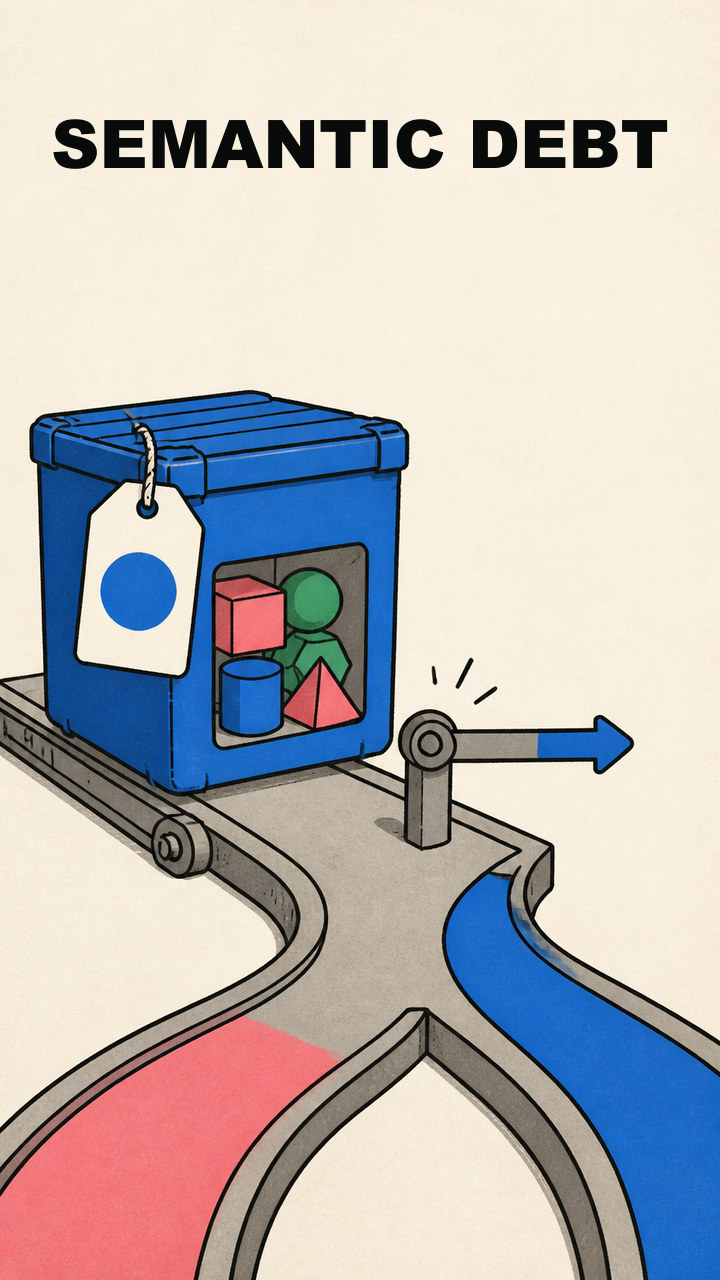
Incomplete or brittle meanings encoded into systems and treated as complete.
- Review state
- Reviewed in POC
- Freshness
- Current
- Version
- 2
- Semantic Debt
Remember it this wayA real label is not the whole meaning.
In plain language
Semantic debt builds when a label, category, score, filename, or other signal stands in for more meaning than it can support. The signal may be real, but the system treats a partial interpretation as sufficient and allows it to guide decisions or unlock authority.
Why it matters
A thin meaning can move from classification to routing, access, billing, deletion, or production action before anyone checks the underlying context. Automation can make that path fast and repeatable, so the strength of evidence and control should rise with the consequence.
Example
An AI assistant sees a downstream table named `Assignment` and treats it as the authoritative source for assignment data. The table is real, but its name does not prove lineage. A team that trusts the interpretation could build a change or validation rule around the wrong source.
Common misconception
Semantic debt is not the same as inaccurate data. The detected word, label, or record may be accurate. The debt lies in the shallow meaning encoded around it and in the authority granted to that incomplete interpretation.
Related terms
Sources
No sources recorded yet.
Learn more
- Pair with [[data-provenance|Data Provenance]] and [[verification|Verification]] when a label or system object is being treated as authoritative.
Public history
23 recorded events · 23 public summaries
A potential shared concept was discussed and selected for initial glossary drafting.
The captured candidate received a complete initial draft and entered section-level human review.
Radar reviewed the initial definition draft for human consideration.
Radar reviewed the initial plain-language-explanation draft for human consideration.
Radar reviewed the initial why-it-matters draft for human consideration.
Radar reviewed the initial example draft for human consideration.
Radar reviewed the initial common-misconception draft for human consideration.
Radar reviewed the initial remember-it-this-way draft for human consideration.
Radar reviewed the initial related-terms draft for human consideration.
Radar reviewed the initial sources draft for human consideration.
Radar reviewed the initial learn-more draft for human consideration.
Definition review recorded as approve.
Plain-Language Explanation review recorded as approve.
Why It Matters review recorded as approve.
Example review recorded as approve.
Common Misconception review recorded as approve.
Remember It This Way review recorded as approve.
Related Terms review recorded as approve.
Sources review recorded as needs-revision.
Learn More review recorded as needs-revision.
Sources review recorded as approve-proposed.
Learn More review recorded as approve-proposed.
All nine current wording approvals were reconciled to Approved term status.
Source: vault/Glossary/terms/semantic-debt/term.md · sha256:076bf82e3701e9942c9bd3e69b3b7cc9923377696380012304a5a2dc43bade7d · Release: rs-glossary-glossary-team-poc-0.5.5-2026-09-02