RS Glossary
State Transition Protocol
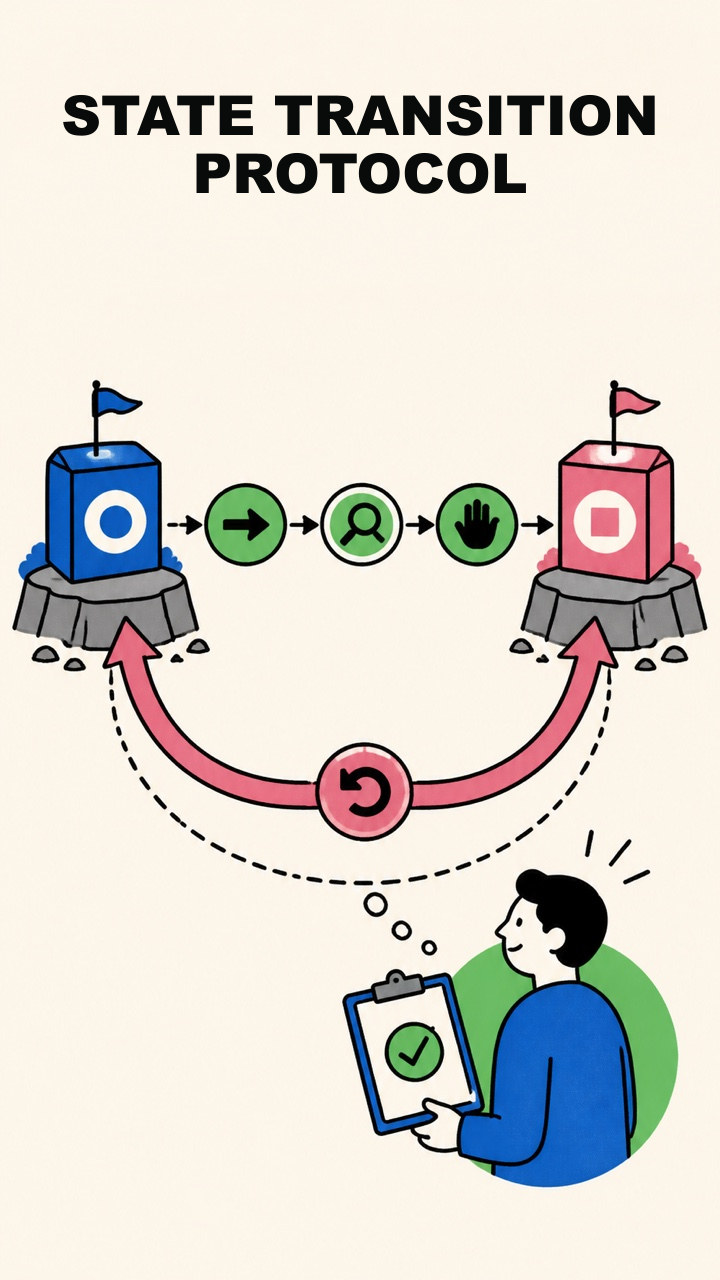
A state transition protocol is the agreed plan for moving a system from how it works now to how it will work next: the order of the steps, who owns each decision, how the new arrangement is verified as actually working, and how to get back if it doesn't. In most workplaces the same thing is called a change management plan, a cutover plan, or a runbook.
- Review state
- Reviewed in POC
- Freshness
- Current
- Version
- 3
- State Transition Protocol
Remember it this wayMove, verify, own, and know how to return.
In plain language
A safe change needs more than a target state. The protocol says what happens in what order, who owns each decision, how the new state is verified, and how to return if the transition fails.
Why it matters
Ambiguous transitions create partial changes, split assumptions, and unsafe recovery. An explicit protocol makes the change observable and reversible.
Example
A database cutover specifies readiness checks, the migration sequence, owner signoffs, traffic switching, success measures, and the conditions for rolling back.
Common misconception
A state transition protocol is not merely a deployment checklist. It includes authority, verification, failure handling, and evidence that the new state is real.
Related terms
Sources
- NIST SP 800-128, *Guide for Security-Focused Configuration Management of Information Systems*provides a controlled process for proposing, analyzing, testing, approving, implementing, and monitoring system changes.
- NASA Systems Engineering Handbook, Appendix Bdefines product transition as moving a verified and validated product to the next integration level or intended user. These sources support the controlled-change mechanism behind the Renaissance Solutions term; neither uses the label “State Transition Protocol.”
Learn more
- Use with [[verification|Verification]] and [[distributed-commitment|Distributed Commitment]].
Public history
25 recorded events · 25 public summaries
A potential shared concept was discussed and selected for initial glossary drafting.
The captured candidate received a complete initial draft and entered section-level human review.
Radar reviewed the initial definition draft for human consideration.
Radar reviewed the initial plain-language-explanation draft for human consideration.
Radar reviewed the initial why-it-matters draft for human consideration.
Radar reviewed the initial example draft for human consideration.
Radar reviewed the initial common-misconception draft for human consideration.
Radar reviewed the initial remember-it-this-way draft for human consideration.
Radar reviewed the initial related-terms draft for human consideration.
Radar reviewed the initial sources draft for human consideration.
Radar reviewed the initial learn-more draft for human consideration.
A proposal was opened for section-level human review while preserving the current version.
A human reviewer opened a proposed revision while preserving the current approved or captured version.
definition approved by a human reviewer.
plain-language-explanation approved by a human reviewer.
why-it-matters approved by a human reviewer.
example approved by a human reviewer.
common-misconception approved by a human reviewer.
remember-it-this-way approved by a human reviewer.
related-terms approved by a human reviewer.
sources approved by a human reviewer.
learn-more approved by a human reviewer.
All section gates are approved; content version 1 is now a fully approved term.
Definition review recorded as replace.
Sources review recorded as approve-proposed.
Source: vault/Glossary/terms/state-transition-protocol/term.md · sha256:463e00cb6716f592c2a048b85a1b464895668f2d8e7863e3f431fbf405ad878c · Release: rs-glossary-glossary-team-poc-0.5.5-2026-09-02