RS Glossary
Distributed Commitment
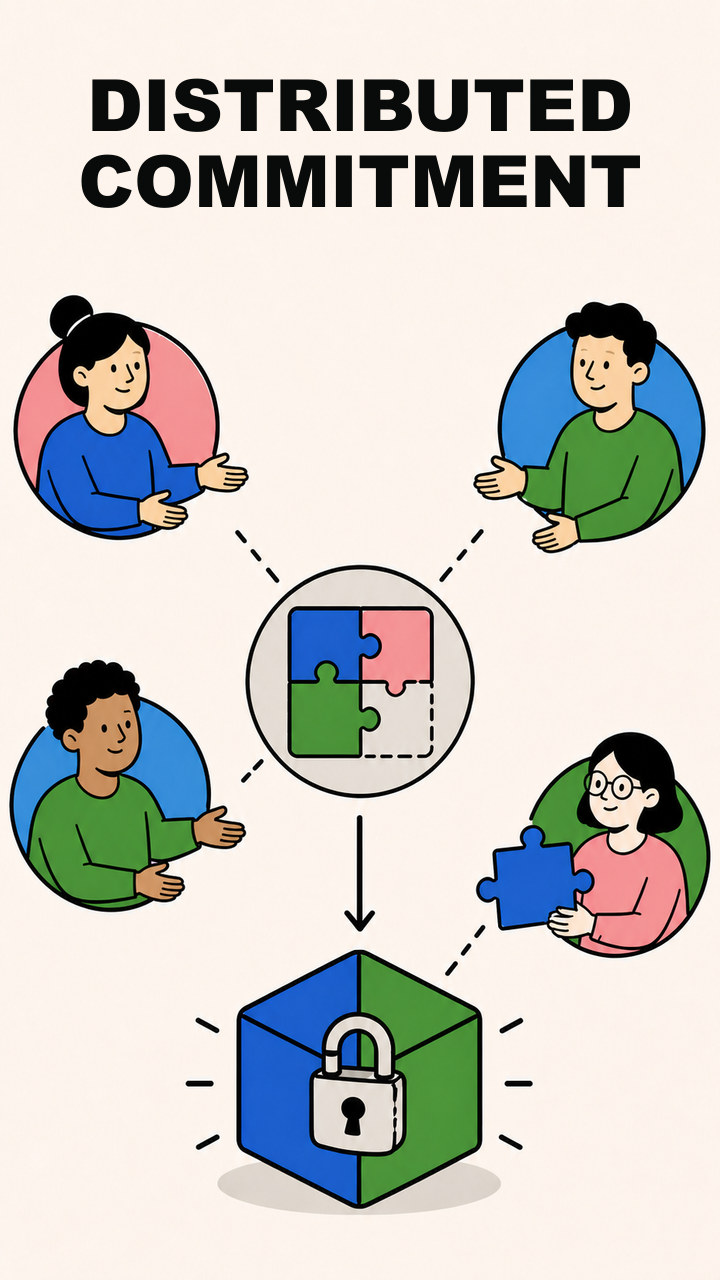
Distributed commitment is a change that only becomes real when several independent parties each act on it. Each one has to accept it, switch to it, sign it, publish it, or fund it — and until they all do, the old and new arrangements exist side by side.
- Review state
- Reviewed in POC
- Freshness
- Current
- Version
- 3
- Distributed Commitment
Remember it this wayThe change is real only when all required parties commit.
In plain language
No single participant can declare the transition complete. Several actors must independently accept, switch, sign, publish, fund, or otherwise commit before everyone can rely on the new state.
Why it matters
Treating one announcement as completion creates split states and hidden holdouts. The change needs observable commitments and a rule for partial completion.
Example
A shared data standard becomes operational only after producers publish the new format, consumers accept it, and the governing body activates the new version.
Common misconception
Distributed commitment is not simply collaboration. The new state depends on multiple commitments that no single actor can substitute for.
Related terms
Sources
- Jim Gray and Leslie Lamport, “Consensus on Transaction Commit”explains how a distributed transaction depends on the commit-or-abort decisions of its participants and coordinated agreement. This is a technical analogue for the mechanism behind the Renaissance Solutions term; the paper does not define organizational “Distributed Commitment.”
Learn more
- Distinguish from [[synchronization-cascade|Synchronization Cascade]] and use with [[state-transition-protocol|State Transition Protocol]].
Public history
25 recorded events · 25 public summaries
A potential shared concept was discussed and selected for initial glossary drafting.
The captured candidate received a complete initial draft and entered section-level human review.
Radar reviewed the initial definition draft for human consideration.
Radar reviewed the initial plain-language-explanation draft for human consideration.
Radar reviewed the initial why-it-matters draft for human consideration.
Radar reviewed the initial example draft for human consideration.
Radar reviewed the initial common-misconception draft for human consideration.
Radar reviewed the initial remember-it-this-way draft for human consideration.
Radar reviewed the initial related-terms draft for human consideration.
Radar reviewed the initial sources draft for human consideration.
Radar reviewed the initial learn-more draft for human consideration.
A proposal was opened for section-level human review while preserving the current version.
A human reviewer opened a proposed revision while preserving the current approved or captured version.
definition approved by a human reviewer.
plain-language-explanation approved by a human reviewer.
why-it-matters approved by a human reviewer.
example approved by a human reviewer.
common-misconception approved by a human reviewer.
remember-it-this-way approved by a human reviewer.
related-terms approved by a human reviewer.
sources approved by a human reviewer.
learn-more approved by a human reviewer.
All section gates are approved; content version 1 is now a fully approved term.
Definition review recorded as replace.
Sources review recorded as approve-proposed.
Source: vault/Glossary/terms/distributed-commitment/term.md · sha256:1d6596aeae0ddbdceecd572f31c9fa5d906098d39af7275a79d497065dd12044 · Release: rs-glossary-glossary-team-poc-0.5.5-2026-09-02