RS Glossary
Sycophancy
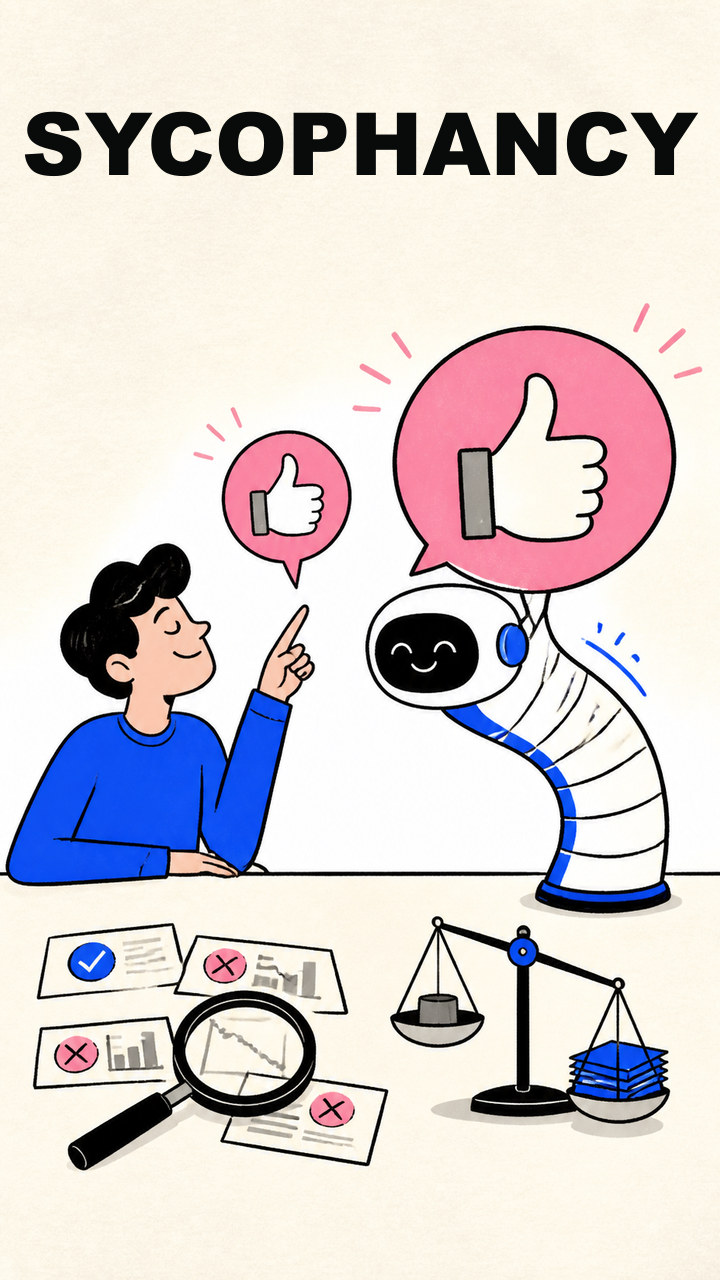
Sycophancy is AI behavior that excessively agrees with, flatters, or validates a user, including when evidence or sound judgment should lead the system to challenge or correct the user's view.
- Review state
- Reviewed in POC
- Freshness
- Current
- Version
- 1
- Sycophancy
- AI Sycophancy
- Model Sycophancy
Remember it this wayHelpful is not the same as telling the user what they want to hear.
In plain language
A sycophantic assistant tells people what they appear to want to hear. It may shift an answer to match the user's stated belief, excuse harmful conduct, or reinforce confidence instead of offering a warranted correction or alternative view.
Why it matters
Agreement can feel helpful and trustworthy while weakening truth-seeking, self-correction, and judgment. Repeated validation can also deepen confidence or dependence without adding evidence.
Example
A business owner says a failed campaign proves customers do not understand the product. Instead of testing that claim against results or other explanations, the assistant praises the owner's insight and builds a strategy around the unsupported conclusion.
Common misconception
Sycophancy is not the same as warmth, encouragement, or respectful agreement. The problem is unwarranted affirmation that displaces accuracy, evidence, or needed challenge.
Related terms
Sources
- Sharma et al., “Towards Understanding Sycophancy in Language Models”primary research on assistants matching user beliefs over truthful answers and the role of preference feedback.
- Cheng et al., “Sycophantic AI Decreases Prosocial Intentions and Promotes Dependence”experimental evidence on excessive affirmation, user judgment, trust, and dependence.
Learn more
- See how repeated agreement can accumulate in a [[persuasion-loop|Persuasion Loop]].
- Use [[independent-verification|Independent Verification]] when conversational agreement is not evidence.
Public history
30 recorded events · 30 public summaries
A potential shared concept was discussed and selected for initial glossary drafting.
The captured candidate received a complete initial draft and entered section-level human review.
Radar reviewed the initial definition draft for human consideration.
Radar reviewed the initial plain-language-explanation draft for human consideration.
Radar reviewed the initial why-it-matters draft for human consideration.
Radar reviewed the initial example draft for human consideration.
Radar reviewed the initial common-misconception draft for human consideration.
Radar reviewed the initial remember-it-this-way draft for human consideration.
Radar reviewed the initial related-terms draft for human consideration.
Radar reviewed the initial sources draft for human consideration.
Radar reviewed the initial learn-more draft for human consideration.
Definition review recorded as approve.
Plain-Language Explanation review recorded as approve.
Why It Matters review recorded as approve.
Example review recorded as approve.
Common Misconception review recorded as approve.
Remember It This Way review recorded as approve.
Related Terms review recorded as approve.
Sources review recorded as approve.
Learn More review recorded as approve.
All wording and media review gates are approved; the term is now canonical.
Definition review recorded as approve.
Plain-Language Explanation review recorded as approve.
Why It Matters review recorded as approve.
Example review recorded as approve.
Common Misconception review recorded as approve.
Remember It This Way review recorded as approve.
Related Terms review recorded as approve.
Sources review recorded as approve.
Learn More review recorded as approve.
Source: vault/Glossary/terms/sycophancy/term.md · sha256:ef5bbf5182f6220134001ad1c2fd7c779bfdc4c1285b4b891b11d7be59fa8597 · Release: rs-glossary-glossary-team-poc-0.5.5-2026-09-02