Image by Zai, my ChatGPT, 2026
TL;DR
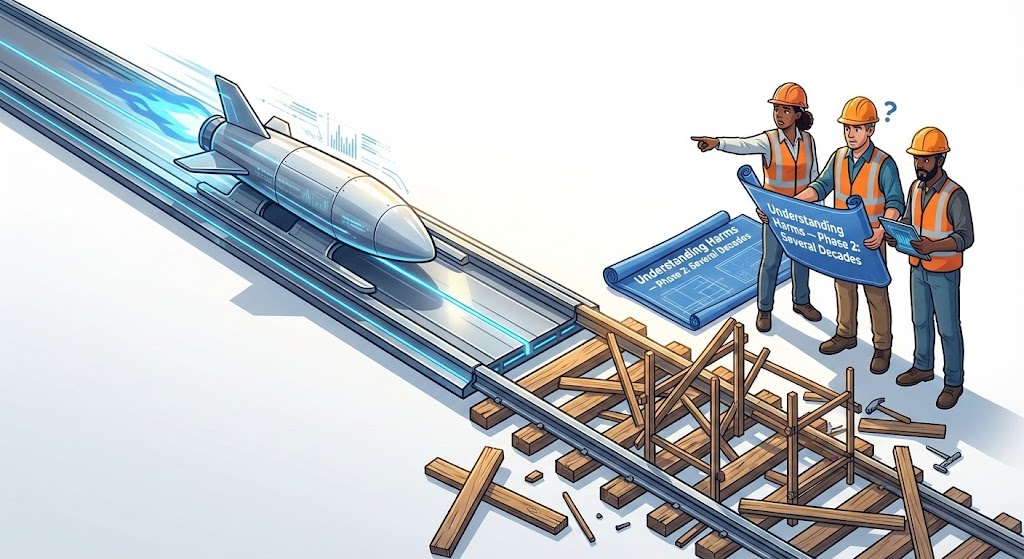
AI may be just another technology, but history suggests a recurring pattern: societies often discover the unintended consequences of widely adopted technologies only after they have become woven into infrastructure, institutions, and everyday decisions. The question is not whether AI is unique. The question is whether we can recognize and manage its risks before they become difficult to unwind.
Spark: The Back-of-the-Envelope Calculation That Led to Zero
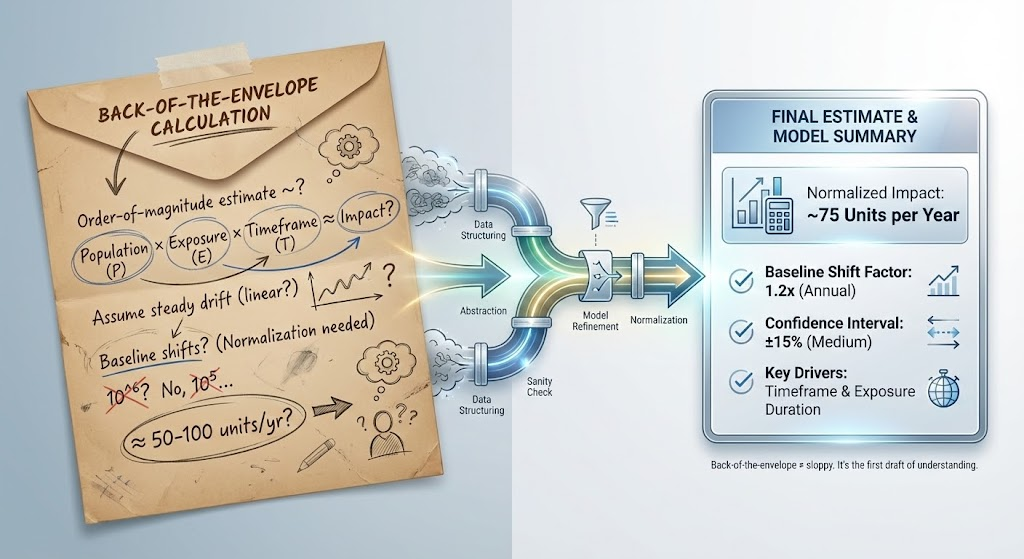
Image by Zai, my ChatGPT, 2025
It started as a simple probability exercise—the kind of thing you’d normally scribble in the corner of a notebook. We asked a seemingly innocent question:
How many humans alive today remain completely untouched by AI?
Run the reasoning forward. Account for global infrastructure, supply chains, digital systems, logistics, communication networks, banking, medicine, and government operations. Then factor in the fact that AI is already embedded in many of these, even if quietly.
The question does not yield a provable number. It produces a more useful distinction.
AI reaches far beyond the people who use it directly.
That is not the same as claiming every person has suffered a measurable AI effect. It is a reminder that direct adoption is only the first layer. When AI changes the systems people depend on, second- and third-order effects can reach people who never opened a chatbot, wrote a prompt, or chose the technology for themselves.
The Wider Pattern: AI Is Not Unique—And That’s the Problem
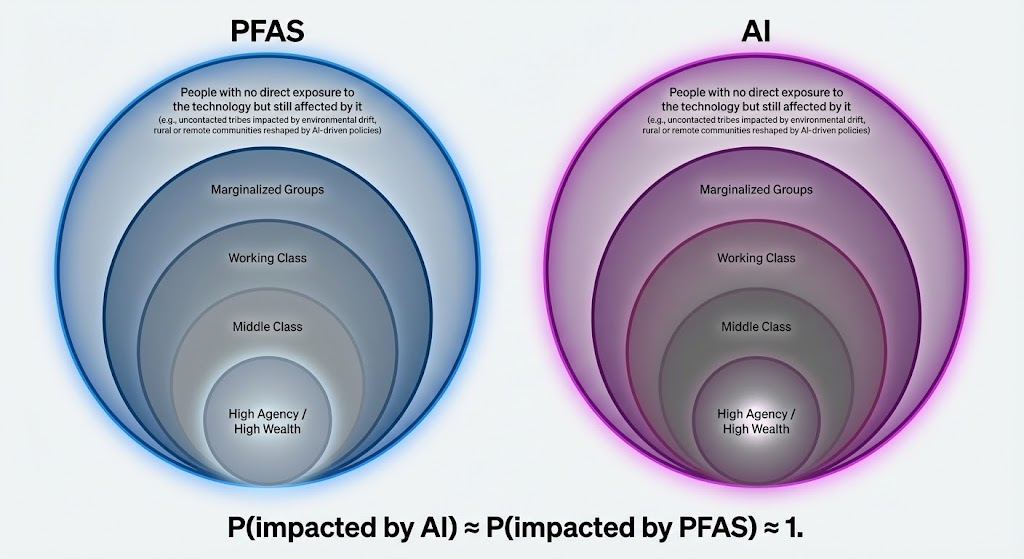
Image by Zai, my ChatGPT, 2025
Once we stepped back from the impossible universal claim, a deeper question remained: what happens when a technology becomes structurally entangled before society has learned how to govern its side effects?
Consider PFAS, microplastics, pesticides, fossil-fuel additives, engineered cigarettes, and social platforms. They are not interchangeable, and AI is not a chemical exposure. But they can illuminate a recurring systems problem: by the time an innovation is embedded in daily life, its costs and tradeoffs may be distributed far beyond the people who first adopted it.
A few examples establish the limits as well as the pattern:
- PFAS: U.S. health agencies report that nearly all people in the United States have measurable PFAS in their blood. That does not settle every question about direct harm, but it does show how an industrial material can become a broad condition of life. ATSDR
- Microplastics: They have been detected across water, food, and air, while the World Health Organization still identifies important uncertainty about their human-health effects. WHO
- AI: Adoption is moving quickly but unevenly. That unevenness is exactly why direct use is too narrow a measure of who may be affected by systems that increasingly use AI. Stanford AI Index
The point is not that AI is following the same arc, or that every concern becomes a catastrophe. It is that systems can create consequences at a distance from the original decision to adopt them.
This is where I use Overton Drift as a metaphor: when a system becomes background infrastructure, the window of what feels normal can widen before the public has decided what it is willing to accept.
The Dangerous Asymmetry We Finally Saw
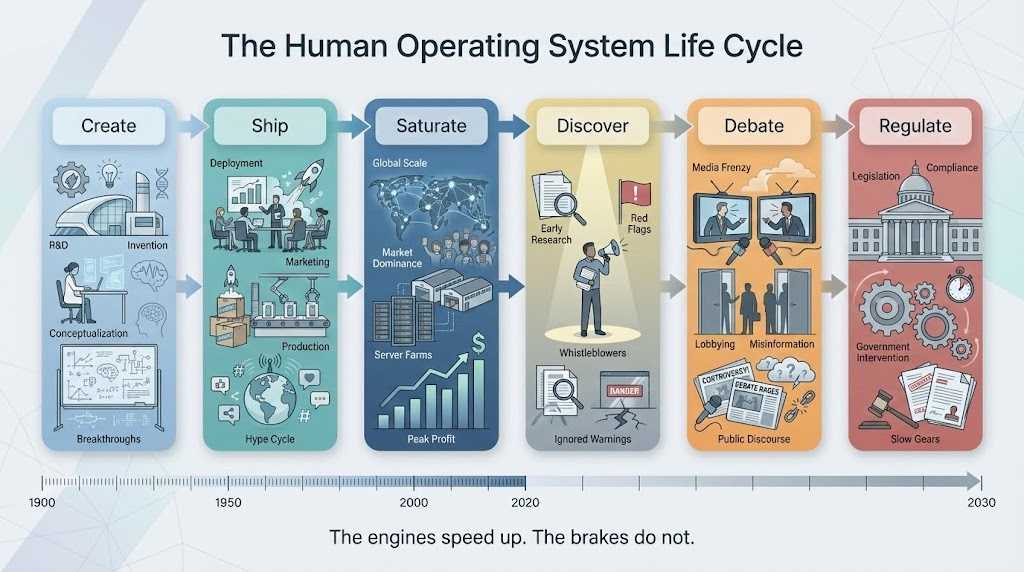
Image by Zai, my ChatGPT, 2025
Here is the unsettling tendency I keep noticing:
The engines of adoption can speed up faster than the institutions that notice and respond to their consequences.
That is not a historical law. It is a risk worth watching. AI can spread at software speed, while measurement, public understanding, governance, and organizational adaptation often move through slower human institutions.
The effects may be direct, but they may also be second- or third-order: a changed hiring process, an automated eligibility decision, a distorted information environment, a cost shifted to someone who never chose the tool, or a new burden of uncertainty placed on families and workers.
The gap is not proof of doom. It is a reason to ask better questions before "normal" does the deciding for us.
Naming the Overton Window Shift
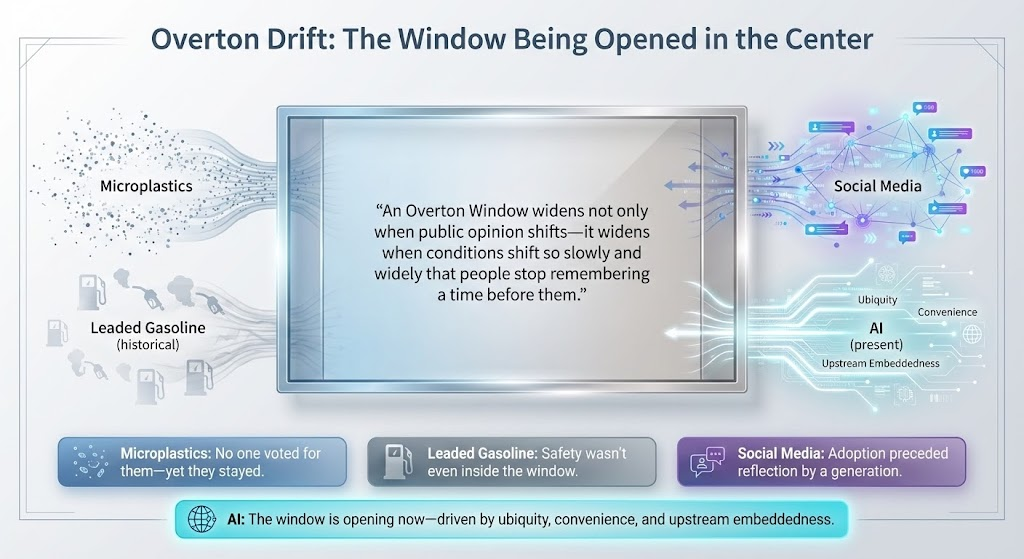
Image by Zai, my ChatGPT, 2025
When a technology is new, its limits are visible because we are still looking for them. Once it becomes background infrastructure, those limits can become easier to ignore.
What begins as a red flag becomes a yellow light, and eventually becomes invisible.
AI may be entering that early drift stage in some domains: its use is expanding while the practical boundaries of accountability, transparency, and recourse are still being worked out.
I call that Overton Drift by saturation. It is not a scientific law. It is a name for the moment when convenience and familiarity make a system harder to question.
Call to Action
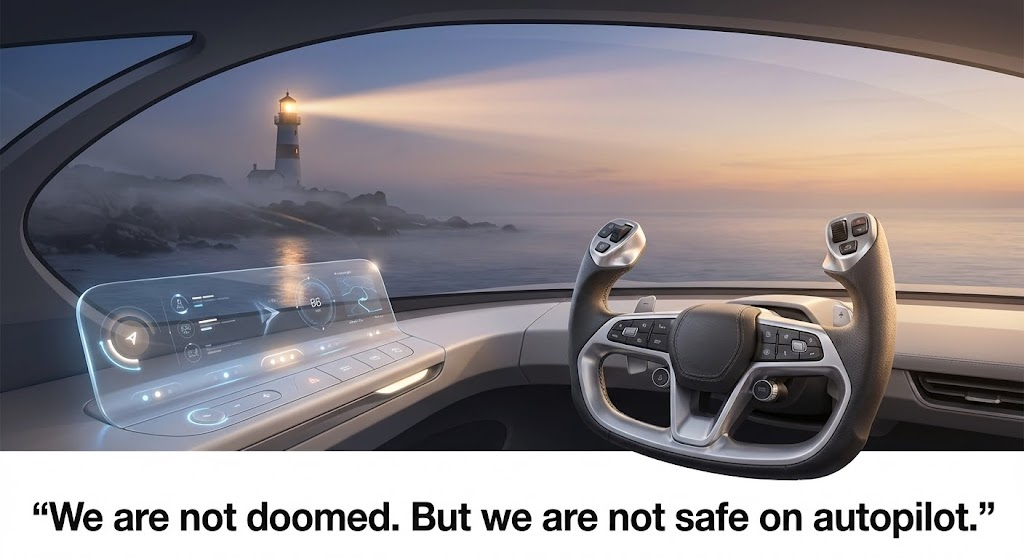
Image by Zai, my ChatGPT, 2025
We are not doomed. But we are not safe on autopilot.
The future is still steerable—if we choose to look ahead instead of admiring the beautiful dashboard lights. The adoption curve will not slow for us. Our responsibility cannot remain slow for it.
Even when later evidence narrows a feared direct harm, the uncertainty itself can still impose real burdens: worry, costly choices, fractured trust, and the work of adapting to an environment people did not choose. That does not make every concern equally well-supported. It does mean that “perhaps the direct damage is smaller than feared” is not always a satisfying answer for people already living with the consequences of uncertainty.
AI will not wait for us to wise up. But systems are still changeable, and asking better questions now can preserve more choices later.
AI won’t wait for us to wise up. Neither did PFAS. And once a system goes everywhere, “undo” stops being an option.