The box you never changed
Look at the search box on your phone. Did you pick the search engine behind it?
Most of us didn't. It came that way, and we kept it. That's a default: a choice someone made for you before you showed up. Often it's made by someone who earns money from what you pick.
We know this one was worth money because a federal court looked at it. In the US government's search case against Google, the judge examined the deal that made Google the default search engine in Safari. He found that Google's 2022 payment to Apple under that deal was "an estimated $20 billion." The judge also found that only 5.1% of searches on iPhones went to a search engine other than Google. And he found that Google used deals like this to unlawfully keep its search monopoly.1
Nobody pays that much for a setting people change. They pay because people keep it.
Personally, I used to accept defaults without thinking much about it. While that was over 20 years ago, my junk folder still fills up with recommendations triggered from these default settings.
Every default reflects someone's priorities. When the company setting it earns money from what you pick, its priorities and yours can drift apart. That isn't villainy. It's a reason to look.
Defaults were always for sale
Paid defaults are older than search engines.
Walk down a grocery aisle. Some of what sits at eye level got there because a supplier paid. The Federal Trade Commission (FTC) studied these "slotting allowances," one-time payments a supplier makes to get a new product onto a store's shelves. Most suppliers it surveyed said a national launch would cost $1.5 to $2 million in these fees.2
Or go back to 1984. Travel agents booked flights on computer systems owned by airlines, and the owner's flights tended to show up on the first screen. Other, possibly better flights had to be found in later searches. A spokesman for American Airlines' system told UPI that it showed the best routing on the first screen, but "we may list American first becasue [sic] that is our system." That year, federal regulators required a neutral display.3
So the honest comparison isn't "we used to choose freely, and now a machine chooses for us." We always had a shelf, and someone always arranged it. But we could see the shelf. We could look past the first screen, even if most of us didn't.
What changes when the default is the answer
Now picture a phone with fewer apps and one assistant you talk to. You say what you need, and it handles the rest.
That's no longer just a guess about the future. OpenAI lets people buy some products inside ChatGPT, and Google has announced an open standard for checkout inside its AI tools.45 Apple and Google announced in January that Google's Gemini would underpin Apple's next AI models, and Apple's new Siri AI began rolling out in beta in September.67 The assistant that comes with your phone can itself be a deal between two companies.
Here's where the default changes shape. A search page shows you a list. An assistant may show you one answer, or just ask, "Should I book it?"
Imagine I ask my assistant to find someone to make a weird sign for Renaissance Solutions. If I browse, I might stumble on an odd artist whose work changes what I want. The assistant might pick a reliable supplier, arrange a design, and ask me to approve. Both finish the job. Only one surprises me. And I can't ask for a surprise I don't know exists.
It helps to split "choice" into three things:
- Options that exist. There may be hundreds of sign makers.
- Options you see. Your assistant shows you three, or one.
- Options that get enough business to survive. The sign maker nobody gets shown may not last the year.
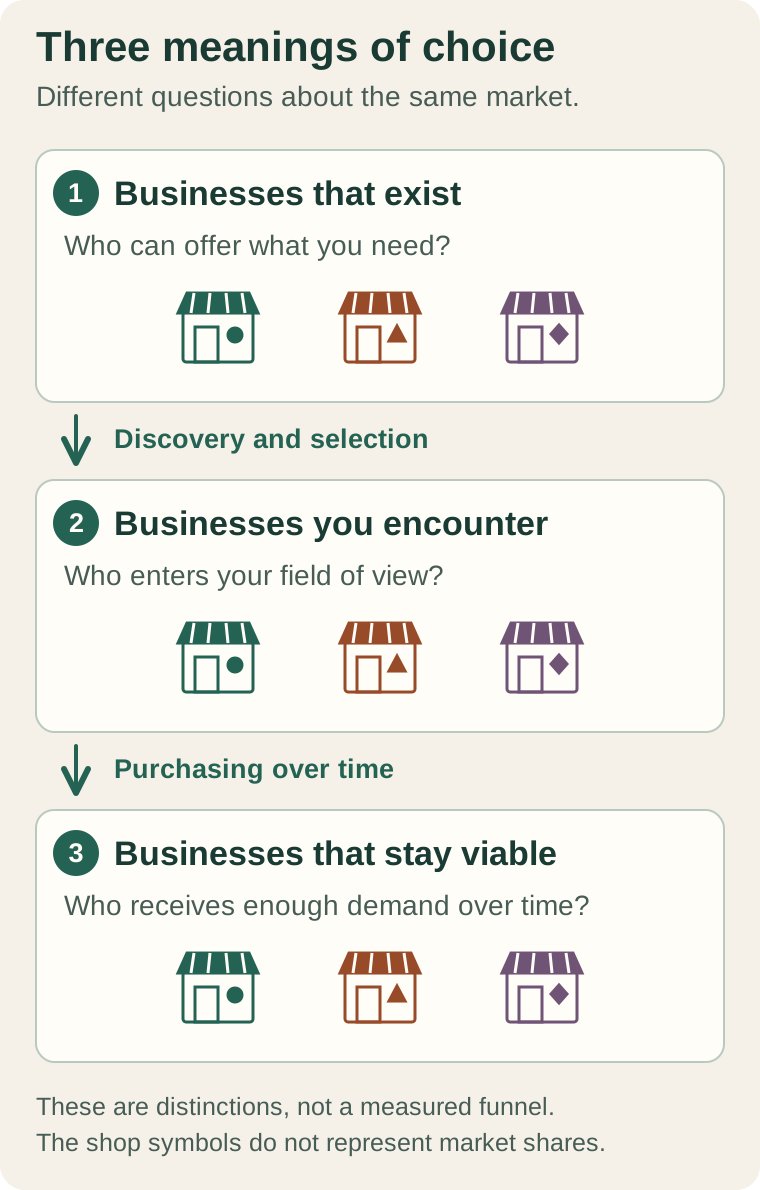
Existing, being encountered, and staying viable are three different things. Original conceptual diagram created with Codex for Renaissance Solutions; CC0.
AI can add to the options that exist while narrowing the ones you see. If it does, the options that survive narrow too, over time.
Here's how that could happen. A new sign maker opens shop. She's good, but she has few reviews and no special connection to the big assistants. The assistant, trying to avoid a bad experience, picks the shop with hundreds of reviews and a working checkout. That shop gets the order and one more good review. Next time, the gap is a little wider. The new sign maker never gets the first order that would let her prove herself. Eventually, she either reshapes her business around what the assistant wants to see, or she closes.
That's a plausible chain, not a forecast. And notice that no one in it is acting in bad faith. The OECD, a group of mostly wealthy countries that studies economic policy, makes the same point: rankings can tilt toward some sellers with no plan to shut anyone out ("even absent explicit exclusionary intent"), just because the system is tuned to keep people engaged or get them to buy.8
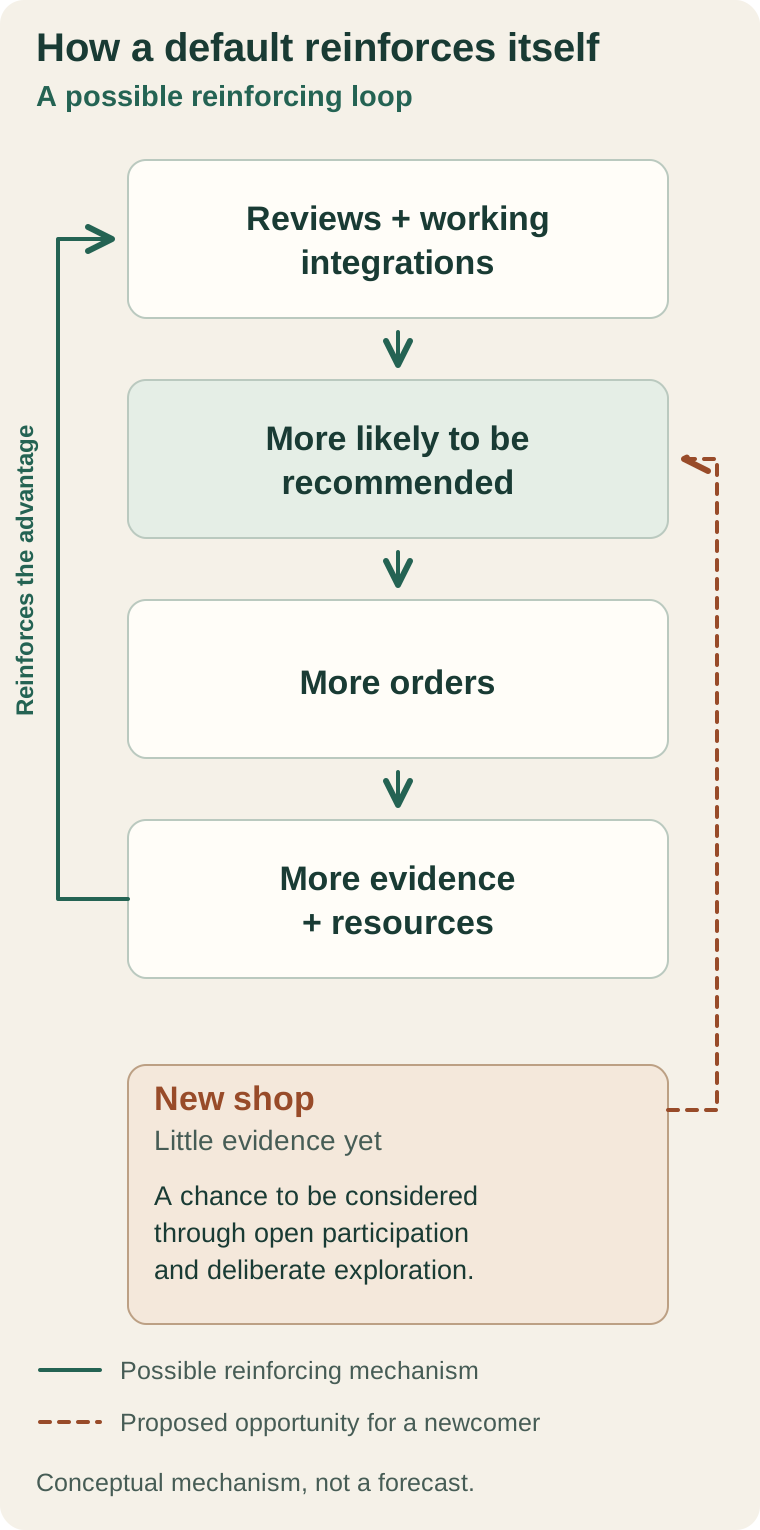
A system trying to reduce disappointment can reinforce the advantage of providers it already knows. This is a possible mechanism, not a forecast. Original conceptual diagram created with Codex for Renaissance Solutions; CC0.
Who sets the default, and why
Someone builds the assistant, and they need to make money. That's not a dark secret. It's printed in their own announcements.
Ads are coming into AI answers. Google says ads can appear "above, below or within" its AI Overviews, and it's testing ads that appear inside AI Mode's own lists of recommendations, labeled "Sponsored."910 OpenAI is testing ads in ChatGPT in the US for its free and lower-cost plans.11 Perplexity has run sponsored follow-up questions.12
Each company also makes a promise. OpenAI says, "Ads do not influence the answers ChatGPT gives you."11 Perplexity says its answers are "not written or edited by the brands."12 Google says these ad formats will be "clearly labeled."10
Those are promises worth taking seriously. They're also promises. We can't see inside the system to check them, and an assistant's own explanation of why it chose something isn't proof of how it chose.
Ads are only one channel. There are referral fees when you buy. There's steering you toward the company's own services, sometimes called self-preferencing. And there's the plain cost of joining: to be listed in these checkouts, a store usually needs a product feed and a technical connection.4 Big retailers have teams for that. A one-person shop may not, though some platforms, like Shopify, plug small sellers in automatically.
The setting isn't neutral just because it came first.
The opportunity is real
None of this means assistants are bad for small businesses or for us. The upside is real, and it's why this is worth getting right.
An assistant working for you could check obscure specialists you'd never find. It could compare more suppliers than you have time to read about. The OECD notes that AI can lower the cost of searching and widen choice.13 A small shop might not need its own app, or even much of a website, to be found.
There's also money in good discovery. People are likely to come back to a tool that keeps finding them the right thing, not just the familiar thing. So platforms have reasons to help choice, too.
The catch is that what's good for the market and what earns the most for one company this quarter don't line up on their own. A healthy market is a bit like a garden. Things don't take root just because the soil exists. Someone has to keep the space open.
What stays human
You might think the fix is simple: make people choose. Europe tried a version of that. Since 2024, big platforms there have had to show choice screens for browsers and search engines. One study of earlier rules that changed search defaults in Europe found that Google's search share fell by less than one percentage point.14
Asking once isn't the same as serving you. Most people keep the box the way they found it. That isn't laziness. It's what a busy person does.
So two things stay human, and both matter more when an assistant does the picking.
Knowing what you value. Local. Independent. Repairable. Cheapest. Someone you already trust. An assistant can't guess that well unless you tell it, and it can't keep honoring it unless the setting sticks.
Knowing what you agreed to. "Find me a plumber" isn't the same as "book a plumber." Looking, recommending, and buying are three different permissions. A court ruling this year put it bluntly in one case: an AI shopping assistant "is a tool, not a person for statutory purposes," and it's the user who acts through it.15 That ruling was narrow and about computer-access law, but it's a useful way to think about it: when your assistant buys something, you're the one buying.
And one phrase is worth keeping close: "best among those checked." That's honest. "Best" is a different claim.
What you can do today
You don't need to be an engineer for any of these. Each starts with a plain question.
- Can I see what it checked? Ask your assistant which options it looked at before it recommended one. Notice when the answer is "one."
- Did anyone pay to be here? Look for "Sponsored" labels in AI answers. When you're about to buy, ask whether a deal or fee is involved.
- Can I change the settings? Open your assistant's settings and find one default you didn't choose. Change it, or decide on purpose to keep it.
- Can I tell it what I care about, once? If your assistant has a place for saved preferences or instructions, write down what matters to you, such as local or repairable.
- Can I still browse? Keep a way to look around yourself, like maps, directories, or a shop's own site. And keep direct relationships with businesses you like, so the assistant isn't the only door.
For the people building the next operating system, the same questions become five asks. Let me pick my assistant. Show me paid influence. Show me what you considered. Let me take my records and leave, which is what people mean by portability. And let a small business be found without a special deal.
Keep the door open
The default isn't the enemy. Good defaults save us time every day, and most of us want an assistant that just handles things.
But a default is always someone's choice. As assistants become the main way into the marketplace, that choice gets bigger, quieter, and easier to miss.
The goal is simple to say: make everyday tasks easier, while keeping the marketplace open to the next person with a good idea. A flourishing market needs more than an efficient checkout. It needs room for something new to take root.
Appendix: A First Brainstorm for the Next Operating System
Meant to start discussion, not settle it. These are ideas, not tested requirements.
- Assistant choice. You could swap out the assistant that came with the device, or use more than one, with the same access as long as each meets the same security rules.
- Open participation. Businesses could connect through public, interoperable interfaces (meaning they work with other companies' tools), without needing a custom partnership.
- Eligibility separate from paid promotion. Safety and competence decide who gets considered. Paid placement is disclosed and never quietly required. (In 1984, the airline display rule still let system owners exclude airlines that refused to pay to be included. One board member dissented that this "threatens to undermine, if not overwhelm" the rule against bias.3)
- Visible commercial influence. Referral fees, sponsorships, ownership, and preferred-provider deals are disclosed when they affect what you see.
- Inspectable selection. You can see which providers were checked, what criteria were used, and where the gaps are. "Best among those checked," backed by records, not just the model's own explanation.
- Exploration beyond chat. Browsing, maps, directories, and comparisons stay available, so you don't have to know exactly what to ask for.
- Your priorities, saved. Lasting, editable preferences for things like local, independent ownership, repairability, accessibility, cost, and existing relationships.
- Practical portability. You can export your preferences, records, and workflows, and switching doesn't cost a fortune in time or data.
- Direct relationships. You can still talk to and buy from a business directly, so the intermediary (the middleman) isn't a toll booth on every future visit.
- Accountability and appeal. Businesses can learn why they were left out, fix wrong records, and appeal before exclusion sinks them. Outsiders can test how the system behaves.
One idea runs through all ten: separate permission to research, to recommend, and to buy.
Competition agencies in the US, UK, and EU have named some of the same worries, including "mechanisms of lock-in that could prevent companies or individuals from being able to meaningfully seek or choose other options."16
Footnotes
-
United States v. Google LLC, Memorandum Opinion (D.D.C., Aug. 5, 2024) (Mehta, J.), findings 296 and 299. https://www.courtlistener.com/opinion/9418219/united-states-of-america-v-google-llc/ ↩
-
Federal Trade Commission, "Slotting Allowances in the Retail Grocery Industry," staff report, Nov. 14, 2003. Small sample; may not be representative. https://www.ftc.gov/reports/use-slotting-allowances-retail-grocery-industry ↩
-
Jack Lesar, "In a move that could save travelers millions and…," UPI, July 30, 1984. https://www.upi.com/Archives/1984/07/30/In-a-move-that-could-save-travelers-millions-and/8206800004450/ ↩ ↩2
-
- OpenAI, "Buy it in ChatGPT," Sept. 29, 2025, https://openai.com/index/buy-it-in-chatgpt/
- "Powering Product Discovery in ChatGPT," March 24, 2026, https://openai.com/index/powering-product-discovery-in-chatgpt/
-
Vidhya Srinivasan, Google, blog post announcing the Universal Commerce Protocol for agent checkout, Jan. 11, 2026. https://blog.google/products/ads-commerce/agentic-commerce-ai-tools-protocol-retailers-platforms/ ↩
-
Google and Apple, "Joint statement from Google and Apple," Jan. 12, 2026. https://blog.google/company-news/inside-google/company-announcements/joint-statement-google-apple/ ↩
-
Apple Newsroom, announcement of Siri AI rolling out in beta, Sept. 14, 2026. https://www.apple.com/newsroom/2026/09/siri-ai-a-profoundly-more-capable-and-personal-assistant-is-here/ ↩
-
OECD, Artificial Intelligence and Competitive Dynamics in Downstream Markets, "AI-related competition concerns," Nov. 14, 2025. https://www.oecd.org/en/publications/artificial-intelligence-and-competitive-dynamics-in-downstream-markets_ccf0624a-en/full-report/component-6.html ↩
-
Google Ads Help, page on ads in AI Overviews. https://support.google.com/google-ads/answer/16297775 (accessed Oct. 24, 2026) ↩
-
Google, Google Marketing Live announcement on search ads, May 20, 2026. https://blog.google/products/ads-commerce/google-marketing-live-search-ads/ ↩ ↩2
-
OpenAI, "Our approach to advertising and expanding access," Jan. 16, 2026. https://openai.com/index/our-approach-to-advertising-and-expanding-access/ ↩ ↩2
-
Perplexity, "Why we're experimenting with advertising," Nov. 2024. https://www.perplexity.ai/hub/blog/why-we-re-experimenting-with-advertising ↩ ↩2
-
OECD, Artificial Intelligence and Competitive Dynamics in Downstream Markets, executive summary, Nov. 14, 2025. https://www.oecd.org/en/publications/artificial-intelligence-and-competitive-dynamics-in-downstream-markets_ccf0624a-en/full-report/component-3.html ↩
-
Decarolis, Li, and Paternollo, American Economic Journal: Microeconomics, Aug. 2025. Result is for the European Economic Area (EEA); effects were larger in Russia and Turkey, where remedies were designed differently. https://www.aeaweb.org/articles?id=10.1257%2Fmic.20230193 ↩
-
Amazon v. Perplexity, No. 26-1444 (9th Cir. Aug. 4, 2026), p. 15. A preliminary-injunction ruling under the Computer Fraud and Abuse Act; the court said it does "not establish a new legal regime governing agentic AI" (p. 17). https://cdn.ca9.uscourts.gov/datastore/opinions/2026/08/04/26-1444.pdf ↩
-
European Commission, UK Competition and Markets Authority, US Department of Justice, and US Federal Trade Commission, "Joint Statement on Competition in Generative AI Foundation Models and AI Products," July 23, 2024. https://www.gov.uk/government/publications/joint-statement-on-competition-in-generative-ai-foundation-models-and-ai-products/joint-statement-on-competition-in-generative-ai-foundation-models-and-ai-products ↩