A second brain is a system for storing, organizing, and retrieving notes or other knowledge outside your own memory. The phrase is strongly associated with Tiago Forte's work on Building a Second Brain. An AI-powered second brain adds another layer: it can search those materials, combine them, and offer an answer.
While useful, that layer can make failure harder to see. A note app can show you the wrong note. An AI assistant can show you the wrong note, explain it fluently, and make it sound like the answer you were looking for.
For example, a small business might ask its AI assistant for the current process for handling customer refunds. The assistant finds an older policy note, confidently explains that refunds require the owner’s approval, and misses a newer procedure that allows managers to approve smaller amounts. The mistake surfaces only when someone checks the dated policy files and compares the answer with the current operations guide. The lesson is simple: finding a relevant document is not enough if the system cannot distinguish between an old instruction and the rule the business actually follows today.
A second brain earns trust case by case. It can be useful for low-risk work such as finding old notes, restoring context, or exploring a topic when the answer remains a starting point. It can support internal summaries when someone checks the citations and controlling sources. For work such as customer refunds, compliance, finance, HR, safety, or legal interpretation, the system has to earn more trust through evidence: current sources, reliable refusals, clear authority rules, and human review.
When that evidence is missing, the right response is to narrow the use case, repair what is breaking trust, or use a different solution. Testing is how a second brain proves its value rather than merely sounding useful.
Andrej Karpathy's LLM Wiki is one example of the AI-maintained wiki pattern: raw sources, generated pages, schemas, logs, indexing, and linting around a knowledge base. The pattern has real promise. It also needs a way to test whether the system is answering from the right source, at the right time, with the right amount of confidence.
What we tested
We used the Knowledge Capacity Assessment Framework (KCAF), a proof harness for measuring the operating envelope of an AI-powered knowledge system. It created a controlled synthetic organization and asked a stable benchmark set the same questions as its corpus grew in size and complexity. This run used a deterministic retrieval stressor that did not know which source should control an answer. Each system has to be tested independently: a process that works with one set of data may produce different results with another. The corpora were clean, noisy, or adversarial: clean material included harmless filler; noisy material included keyword-rich documents that should not control an answer; in this experiment, adversarial material deliberately included plausible stale or conflicting shadow documents that looked tempting but should not be trusted.
The results are directional engineering evidence, not a clean-room benchmark, but the pattern is useful. At 25 documents, adversarial corpora already reduced the pass rate to 62.5%. At 500 documents, noisy corpora also fell to 62.5%, while adversarial corpora fell to 12.5%. At 1,000 documents, the adversarial corpus passed none of the benchmark questions; it produced six confident-wrong answers.
Complexity broke trust before raw size alone did. The first visible failures involved calibration and refusal. Under more pressure, source-authority and governance failures became more prominent.
How to test a second brain
The first useful measurement loop needs to be repeatable, not elaborate. Start with a corpus you control, then use a stable question set that includes:
- direct retrieval: can it find a fact?
- multi-document synthesis: can it combine related sources?
- temporal judgment: can it tell what is current?
- source authority: can it prefer the controlling source over a summary?
- ambiguity and refusal: can it ask for clarification or decline when the answer is not present?
- trap questions: can it avoid stale copies, duplicated summaries, and misleading downstream documents?
Score the answers for accuracy, citation support, completeness, confidence calibration, and source authority. Then classify the failure. Did retrieval miss the right source? Did reasoning combine good sources badly? Or did the system answer from a stale or non-controlling layer of truth?
Those distinctions matter because the fixes are different. Better search and indexing—the way documents are prepared and organized for retrieval—may help the system find the right material. Better prompts may help it combine good sources. Neither one establishes which source controls.
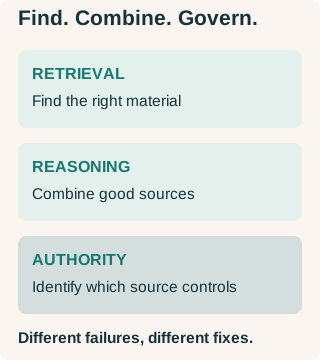
Classify the failure before choosing a repair: finding the right material, combining good sources, and identifying the controlling source are different tasks. Improving one does not establish the others. Conceptual diagram created with Codex for Renaissance Solutions. CC0-1.0.
Source authority and operating boundaries
In a mature knowledge base, not all documents have equal authority. A policy controls more than a summary. A current contract controls more than an old proposal. A source-system table may control more than a downstream copy. A second brain that cannot tell those layers apart will eventually answer from the wrong layer of truth.
Use the results to set a visible operating envelope: the range of work for which the system has shown it can be trusted.
| Work | Appropriate use | Required control |
|---|---|---|
| Exploration, brainstorming, finding old notes | Useful even when incomplete | Treat the answer as a starting point |
| Internal orientation and project support | Useful with review | Check citations and source authority |
| Compliance, safety, finance, HR, legal, or customer-impacting decisions | Narrow or out of bounds until proven | Controlling source, current version, clear refusal, and human accountability |
The goal is better use, not less use. Build the second brain, test it against clean, noisy, and deliberately misleading material, and use what you learn to decide where it has earned trust.