The Spark
I keep hearing that GenAI is not just doing math, it is changing how math is done. At least that is the hype that they algorithm keeps feeding me. But for the last few years, we have been told that GenAI cannot even count the r's in strawberry. So, I did some research and learned that the answer is complicated and depends on what math we are talking about.
The Answer (Spoiler Alert)
Yes. You can trust AI-assisted analytics — not because a chat window suddenly became a calculator, but because sophisticated analysis is more accessible. You still need to know how the number was produced before you trust it, though.
One of the biggest challenges today is the imprecise words that we use. If we need a return rate, a margin, a cohort number, a chatbot answers fast. Relief arrives. Then a quieter question: how did we get that number?
What was true before
Business math always split meaning from calculation. Define the metric. Run the formula. Tell the story. Spreadsheets and business dashboards already owned the middle.
People still mixed them up. Wrong definition, perfect arithmetic. Right definition, fat-fingered formula. Before GenAI, the calculator was separate from the narrator. After, they share one chat window — so the split is easy to miss.
What GenAI changes
The assistant can sound like it calculated when it reasoned. Or it can actually call a tool and calculate. That is progress. It also raises the value of clear definitions, numerical provenance, and judgment. Not fear. Right-tool literacy.
Meaning, then calculation, then interpretation
Three jobs, often in one conversation:
- Meaning — What question are we answering? What does the metric mean? What’s ambiguous?
- Calculation — Deterministic compute for consequential numbers: same inputs give the same answer every time (code, SQL, a sheet, a calculator).
- Interpretation — What does the result mean for the decision? Caveats? Next questions?
In practice: the LLM helps with meaning, a tool does the consequential math, then the LLM helps tell the story. Same chat is fine when the middle step is real compute you can inspect.
Arithmetic isn’t the only business risk
Sometimes the same words can mean more than one thing (semantic ambiguity). “Highest return rate” — dollars returned, units returned, or transactions returned?
Flawless arithmetic on the wrong definition still fails the business. Deterministic tools protect the calculation layer. They don’t decide what the business means. That stays human.
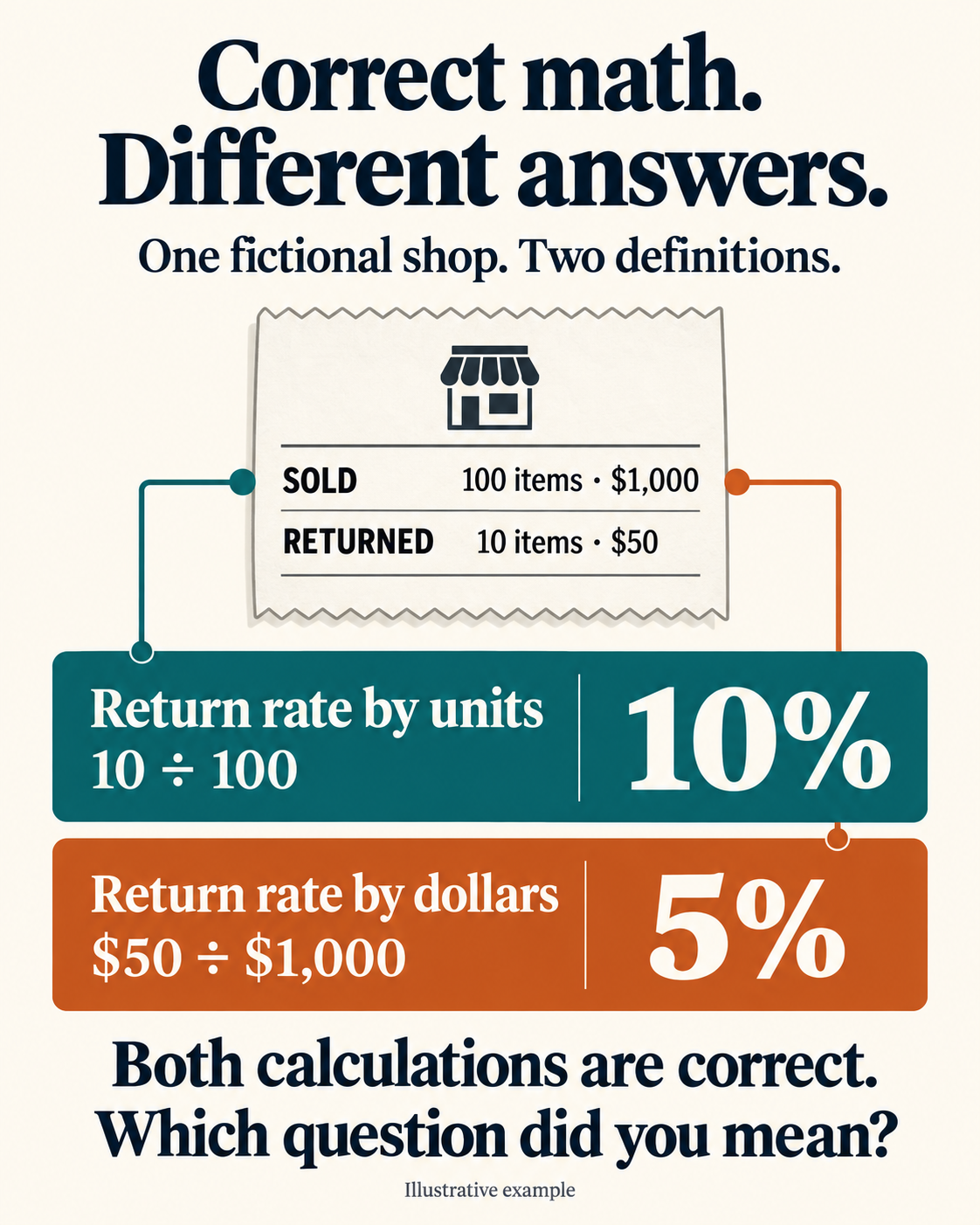
Illustrative example: a fictional shop sold 100 items for $1,000. Of those sales, 10 items worth $50 were returned. By units: 10 ÷ 100 = 10%. By dollars: $50 ÷ $1,000 = 5%. Both calculations are correct; the definition determines which answers your question. Infographic created with OpenAI image generation.
Numerical provenance
Numerical provenance is the path from source to the number you act on: source, then definition, then any transformation, then calculation, then the result, then interpretation.
One-line test of whether that path is reproducible: Could someone get the same number tomorrow without asking the LLM to reason a fresh answer?
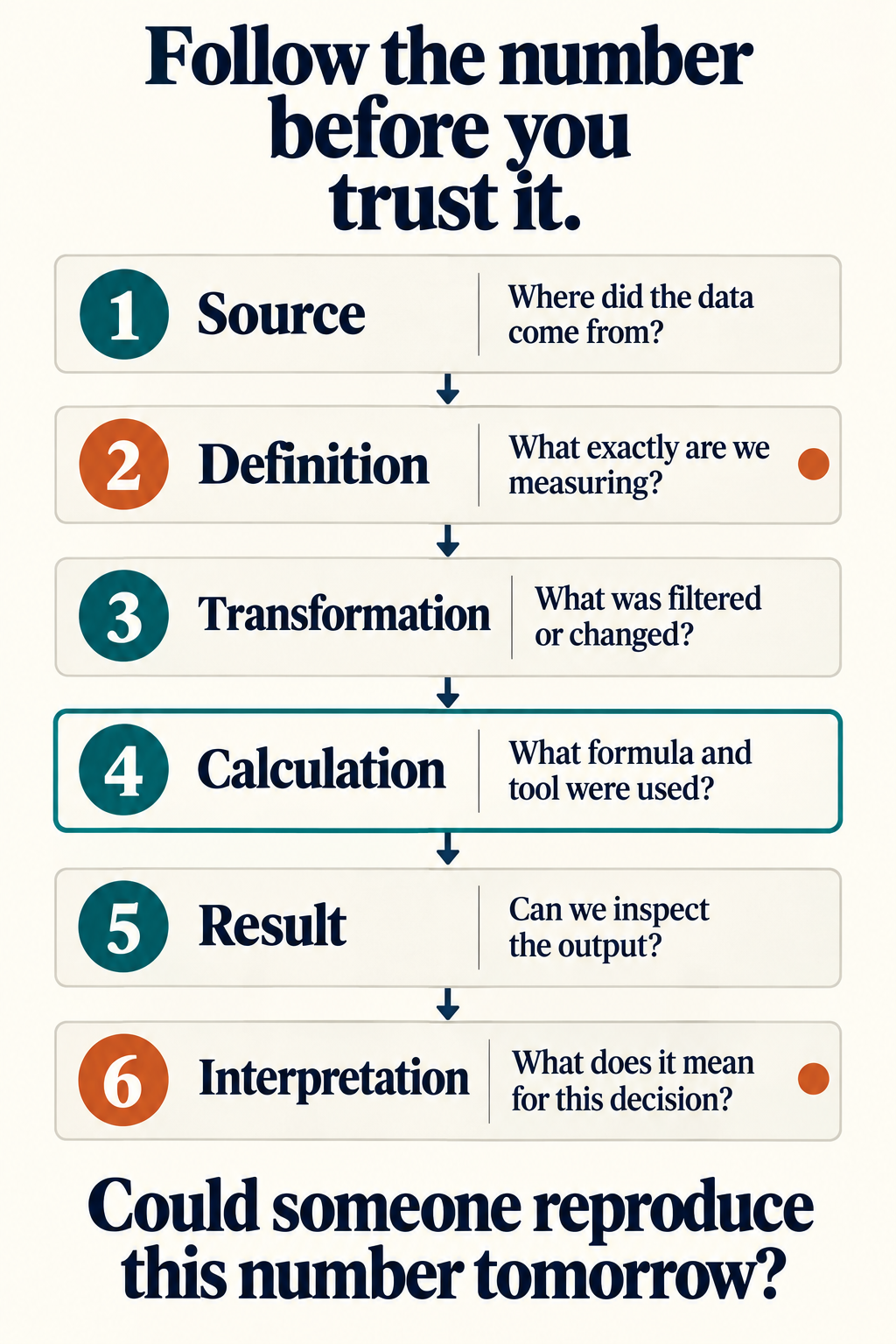
Follow the number: Source — where did the data come from? Definition — what exactly are we measuring? Transformation — what was filtered or changed? Calculation — what formula and tool were used? Result — can we inspect the output? Interpretation — what does it mean for this decision? Human judgment defines the metric and informs the decision; the calculation must be inspectable. Infographic created with OpenAI image generation.
Following along — without becoming a programmer
Major products already support this pattern. ChatGPT data analysis runs Python in a sandbox and asks you to review code, outputs, and assumptions.1 Claude can run code, build sheets with working formulas, and let you download artifacts to audit.2 Gemini’s code-execution path returns the code and the run result as separate, inspectable pieces.3
You don’t need to become a programmer. Ask the assistant to expose a short checklist, scaled to the stakes:
- Metric definitions
- Assumptions and ambiguities
- Sources and exclusions
- Formula
- Tool used
- Intermediate totals
- Code, query, or workbook when useful
“I don’t know Python” is not a blocker. The human role is still: define the question, resolve ambiguity, follow the logic, check sources, decide if the evidence is enough.
What stays human
Judgment about meaning, stakes, and “good enough.” Choosing when a back-of-envelope chat number is fine versus when you need a reproducible path. No shame for either. Match tool depth to consequence.
Three practical moves
- Ask how, not only what. “How was this number produced?” before you act on it.
- Split the job on purpose. Meaning and story with the LLM; consequential math with a tool you can inspect.
- Scale inspection to stakes. A $10 curiosity and a $100k decision need different depth of definitions, intermediates, and reproducibility. (Illustrative stakes — not a case study.)
Optional experiment (homework)
Take the same fictional dataset (your choice), two modes:
- calculate in chat;
- define the metric, run a tool, show intermediates.
Close
AI is making sophisticated analytics more accessible. That makes following the number — and owning the meaning — more valuable, not less. Trust a workflow that produces a number with a path you can check.
Footnotes
-
ChatGPT data analysis — review code, outputs, and assumptions:
- https://help.openai.com/en/articles/8437071-data-analysis-with-chatgpt
- API Code Interpreter: https://developers.openai.com/api/docs/guides/tools-code-interpreter
-
Claude file creation / code execution (updated Aug 6, 2026):
- https://support.claude.com/en/articles/12111783-create-and-edit-files-with-claude
- API: https://platform.claude.com/docs/en/agents-and-tools/tool-use/code-execution-tool
-
Gemini code execution — inspectable code + result:
↩