Hardly a day goes by that the algorithm does not share another Stephen King-like Mangler story from the tech or business world. A system sees a word, a label, a filename, a category, or a token. It decides that the signal means something. Then it acts.
At human speed, someone may notice the mistake and ask a question. At machine speed, a thin interpretation can reach a billing rule, an access-control decision, a production tool, or a customer record before anyone has time to stop it.
I saw this in my own work while testing an AI “second brain” built from years of code, documentation, and data definitions. The signal was a downstream table named Assignment. The system interpreted that name as evidence that the table was the primary home of assignment data, even though the authoritative records originated elsewhere and the downstream table existed for a narrower reporting purpose.
Because the answer was fluent and cited real system objects, it briefly gained more authority than it deserved. Had someone used it without tracing the lineage, they could have designed a change, investigation, or validation process around the wrong table. We caught the problem during testing, compared the answer with the actual data flow, and revised the documentation and evaluation prompts to distinguish clearly between authoritative sources and convenient downstream representations.
This incident does not show that an AI system will always choose the most obvious label. It shows that, in this case, a semantically persuasive name was enough to pull the answer away from the system’s actual structure.
What semantic debt is
Technical debt comes from shortcuts in code or architecture. Data-quality debt comes from incomplete, inaccurate, or poorly governed data. Semantic debt is the accumulated risk created when people encode shallow or brittle meanings into a system, then let the system act as if those meanings are complete.
A filename becomes evidence. A keyword becomes policy. A label becomes identity. A classifier score becomes authority.
The signal may be real. The mistake is treating it as sufficient.
Follow the chain
The useful way to inspect semantic debt is to follow a decision from signal to consequence:
- Signal: What did the system detect—a word, filename, label, score, or pattern?
- Meaning: What did people decide that signal meant?
- Authority: What permission, route, or consequence did that interpretation unlock?
- Action: What happened automatically or became easy to approve?
- Visibility: Could an operator or affected person see the decision path?
- Recovery: Could the action be reversed, corrected, appealed, or replayed?
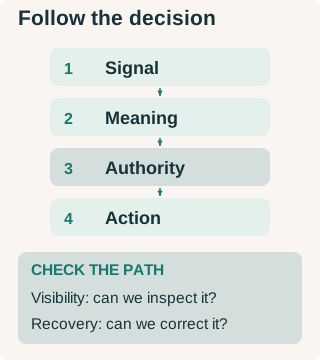
Inspect the path from signal through meaning and authority to action. Then ask whether the path is visible and whether its consequences can be corrected. These are review questions, not measurements of an incident. Conceptual diagram created with Codex for Renaissance Solutions. CC0-1.0.
The chain matters because a weak signal can be harmless at the beginning and consequential at the end. A keyword may be enough to suggest a review. It is rarely enough to justify billing, blocking, deletion, suspension, or a production change. Continuing the earlier example:
-
Signal: The system encountered a downstream table named
Assignment, along with code and documentation showing that it contained assignment-related data. -
Meaning: It interpreted the table name as evidence that this was the primary or authoritative source for assignments, rather than a narrower reporting representation.
-
Authority: That interpretation became more credible because the answer referred to real objects in the system and presented the conclusion confidently. The label was allowed to stand in for verified lineage.
-
Action: No production change was made, because this occurred during testing. But an unchecked answer could have led someone to build a query, validation rule, integration, or system change around the wrong table.
-
Visibility: The reasoning path was only partly visible. The system could cite the table and related artifacts, but it did not make clear that it had inferred authority from the table’s name and apparent relevance rather than confirming the direction of the data flow.
-
Recovery: We corrected the answer by tracing the lineage back through the code and documentation. A source-of-truth map, explicit authoritative-source metadata, or a required lineage check before recommending a system object would have stopped the interpretation from gaining too much authority.
Why speed changes the cost
Older systems had their own semantic traps. Reserved names such as CON, PRN, or NUL looked like ordinary filenames to people but meant something else to the operating system. The result was usually an odd error and a developer's lost afternoon.
Modern systems can connect a classification to a larger consequence. A brittle category can route a customer into the wrong process. A mistaken inference can make a record inaccessible. A tool can discover an authority it should never have been allowed to use. Speed removes the small conversations that once caught some of those errors.
That does not make automation the villain. It makes the design of authority more important.
Put the controls where the consequence is
The stronger the consequence, the stronger the evidence and control should be.
| Consequence | Appropriate starting control |
|---|---|
| Suggest, tag, or sort | Make the signal and reason visible. |
| Queue, throttle, or prioritize | Provide review and a way to correct the classification. |
| Bill, block, delete, or suspend | Require stronger evidence, confirmation, explanation, and recovery. |
| Legal, employment, safety, or production action | Use bounded authority, human review, an audit trail, and a stop path. |
Ask the same questions before a consequential rule goes live: What signal did it use? What did it infer? What can that inference do? Who can see the reasoning? How is the action undone?
Weak signals may suggest. They should not punish.
The work ahead
Semantic debt is not a single bug class or a single vendor problem. It is a pattern: incomplete meaning becomes operational, then authority outruns the evidence behind it.
The remedy is less glamorous than another dashboard. Make meanings inspectable. Limit authority. Keep consequential decisions visible. Build a way to slow down, correct, and recover when a system finds a word and gets the world around it wrong.