Whenever you adopt new support software, it changes how your business operates, and AI is no different. Often, a new tool comes with an implementation phase where you’re plugging it into your pipelines and getting staff trained in its use. This phase also often comes with a few growing pains. How it manifests is unique for every company, but it’s inevitable that there will be a few fires to put out during the process.
These potential fires become much less nerve-wracking, however, once you know how to troubleshoot them, and learning how is easier than you might expect. AI may seem like a confusing new frontier, but it isn’t as foreign as you might think. A lot of unique “AI issues” are old problems in a new wrapper, and problem-solving skills you’ve learned in other situations still apply here.
So let’s talk about fires and how to solve them.
Categorizing Fires: Active, Smoldering, and Fuel
Let’s build our framework. You probably already know how this works on an instinctual level, but a formal lens will help you better understand what problems you’re encountering and how to fix them. You can break any problem into three categories:
-
Active fires are obvious problems that need to be addressed right now. They’re either preventing work, reducing the quality of that work, or creating friction for your team to perform that work. They’re also often specific events; they have clear inciting incidents and resolutions. In non-AI contexts, this could be anything from your software breaking down and giving you an error code to the many issues a customer service team fields daily when something goes wrong with your product.
-
Smoldering fires are slow-burn issues that cause damage over time. Often, these are structural problems: pipeline bottlenecks, inefficient or poorly documented processes, and the like. You may even be aware of these issues, but they can linger forever because there’s always day-to-day work to prioritize instead.
-
Fuel can be the hardest to diagnose. These are your potential problems, the landmines inherent to a process or technology that you just haven’t stepped on yet. They can sit in obscurity for months, even years, before you realize they’re an issue when you trigger them and they become an active fire. These can be as simple as your company’s pipeline breaking down when an important team member goes on vacation, or an obscure edge case with your product that nobody saw coming. That’s not the only reason they’re hard to notice; “fuel” problems can often be rooted in your own company’s assumptions and biases, and they don’t start blazing until you’re taught a painful lesson about why those assumptions are incorrect.
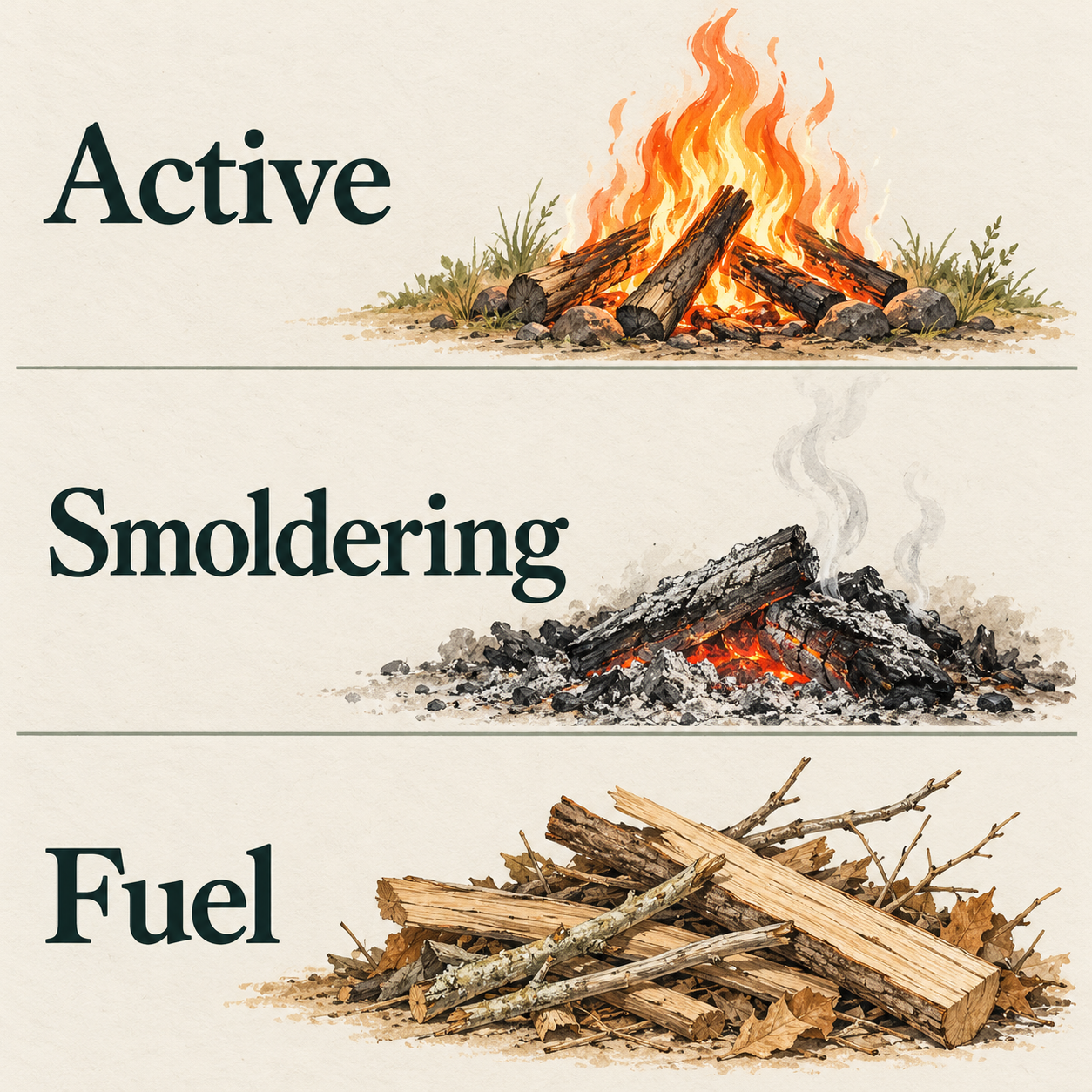
An active problem, a problem doing damage over time, and conditions that could become a problem call for different responses. AI-generated conceptual illustration created with Codex for Renaissance Solutions; CC0.
That’s how these problems often look in the abstract. Now let’s focus on AI-specific fires, both what they look like and how you can put them out.
Active Fires
AI active fires often involve situations where the AI has committed an error that has led to an immediate problem. Most often, this is caused by hallucinations or inaccuracies, in particular ones that made it past a human checker and all the way out to a customer. The how and why for these fires are self-explanatory.
Other examples of active fires can be as straightforward as security breaches and data exposures, or a systematic issue like an AI with an open-ended task and no limit on token usage producing a big bill overnight. The fire doesn’t even have to originate from the AI itself, such as when it’s fed incorrect data which it then uses to produce an incorrect result.
In all of these cases, the AI has done something you didn't want it to, and now there are immediate consequences to manage.
How To Handle Active AI Fires
When handling active fires, there are four steps to follow: contain, restore, investigate, and prevent. Based on the severity of the situation, you may not follow all four every time, but this is a starting point for approaching many problems, both AI-related and not.
Contain
The obvious first step is to put out the fire. What form your damage control takes is very context-dependent, but we’re not talking about solving the problem itself yet. Right now, all we are trying to do is stabilize the situation.
You have a few options in the short term. Like many software companies experiencing a critical bug, you could post a notice that you’re aware of an issue and are taking steps to solve it, and in the meantime, here is your best advice on how affected customers should proceed. If you have the means, you can have humans take over the affected task until you’ve fixed the problem. Human review isn’t just a great policy to catch these fires before a customer notices them; it also guarantees that someone will be available to step in and fix a critical issue if it does slip past the first time.
Restore
Once a fire has stabilized, it’s time to look at how to fix the problem.
What that looks like depends a lot on what started the fire in the first place, but the goal is to restore the situation back to what it was before the fire occurred. If a new model caused the AI to fail at tasks it once did just fine, the simple solution would be to go back to the older version. If it was a one-time error, you may be able to just fix the AI’s work and move on. If that same mistake keeps happening, it’s time to make deeper, structural changes.
Investigate
With the crisis behind you, it’s important to investigate what went wrong. After all, you don’t want it to happen again!
The first two steps were about treating symptoms, but investigating is about finding the root cause(s) behind them. You may have already found a lot of the information you need while seeking a solution in the restore phase, but it’s just as likely there will still be blanks to fill in about what went wrong. Even if the answer is obvious, this is still a good opportunity to relax after you’ve resolved the problem and organize your notes under more controlled circumstances.
It’s important not to skimp on this step. No two fires are the same, and your solutions need to be tailored to them, as well. You need this information to make educated, purposeful decisions in the next step.
Prevent
In an ideal situation, you would now be able to take what you learned from your investigation and establish policies to prevent a repeat of the situation.
If, as a hypothetical, your AI was having issues hallucinating incorrect information, there would be several possible ways you could approach the situation.
-
AI is a changing landscape, with new tools coming out all the time. If a particular model is giving you a specific problem, a competing product may not. Or, if you do some research, you may find a plug-in that does the hard work for you and adjusts your AI’s behavior.
-
Skills are important enough to earn a category all their own. These are, in effect, prompts you can pre-build to specialize your AI’s abilities towards a particular task. These help you construct AI pipelines for a specific industry and adjust its behavior for different tasks that call for different tactics. Tinkering with skills is one of the best ways to get your AI functioning how you want it to.
-
If your AI is having repeated difficulties with accuracy, you may be looking at a smoldering fire, instead. In these cases, it’s best to inspect the data it has access to and make sure it’s accurate. The root of your problems may very well be there. Even if the data is accurate, complex instructions may be interpreted in unexpected ways, especially when commands overlap and affect each other. In all cases, follow the thread of what broke and you’ll often find the cause somewhere earlier down the line.
-
You could attempt to train the AI. Sometimes, they can get stuck on an idea they’ve internalized and repeat it over and over. If the problem is the AI spreading the same piece of misinformation, it is possible to teach it to do better. It takes patient, repeated corrections, but you can adjust an AI’s behavior over time.
-
You could use an AI hosted on your server, rather than a generic model you got a subscription for. This would be the nuclear option, and would require a great deal of disruption and work to set up, to say nothing of the maintenance involved. I would not recommend this option for a small business, but it does have its benefits. This gives you far greater control over the data going into the AI, which in turn means better control over the answers coming out. It also has several security benefits if your company handles sensitive data.
-
You could decide that this is a task best automated through other methods. AI is not the end-all, be-all solution to everything, and you’re within your rights to decide it isn’t worth using. At that point, it’s time to open a new conversation investigating what alternatives you have.
Smoldering Fires
There are any number of ways a smoldering fire could develop. An AI’s work can drift in quality over time as it absorbs small inaccuracies, then magnifies them into larger issues by latching onto and repeating them. The information could also be accurate, but irrelevant or unhelpful. You can even encounter a feedback loop of AI and employees repeating the same bad information back and forth until everyone treats it like gospel.
You may also be familiar with the idea of “shadow AI” use, when individual employees get ahead of corporate policy and start using AI in their own work. In responsible hands, shadow AI usage can be benign, even helpful, but you’ve probably also heard about workslop, the slang people have adopted for when they have to clean up after a coworker’s shaky vibed-out work.
It can also be a hazard if you work in a field with strict compliance or legal restrictions. In these environments, random AI usage can introduce unwanted instability in a system that needs to be kept regimented for a reason. It's valuable to have an official policy for AI usage. Even if it’s a permissive one, just the act of setting expectations does a lot to mold behavior for comparatively little effort.
How To Handle Smoldering AI Fires
Handling smoldering fires is one part investigation and one part science experiment. The scientific method is, in general, a great framework for solving these problems. You start by making observations and recording what’s going wrong, then try to make a targeted fix addressing the problem you found, then observe how your solution affected the situation.
Observe
Once you become aware of a smoldering fire, it’s time to research it. You’ll find this process very similar to investigating an active fire, but systemic issues can make that process much more involved. Often, discovering one problem can reveal hints of another right underneath causing it. It’s important to keep following this chain and trace a systemic issue back to its root causes.
The more information you can gather during this process, the better. Not just anecdotal evidence from employee or customer complaints, but empirical evidence, as well. If the AI’s output quality is drifting, for example, it’s helpful to name the metrics that define “good quality” and find a way to measure them.
This is a particular priority with AI because it is so opaque. Just like the human brain, you can’t crack an AI open and start investigating why it made a particular decision. There are too many variables to isolate just one. You can, however, measure its output and track trends in its performance over time. As you go through the troubleshooting process, it’s useful to have a defined goal or statistics to measure whether your changes are improving the situation.
There are also a few basic concepts about how AI works to keep in mind when troubleshooting smoldering fires.
-
AI is probabilistic. Instead of working according to an established script like a traditional program, it uses probability to establish the best response for a given situation. This is necessary to help it navigate tasks that more structured programs can’t handle, but also means that its output won’t always be identical, even when the input is.
-
AI is always changing. Providers update how their models behave all the time, and those changes can cause noticeable differences in the end product’s performance.
-
AI is a long-term project. Most of the successful AI startups I’ve encountered didn’t see OpenAI hit the market and smash out a tool built on their models in a year. They started developing their AI a decade ago, and back then, their products were just as accident-prone as today’s leading LLMs. They spent all that time more or less bug fixing their product by treating each error one by one as they arose, and only now have their products reached maturity.
All of this means that it’s just as important to investigate the system around the AI and how it is interacting with those elements. Often, an AI doesn’t decide to just wake up in the morning and decide to hallucinate on purpose. Investigate how people are using it and what other tasks it’s performing, and you’ll often find some clear connections that explain its behavior.
Change
Often, fixing a smoldering fire can be as complex as investigating it. There are often several variables involved, and because the solution often involves changing something about how your company works, it can be disruptive to your day-to-day productivity.
Because of these traits, it’s best to take a measured approach to fixing smoldering fires, changing just one thing at a time. Changing everything at once not only introduces larger and more painful ripple effects, but muddies how individual changes are causing that disruption. Instead, you want to target one issue at a time and see how the system reacts.
So once you’ve finished observing, target the single biggest pain point you’re seeing and build an action plan to solve it. Every fire will require its own unique plan, so there is a limit to the general advice that can be given on executing this step. But if you’re not seeing a clear course of action, you may be trying to tackle too large a problem. Look at the problem’s individual elements and see if you can target those one at a time instead of trying to cut off every head of the hydra all at once.
Observe (Again)
Once you’ve made a change, it’s time to sit back and trust the scientific method. Assuming you only targeted one variable, taking note of how your business changes will tell you whether the fire’s still smoldering away or not.
Much like the scientific method, this process loops back into itself. Once you have a good idea of how your initial change has affected the business, you can decide on next steps.
If the problem appears solved, great! Mission accomplished. If the change improves conditions but there’s still more work to be done, then it’s time to look for the next pain point to solve. If things didn’t improve, well, science is imperfect; it’s time to dust yourself off and come up with the next plan.
Fuel
With AI, the biggest potential source of fuel is dependency.
This can be a vendor dependency. Companies tweak model behavior all the time, and in the cloud era, you don’t get much say on which way your software vendors drag you. AI moves faster than a lot of businesses do, and something that works today may not perform the same way in six months.
But just as often, this can be a dependency on a single AI. One AI can be loaded with too many or contradictory tasks. An AI can only do so much to differentiate between these tasks, and so the more you muddy its duties, the more often you’ll encounter errors.
Likewise, it’s easy for companies to depend too much on AI to perform its job independently of oversight. This can be a very tempting corner to cut, especially if the AI has been performing without issue so far, but a human must be kept in the loop at all times. Cutting out human review is just asking for trouble to come knocking.
That’s the fundamental concern with fuel: It’s not a problem today, but one day, it might be. And the day it picks may prove inconvenient.
How To Handle AI Fuel
The most important thing to remember with fuel is that you’re not trying to build a fireproof business. You’re never going to have the time and foresight to prevent every possible problem. The only way to guarantee you won’t ever encounter a fire is to just never do anything.
What you want to build instead is a robust set of firefighting policies. Instead of running from these potential problems, it’s more productive to ask what systems you can put in place to ensure that, whatever happens, you’ll have the tools to fix it.
Identify
As is the theme with all fires, this process starts with understanding what potential points of failure your company has.
It’s also important to consider what processes are most essential at your company, the parts of it that cannot, under any circumstances, experience an interruption. While it’s often impossible to make your entire company fireproof, it is more feasible to prioritize keeping the most important parts of it safe.
Restrict
Just like how a lot of public buildings install fire doors that slow the spread of a fire in the event one breaks out, you can establish firebreaks in your business.
The digital version of this is permission management. You can restrict the actions an AI can perform or the parts of the company it can access by managing what it’s allowed to handshake with.
If you handle particularly sensitive data, it might be prudent to restrict an AI to activities that don’t touch that information.
Another common-sense safeguard is to always keep a human in the loop. The earlier an AI gets caught, the less damage it can do. It’s a lot harder for an AI to cause problems if it has a manager policing it.
Prepare
A lot of IT best practices still hold true in the AI world. It’s prudent to have regular data backups, policies for restoring order after a data breach, and redundant systems in place in case one fails.
Test
After you’ve established all your firefighting processes, it’s prudent to have a fire drill. You really don’t want to discover that the emergency policies you established don’t work in the middle of a live fire scenario, or reach for your data backups one day, only to discover that they’re corrupted.
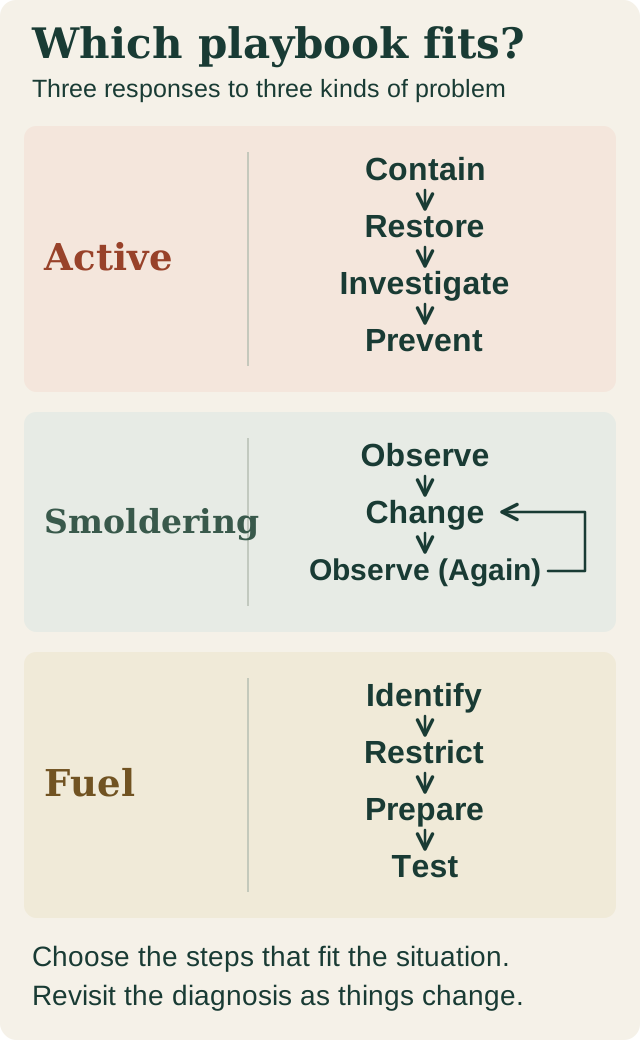
Match the response to the kind of problem you are dealing with. Revisit the diagnosis as the situation changes. Original conceptual infographic based on Alex Cannella’s article, created with Codex for Renaissance Solutions; CC0.
The Fire Lifecycle
The lesson to take away across all of these different problems is that you should look before you leap.
Why? Because just like fires, problems transform over time. Let a small problem fester long enough and it might develop into a big, active one. Recurring active fires are a warning that you have deeper, systemic issues. And fuel is, by definition, a fire waiting to happen.
The final piece of this metaphor is that problems can be fluid, and your problem solving should be too. Before you can fix a problem, you have to understand what kind of problem you’re dealing with.
This is important to remember when working with AI. It transforms any pipeline it touches and it’s new enough that we are still establishing “common sense” rules for its use. The manual is still being written, but the next best thing to fall back on is a set of general problem-solving principles. With a bit of time, research, and creativity, AI fires can be managed and mitigated like any other.
Like all metaphors, this guide isn’t the end-all be-all guide to troubleshooting AI, but a framework to give you the language to recognize and talk about how you go about solving problems when you have to do it live. The most challenging part of dealing with new technology like AI is the uncertainty and discomfort of not having that manual to reach for.
Remember, you’ve been there before, you’ve figured it out in the past, and when an AI fire strikes, you can do so again.