A Definition
Resilience debt is the debt that builds when efficiency removes the second way to keep operating.
Most business leaders know technical debt: a shortcut saves time today, then creates rework later.
I use resilience debt for a different trade. It builds when convenience, efficiency, or automation remove the alternate skills, channels, and relationships that let an organization keep operating while a primary system is impaired.
Nothing has to fail for the debt to grow. Normal operations may even get faster.
Two related ideas sit next to that definition. Keeping the business useful while the preferred system is unavailable is business continuity. Getting the systems themselves back — restore them, recover data, or switch to a backup system — is system recovery. Both matter. They are not the same job.
The bill arrives when the usual path disappears.
Years ago, a severe summer storm knocked out power in my neighborhood for nearly a week. Basements flooded. Extension cords crossed yards. Generators became community infrastructure. Neighbors checked on neighbors. It was inconvenient, but life continued because people kept finding other ways to communicate, share resources, and solve problems.
Neighbors pointed out which business were still open by providing shoppers flashlights and powering registers with generators. Although many shops reportedly shifted to cash only, some located their older credit card imprint devices. The enterprises that maintained a backup—such as those imprint tools—could still accept cards when the standard system failed.
The business continuity lesson: Resilience is not the absence of disruption. It is the capacity to keep serving people while the preferred system is unavailable.
When efficiency removes the second way
Most organizations do not lose that capacity through recklessness. One cloud product that handles email, files, and chat can also hold reporting, customer records, approvals, and day-to-day workflows. A consolidated vendor can lower cost and eliminate duplicate work. An automated workflow can remove a tedious manual handoff.
Each choice may be rational on its own. The problem appears when too many essential activities depend on the same service, the same credential, the same dashboard, or the same person who knows how the work is done.
Imagine a small business whose cloud platform holds its email, customer history, schedules, internal chat, and operating reports. (That scene is a teaching illustration, not a case study.) During an outage, the servers may be recovering exactly as planned, but the business still has to decide what customers need to hear, who can approve an exception, and how employees can find the next appointment. A printed contact list, an alternate communication channel, a current export of essential records, and a practiced manual process do not replace the platform. They give the business a way to keep moving until the platform returns.
In my experience, many small businesses rely on a single cloud provider for office productivity and automation. When this trend first started, I noticed that many businesses still printed out tomorrow’s or even next week’s schedule ahead of time, just in case. After a few years without needing to revert to pre-printed schedules, they stopped printing them. When they suffered their first cloud outage, they realized they had saved a few minutes each day only to lose days. Today, some of these companies have automated the printing of tomorrow’s schedule.
That is resilience debt in practice: the organization has optimized away too many second ways to operate.
A practical continuity test
Technology recovery still matters. Teams need to restore systems, recover data, and switch to a backup system when they can. The continuity questions are different:
- Can the business continue operating while recovery is underway?
- Do employees know how to perform critical activities if a key application is unavailable?
- Can leaders make essential decisions if dashboards are offline?
- Are critical contacts available outside the primary platform?
- Can teams communicate through an alternate channel?
- Can customer commitments still be met during a disruption?
These questions reveal where resilience debt is accumulating. They also make the remedy less mysterious. Keep an alternate route for work that cannot stop. Preserve the knowledge people need when systems are down. Practice the handoff before an emergency turns it into an improvisation exercise.
For example, a team that depends on a shared scheduling system might keep an automatically printed copy of the current schedule as its fallback. Someone is explicitly responsible for making sure that process still works, the schedule is refreshed from the live system rather than maintained separately, and employees periodically practice working from the printed copy and handing updates back when the system returns.
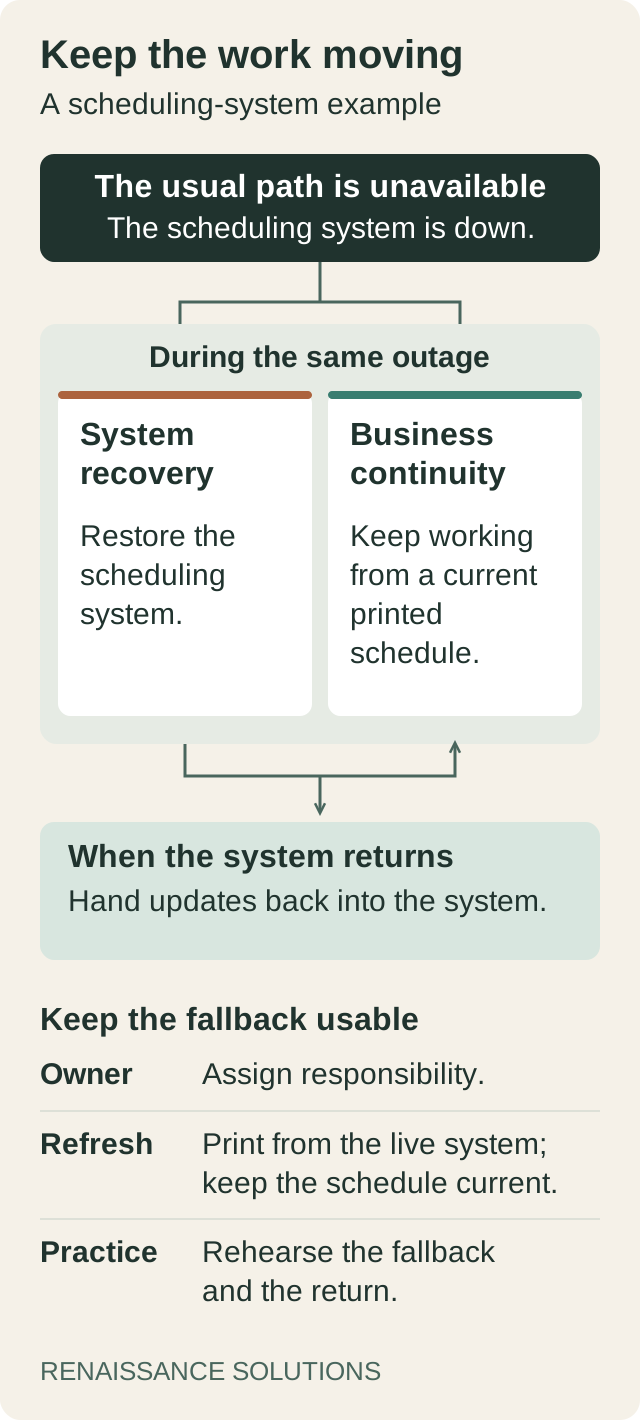
Recovery brings the system back. Continuity keeps essential work moving while it is unavailable. Original diagram created with Codex for Renaissance Solutions.
The trust test
Customers do not expect an organization to prevent every interruption. They do notice whether it can explain what happened, continue the most important work, and make a credible next promise. That is where resilience becomes a trust issue.
Families understand the logic. Flashlights, batteries, emergency supplies, and a plan for reaching one another are not predictions of catastrophe. They are a way to stay useful when ordinary systems are temporarily unavailable.
Businesses need the same discipline. Resilience debt is easier to manage before the disruption that exposes it.