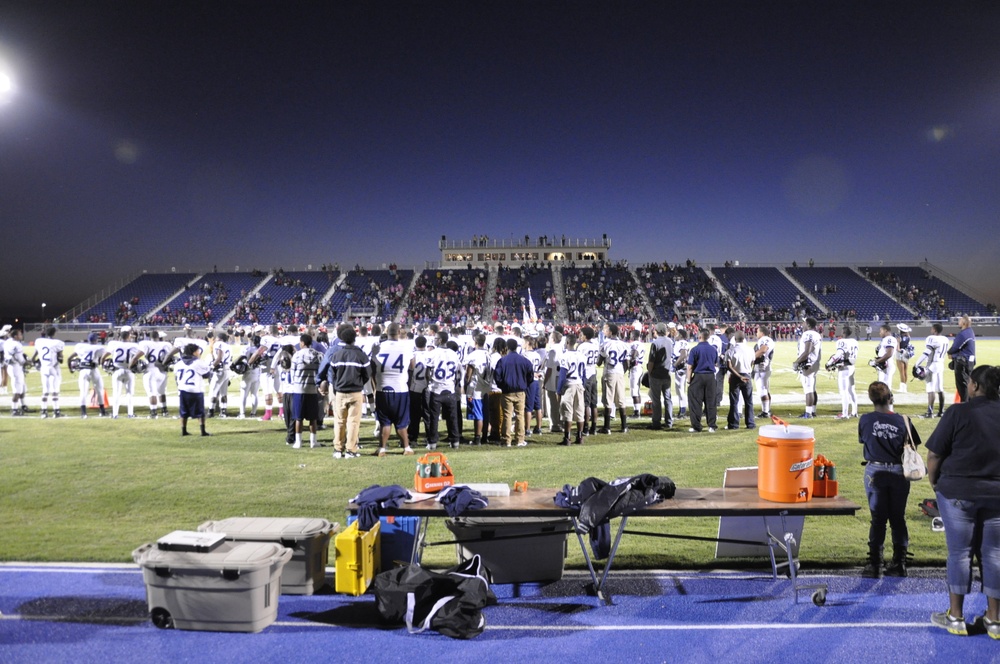
Before the coin toss at the Harker Heights–Shoemaker high school game, Prichard Stadium, Texas, October 19, 2012. Photo: Randy Cephus, U.S. Army Corps of Engineers / DVIDS. Public domain. This photograph shows a different game from the video below.
This week, the algorithm, aware of my frequent clicks on marching band stories, decided to share a story about a German family attending a Texas high school football game.
Here’s the link to the video: https://www.youtube.com/watch?v=3b9n4JLMQF8
Video: Tim’s America, via YouTube. Watch on YouTube.
During the national anthem, the stands fell silent, including the teenagers. Later, an injury timeout brought another moment of stillness, followed by fierce rivals cheering as the injured player limped off the field. Naturally, none of this surprised me; I had been in marching band for nine years; these rituals were muscle memory.
These rituals are our shared reset, a display of respect and belonging. We perform them even during intense competitions with rivals. However, for the visiting German family, this experience served as a reminder that the same behaviors can carry different meanings.
Behavior is not meaning
Visible behavior is not the meaning. Silence can mean respect, fear, grief, prayer, protest, or a learned ritual. Context decides.
A useful check before you name it: What rule do the people performing it believe they are following?
(Identical eyelid motion can be a wink or a twitch — same form, different worlds.1 Stadium silence is that kind of problem.)
Undocumented protocols
When to stand. When humor stops. What counts as respect. Much of that is learned by participation, not by reading a written rulebook. It is often tacit — we know more than we can tell.2
Archival silence
Archival silence is lived meaning that never made it cleanly into the record — or got distorted on the way in. Gaps come from what was never written, what was never kept, and what later stories leave out.3
Ordinary practices, gesture, timing, private talk, “everyone knows” meanings: the archive’s shadow is large.
The recorded-world problem
Recorded-world problem: models — and we — mostly see what got written down, filmed, or filed.
A short lossy chain: lived → noticed → said or shown → recorded → kept and findable. Meaning drops at every hop.
Working line: AI models learn primarily from the portion of reality humans have turned into artifacts.
Why this matters for LLMs — and for us
A corpus may hold many lines like “everyone stood for the anthem” and few explanations of the tacit rules or the different inner meanings under the same stillness.
That is an incomplete record, not a broken mind.
Humans share this trait. We see a behavior, match a familiar pattern, and substitute our own explanation. Short-form media often keeps the behavior and strips the protocol. Not “AI is broken.”
Close
The useful move is not only “my first read was wrong.”
It is: I know what this would mean in my culture. I still need to learn what it means in theirs.
AI may become very knowledgeable about humanity’s records while still having large blind spots about humanity itself. So do we.
Footnotes
-
Optional thick-description gloss (wink vs twitch): OpenStax Introduction to Anthropology §3.2:
↩ -
Michael Polanyi, The Tacit Dimension (1966) — “we can know more than we can tell”:
↩ -
Society of American Archivists Dictionary, “archival silence”:
- https://dictionary.archivists.org/entry/archival-silence.html — classic framing via Michel-Rolph Trouillot, Silencing the Past (1995).