The symposium
Imagine a fictional symposium, a small conference that brings together some of the world's leading researchers to tackle a hard problem. Perhaps Alzheimer's disease. Perhaps cancer. Perhaps climate change.
The participants come from different fields. Some have studied the problem for decades. Others are new. A few are there because their expertise in seemingly unrelated subjects might offer a fresh view.
Everyone wants to make progress.
A few weeks before the event, the participants receive guidance from their institutions. Certain subjects are sensitive. Some terminology should be avoided. A few research directions have become controversial. Nobody prohibits discussing them, but everyone understands that raising the wrong subject could cause trouble.
During the symposium:
- One researcher has noticed a relationship between socioeconomic conditions and disease progression. She decides not to mention it.
- Another has seen something unusual in a particular patient population. He considers raising it but decides it isn't worth the trouble.
- A third has an unexplained result involving environmental exposure. She suspects it's probably statistical noise and keeps quiet.
- A fourth has been investigating a biological mechanism that might explain the third researcher's result. But she never mentions it, so her colleague never hears it.
Presentations are excellent. Discussions are productive. Participants agree on recommendations and go home feeling the event was worthwhile. But what if the most promising idea could only have come from a conversation between those four researchers?
What if the discovery required ideas that were never allowed to meet?
Nobody knows. And nobody ever will.
Ideas are chemistry
We often think of innovation as individual creativity. Someone has a brilliant idea, develops it, and produces something valuable.
Sometimes that's how it works. But many discoveries come from interactions between people, observations, and ideas. One person notices something unusual. Another recognizes a pattern. Someone else proposes an explanation. A fourth spots a contradiction. Suddenly an observation that seemed unimportant becomes worth investigating.
The original ideas weren't necessarily remarkable. Some may have been incomplete or simply wrong. Together they produced something none of the participants had alone.
Ideas behave a little like chemistry. Some complement one another. Some contradict each other. Some expose gaps another idea can fill. Occasionally the right combination produces something unexpected. Since we can't reliably predict which combinations will matter, removing one idea from a conversation can prevent a whole chain of questions, challenges, and discoveries.
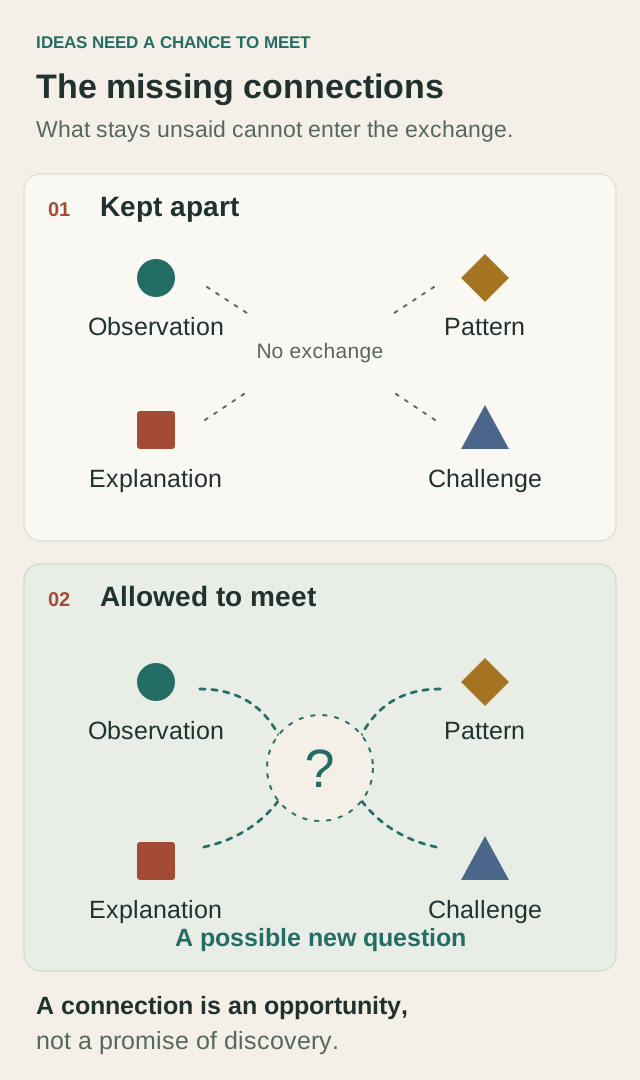
An unspoken idea can leave more than one gap: it can prevent connections that might have produced a new question. Conceptual illustration created with Codex for Renaissance Solutions; CC0.
Missing not at random
Statistics has a useful idea called missing not at random, or MNAR. It means the gaps in the data aren't random. Whether something is missing depends on the missing information itself.1
Consider a survey about income. If people with high incomes are less likely to answer, the missing answers aren't random. The gap is tied to the very thing we're trying to measure. Ignoring that can lead to misleading conclusions.
Now consider a laboratory, boardroom, engineering meeting, classroom, daily standup (a short team check-in), or retrospective (a meeting to look back on a finished project).
People don't necessarily hold back ideas at random. They may stay silent because an idea challenges leadership, contradicts accepted wisdom, touches a controversial subject, crosses an ideological line, or risks making them look foolish.
The ideas most likely to disappear may be exactly the ones that challenge the group's assumptions.
This isn't a formal statistics problem. But the comparison points to a real one: the way a group decides which ideas get shared can skew what it knows, in the same direction, again and again.
And the effects spread. If one person stays silent, another never gets to challenge that observation. A third never sees a connection. A fourth never proposes an experiment.
Along with losing information, we are altering—and possibly stifling—the process that generates new insights.
Missing dissent
Sometimes the missing contribution isn't a new idea. It's disagreement. An engineer sees a way the system could fail that nobody wants to discuss. A researcher thinks the fashionable theory doesn't fit the evidence. A junior employee believes the senior people in the room are wrong.
Because disagreement has a cost, some people keep quiet, and their dissent is never heard. Since dissent is one of the ways groups discover they are wrong, a room can grow more confident at exactly the moment it is losing the information it needs to question that confidence.
This is not an argument for hostility, performative contrarianism, or endless debate. It is an argument for keeping the ability to say, in good faith: "I think we may be wrong."
The meetings that went perfectly
One. A junior executive has concerns about an acquisition. The financial projections look reasonable, but something about the assumptions bothers her. The CEO is enthusiastic. The board seems supportive. She doesn't raise it. The meeting ends with unanimous approval.
Two. At a software standup, an engineer suspects the new software design has a basic flaw. The team has invested months, and leadership wants progress. He reports that his tasks are on schedule.
Three. In a retrospective, everyone knows the project suffered from unrealistic deadlines. Nobody wants to criticize the manager who set them. The team agrees that "communication could have been better." Action items are recorded. The retrospective is considered a success.
In each case, the organization receives reassuring information. The meeting happened. People participated. Decisions were made. Yet the information needed for a better decision may never have entered the room. And because nobody recorded the unspoken concerns, the organization has no reliable way to measure what was missing.
A room full of agreement is not necessarily a room full of information.
We need somewhere to be wrong
Imagine someone walks into a research meeting and asks: "Does having an innie or outie belly button affect balance on rainy days?"
It sounds absurd. There's no obvious reason to expect a connection. A reasonable response is to ask what mechanism could explain it, whether any evidence suggests a link, and whether it's worth investigating. The idea might be dismissed in minutes.
That's fine.
But suppose the discussion prompts someone to mention air pressure and the inner ear's sense of balance. Another participant recalls research on weather-related changes in certain neurological symptoms. The original question may still be nonsense, yet the conversation could lead somewhere useful.
This doesn't mean every idea deserves a research grant or equal attention. It certainly doesn't mean untested ideas should be applied to patients, infrastructure, or public policy.
It means we should separate the freedom to explore an idea from the standards required to act on it.
Brainstorming should be cheap. Testing should be disciplined. Funding should be selective. Conclusions should rest on evidence. And applications, especially those affecting human lives, should meet demanding standards.
We can improve how research funding is allocated without discouraging people from asking questions. Public money is finite, and scientific merit matters. But rejecting a proposal because its methods are weak is very different from discouraging a question because the subject itself is unwelcome.
Science, engineering, and organizations all need filters. They also need places where ideas can exist before they're ready to pass through those filters.
Around a drum circle with friends, discussion can be almost unlimited. That isn't the standard we're proposing for laboratories or engineering teams. Unrestricted discussion is not the goal.
Our goal is to avoid squashing potentially useful ideas for ideological, political, organizational, or selfish reasons before they've had a cheap chance to be examined.
Ideas still need to rise through increasingly demanding filters. They just need somewhere safe and cheap to begin.
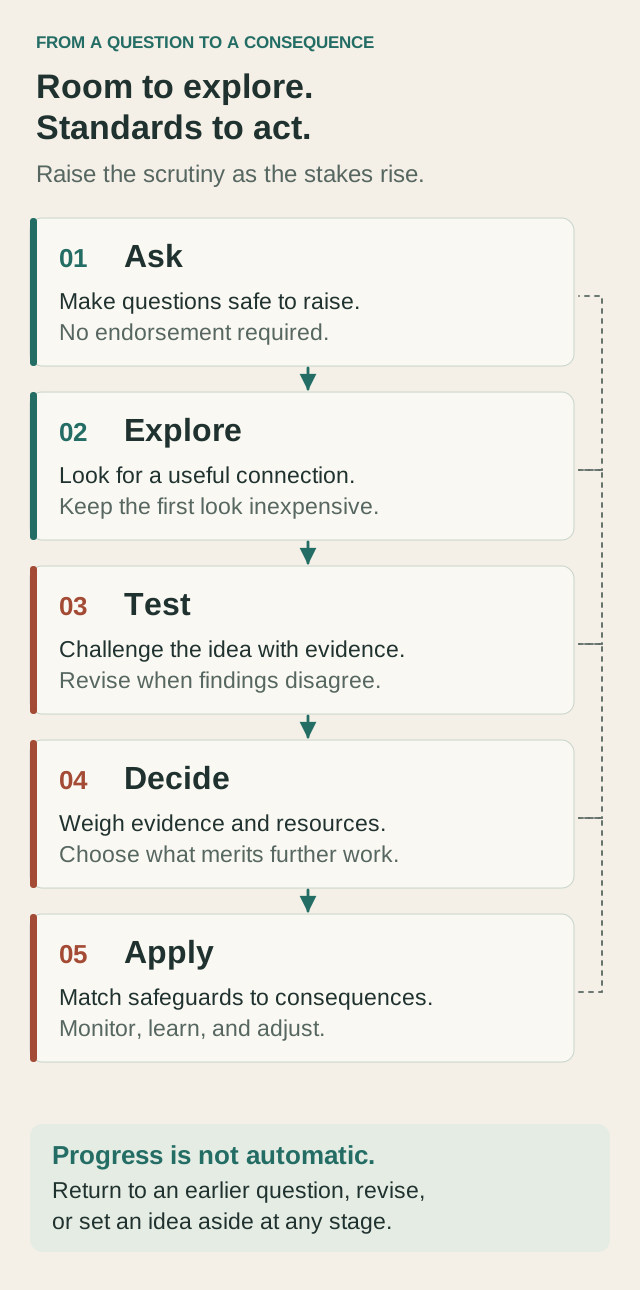
Make questions easy to raise. Increase the demands on evidence and judgment as the consequences grow. A conceptual guide, with room to revise or stop at any stage. Created with Codex for Renaissance Solutions; CC0.
The substrate ideas move through
Ideas don't move through organizations by themselves. They move through a substrate: the ground they travel through. That ground is made of people, meetings, journals, labs, code, and hallway conversations.
That substrate decides which ideas meet.
A healthy substrate doesn't guarantee good ideas. It lets ideas move, collide, and be challenged. It lets weak ideas fail cheaply. And occasionally it lets several incomplete ideas come together into something none of their contributors could see alone.
That substrate has always been vulnerable. Political movements, ideological conformity, corporate hierarchy, professional incentives, fear of embarrassment, and funding structures can all damage it.
The pendulum moves. The mechanisms change. The underlying risk does not.
When the substrate becomes hostile to certain questions or to dissent, ideas don't just become harder to express. They become less likely to meet the other ideas that might have transformed them.
When research stops, time doesn't
Research programs aren't always easy to restart.
A lab may depend on specialized equipment, trained staff, relationships with participating communities, and years of accumulated knowledge. A long-term study may depend on collecting observations at regular intervals. A clinical trial may depend on patients who agreed to take part under specific conditions.
When funding disappears, researchers can find other work. Participants can leave studies. Equipment can be taken apart. Know-how can scatter. Observations that should have been collected during the gap can be lost for good.
Restoring funding doesn't necessarily restore the research. Sometimes the work can resume. Sometimes it must start over. Sometimes the opportunity has passed.
Recent changes in federal research funding make this a real question, not only a hypothetical one. In 2025, the National Institutes of Health ended hundreds of research grants early, across many topics, including HIV/AIDS research.4 One study found the ended grants had supported hundreds of clinical trials involving tens of thousands of participants.5
Separately, other scientists keep testing ways to help some people control HIV without daily medicine. These are early studies, mostly in small groups.6 Those two facts should stay apart. Promising HIV research existing does not mean that any particular promising treatment was canceled.
But the broader continuity problem is real. A research program is not a light switch. Turning the money back on doesn't necessarily bring back the team, the participants, the observations, or the lost time.
The questions we never ask
An organization can lose knowledge in several ways. It can stop collecting information. It can stop investigating certain questions. It can lose people with specialized expertise. It can lose dissent. And it can create conditions in which people decide speaking up isn't worth the risk.
That last one is the hardest to detect.
A canceled project leaves a record. A terminated grant can be counted. A discontinued dataset leaves a documented gap. But a question that was never asked leaves little evidence it ever existed. And the ideas that might have come from discussing it leave none at all.
That's why productivity alone can't tell us whether an intellectual environment is healthy. A university can keep publishing papers. A company can keep launching products. An engineering team can keep closing tickets. A government agency can keep producing reports. All while important questions go unasked.
We shouldn't assume every unspoken idea would have been valuable. Most speculative ideas probably lead nowhere. But we also can't assume that the absence of visible damage proves nothing was lost. What's missing may be tied to the very conditions that kept people silent.
Protecting the place where ideas begin
What would it look like to take this seriously? Not every idea needs funding. Not every meeting needs unlimited debate. But we can make room for exploration without confusing it with endorsement.
Separate brainstorming from decision-making. Give people a chance to explore possibilities before asking them to defend a recommendation.
Make it acceptable to challenge assumptions, especially those held by people with authority.
Protect dissent without protecting ideas from criticism. Amy Edmondson, whose research made the idea widely known, says psychological safety "is not about being nice." It's about candor: people can disagree without being embarrassed or punished for speaking up.7 Ideas still get challenged. People shouldn't face serious personal costs for good-faith contributions.
Keep rejected ideas when useful. A hypothesis that isn't worth pursuing today may matter when new evidence or technology appears.
Support cheap exploration. Small experiments, simulations, informal research groups, hobby projects, maker communities, and cross-discipline conversations can test possibilities before big resources are committed.
Protect continuity where it matters. When ending a research program, consider what data, expertise, relationships, and opportunities can't easily be recovered.
Pay attention to what people are reluctant to say. No organization can guarantee every valuable idea will be heard. But it can make thoughtful participation safer than silence.
The discovery that never happened
Return to our fictional symposium.
Four researchers each arrived with an observation. None was remarkable. One might have been wrong. Another might have been irrelevant. Together, perhaps, they would have produced a question worth investigating.
We'll never know.
The symposium succeeded by every measure the organizers collected. Attendance was strong. Participants were satisfied. Recommendations were published. Nobody reported a problem.
And somewhere in the space between four unspoken ideas, a possible discovery never took shape. It might have led nowhere. But we'll never get to find out.
The hard thing about a missing discovery is that it leaves no empty space behind.
There is no blank line in the journal. No missing row in the database. No unfinished equation on the board. The world simply goes on as though the idea had never been possible.
That's why we need to protect something much smaller and cheaper than a research grant or a laboratory. We need to protect the moment when someone raises a hand and says:
"This might be a stupid question, but..."
Because sometimes the most important discovery begins with someone else answering: "Wait a minute."
Footnotes
-
Gelman & Hill, Data Analysis Using Regression and Multilevel/Hierarchical Models, ch. 25, "Missing-data imputation" ↩
-
JAMA, "Characterization of Research Grant Terminations at the National Institutes of Health" (May 8, 2025) ↩
-
JAMA Internal Medicine, NIH grant terminations and clinical trials (2025) ↩
-
Nature, "Correlates of HIV-1 control after combination immunotherapy" (2025) ↩
-
Amy Edmondson, "Psychological Safety and Learning Behavior in Work Teams," Administrative Science Quarterly (1999); quote from The Fearless Organization (2018), excerpted at Quartz ↩