The Question Behind the Question
I was working with an AI coding assistant on a small educational game.
The game itself was not complicated in the usual enterprise sense. No database. No authentication. No cloud architecture. No giant implementation plan. Just a plain static browser game inside a little collection of other games.
But the conversation took an interesting turn.
We already had a few game patterns in the workshop. One was a systems simulator where the player chooses interventions and watches feedback loops play out. Another was a turn-by-turn balance puzzle where the player tries to keep a fragile system inside survivable bounds. Another was a coloring activity where the point was not to be right, but to make creative choices and produce something useful.
So I asked for a new game that combined the spirit of those things with color theory.
Not a coloring book exactly. More like a learning simulation where the player makes composition and color choices for a piece of art or a space, then gets a no-right-answer assessment. The assistant came back with something called Composition Lab.
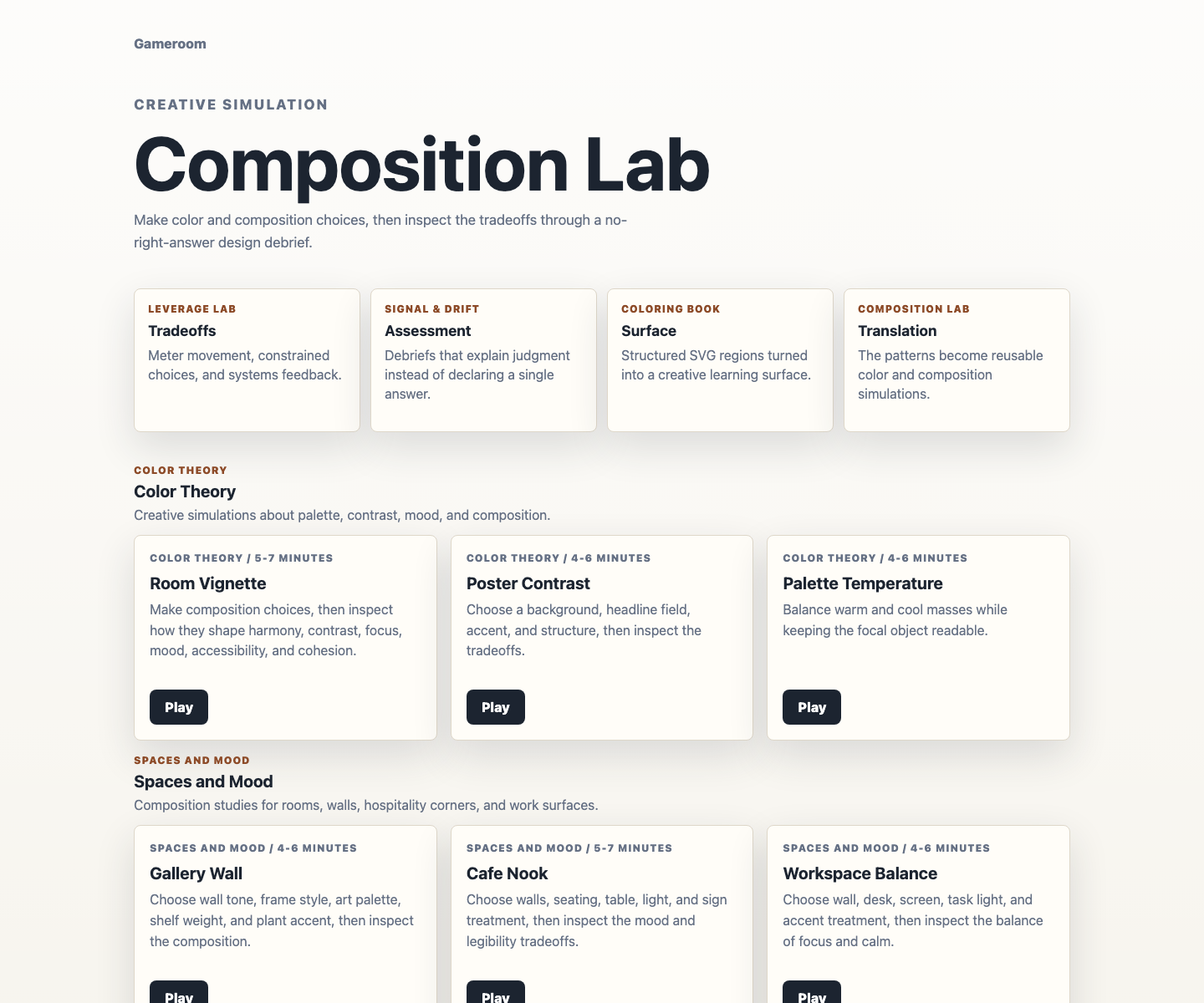
Image by Renaissance Solutions, 2026
The first scenario was a room vignette. The player chooses a wall color, sofa color, accent color, lighting, focal point, and rug treatment. Then the game gives a rubric-style debrief across harmony, contrast, focus, mood, accessibility, and cohesion.
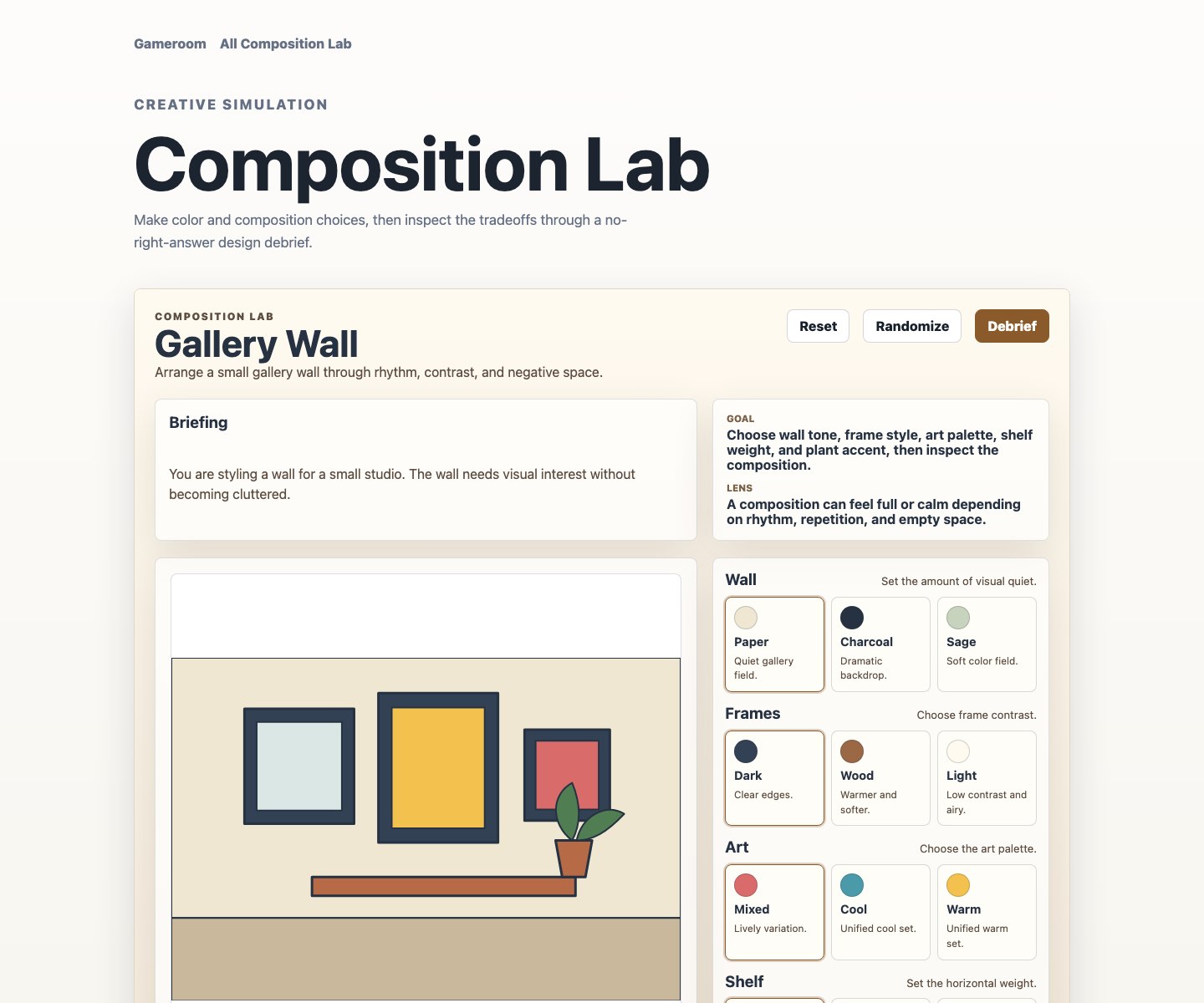
Image by Renaissance Solutions, 2026
It was good enough that I had the natural follow-up question: Where did that come from?
Not From One Place
There is not a satisfying citation for that kind of answer. At least not in the normal way.
The model cannot point to one article, one book, one design system, or one game and say, "This is where Composition Lab came from." It does not have a clean provenance trail for its training data. It does not show the sources that shaped a specific suggestion. And even if it could point to some adjacent examples, that would probably miss the more interesting part.
Because the game did not feel like a copy of something. It felt like a translation.
The assistant looked at the local patterns already present in the codebase. It saw constrained choices, meters, delayed effects, scenario JSON, SVG regions, pack indexes, no-right-answer creative output, and explanatory debriefs. It also carried general background knowledge about color theory, composition, educational rubrics, and interaction design.
Then it mapped one set of patterns onto another. That is the part worth paying attention to.
The Idea Was Not the Hard Part
"What if we made a color theory simulator?" is an idea. It is not a bad idea. But by itself, it does not do much.
Ideas are cheap in the same way raw ingredients are cheap before anyone knows what meal they are making, who is eating, what kitchen they are in, and how much time they have.
The interesting work was not naming the idea. The interesting work was translating the idea into the existing system:
- This cannot become a big framework project.
- This has to stay inside a plain static app.
- It should use approved JSON files.
- It should have packs and scenarios.
- It should preserve the raw embeddable game surface.
- It should avoid persistence.
- It should feel like a learning simulation.
- It should not score the player as right or wrong.
- It should produce useful feedback.
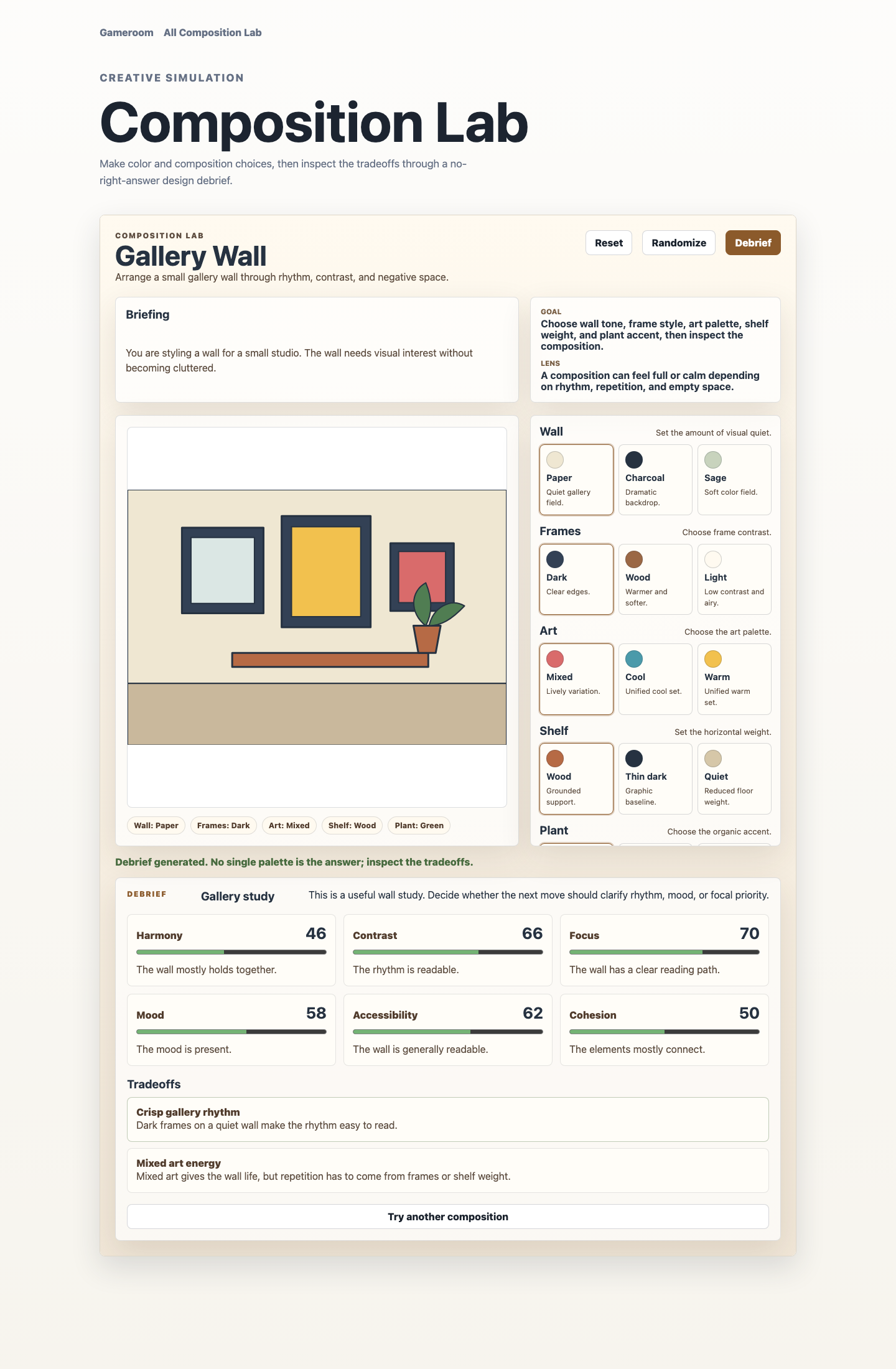
Image by Renaissance Solutions, 2026
Those constraints shaped the answer. Without them, "color theory simulator" could have become almost anything. A quiz. A drag-and-drop canvas. A palette generator. A design critique chatbot. A Figma plugin. A lesson plan. A three-dimensional room designer. A mood board tool. A game with levels and badges.
Most of those would have been wrong for the moment. The useful answer was the one that fit the local terrain.
The Translation Layer
When AI collaboration works well, a lot of the value appears in the translation layer where vague intention becomes a workable real-world artifact. It is the layer that asks:
- What does this idea become in this codebase?
- What existing patterns should it respect?
- What should be generalized, and what should remain specific?
- What does the user actually mean by "game" in this context?
- What does "no right answer" mean in interface terms?
- What does "learning simulation" mean in data terms?
- What kind of assessment feels useful without becoming a grade?
That is more than implementation detail. That is design.
It is also systems work. The assistant was not just generating a feature. It was fitting a new behavior into an existing set of contracts, conventions, and goals.
The more I work with these tools, the more I think this is where much of the practical value lives. Not in having a model shout out brilliant ideas from nowhere, but in having it move ideas across layers.
- From conversation to schema.
- From schema to interface.
- From interface to test.
- From test to route.
- From route to user experience.
- From isolated feature to reusable pattern.
It Is Not Magic, But It Is Not Nothing
There is a temptation to describe this in one of two lazy ways.
- The magic story: the AI invented a creative new game.
- The dismissal story: the AI just remixed things it had seen before.
Of course it remixed things it had seen before. Humans do that too. Most useful work carries precedent. A room vignette carries interior design patterns. A rubric carries teaching patterns. A meter-based simulation carries game-design patterns. A JSON scenario carries software architecture patterns. A no-right-answer assessment carries critique patterns.
The question is not whether precedent exists. The question is whether the system can apply precedent under constraint.
That is where the interaction becomes more interesting. The model did not need to know one perfect source. It needed to recognize a family resemblance among several different domains:
- educational games
- systems simulations
- color theory
- design critique
- static web architecture
- content packs
- scenario validation
Then it needed to produce something that belonged to our local workshop rather than to some generic product category.
The Human Role Is Not Just Prompting
The human role in this kind of work is often described too narrowly. People say "prompting" as if the main job is casting the right spell. That misses the more important work.
In this case, the human contribution was not just a prompt. It was the accumulated context:
- which games existed already
- which ones should not be disturbed yet
- what "raw game surface" means
- why no persistence matters
- why a creative output should not be scored as correct
- why packs matter
- why the game belongs in a workshop before it belongs in a polished site
- what kind of educational tone feels right
Those constraints did not appear from nowhere. They came from previous decisions, corrections, preferences, and taste.
The model could help because the environment had shape.
That is an important distinction. AI does not remove the need for taste. It makes taste more operational. A vague preference becomes a design constraint. A correction becomes a future boundary. A local pattern becomes a reusable path. A conversation becomes part of the working context.
The better the context, the better the translation.
Why This Matters for Builders
If we only judge AI systems by whether they produce novel ideas, we may miss a more useful capability.
Most organizations are not starving for ideas. They are starving for translation.
They have strategy that does not become operations. They have policies that do not become workflows. They have principles that do not become interfaces. They have lessons learned that do not become reusable patterns. They have risks that do not become controls. They have prototypes that do not become products. They have local knowledge that never becomes architecture.
The hard part is often moving meaning from one layer to another without losing the point.
AI might be able to help here. Not because the model knows the business better than the people inside it. It does not. Not because the model can replace judgment. It cannot. But because it can carry patterns across domains quickly, hold many constraints in view, and propose a first translation that humans can inspect, reject, reshape, or extend.
This is closer to assisted interpretation than pure automation.
The Risk
Bad translation can be worse than no translation because it creates the appearance of coherence.
A generated system can look organized while quietly misunderstanding the intent. A rubric can sound thoughtful while measuring the wrong thing. A workflow can look complete while bypassing the real control. A game can look educational while teaching the wrong lesson.
The same translation layer that creates value can also create polished misunderstanding.
That is why the human cannot disappear from the loop. Someone has to know whether the translation preserved the point. Someone has to ask whether the artifact belongs in the system. Someone has to notice when the model made the wrong thing beautifully.
Fluent output does not automatically translate to faithful output.
The Better Question
So when an AI assistant proposes something surprisingly useful, I am less interested in asking, "Where did that idea come from?"
Sometimes that question matters. Provenance, copyright, attribution, and source grounding all matter, especially when factual claims or creative ownership are involved.
But for this kind of work, other questions may be more revealing:
- What translation just happened?
- What did the model carry from one domain into another?
- What constraints shaped the answer?
- What local patterns did it preserve?
- What did it generalize?
- What did it leave alone?
- What did the human provide that made the translation possible?
The world is usually messier than pretending that GenAI is magic.
Closing
I knew that it was possible for GenAI to create a color theory game. What surprised me was how the shared experience and memory we built within a single Codex session increased our productivity and quality while reducing, though not eliminating, frustration.
That is the part I want to keep watching. Not the flash of the idea, but the movement between layers.
In real work, this is where many things fail. Ideas fail to become systems. Systems fail to preserve intent. Interfaces fail to teach the right lesson. Policies fail to become behavior. Strategy fails to become practice.
If AI can help with that translation, the opportunity is more than vibe coding. It may help us notice the hidden structure of our own work.
And if we are observant, it may help us carry that structure from one layer to the next without losing the point.