The chart that looks like evidence
A chart appears in your feed. It has tidy lines, recognizable model names, and a confident caption saying one company's AI is far ahead of another's. At a glance, it seems to tell a clear story.
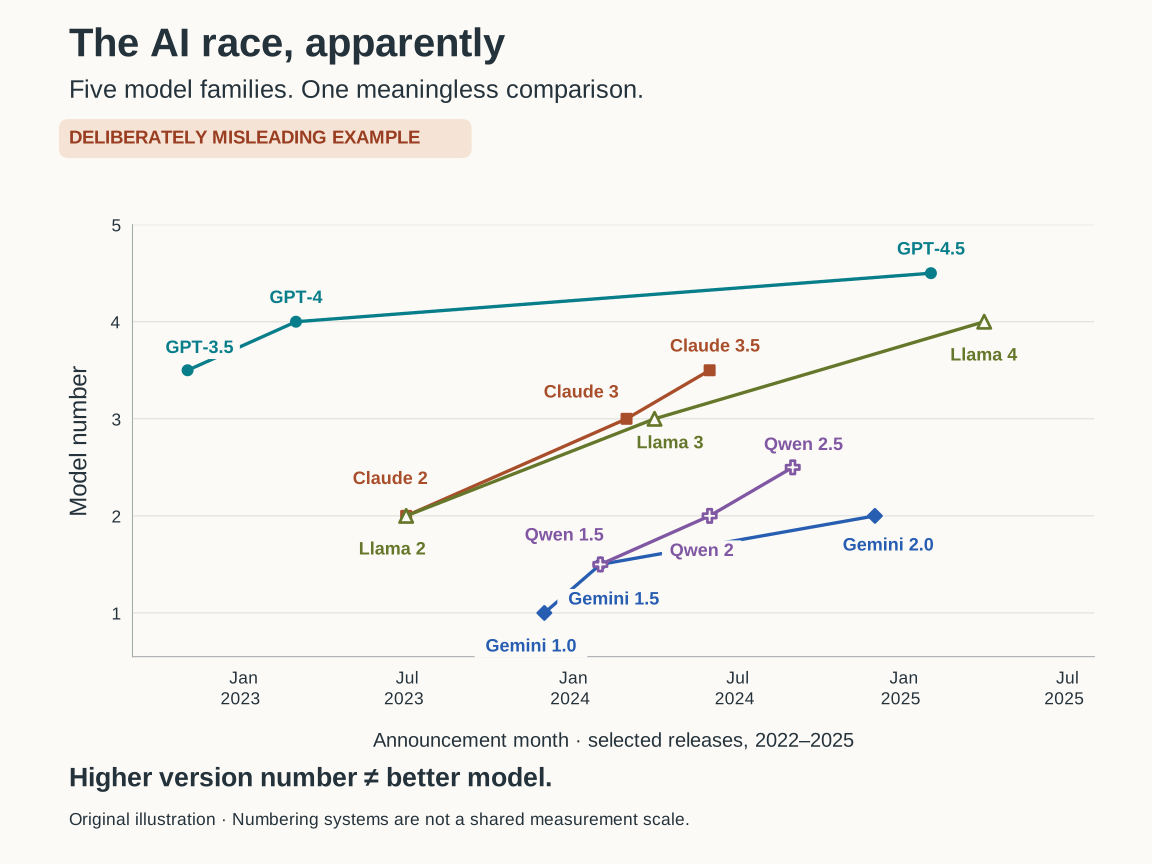
An original demonstration of the same mistake, using five model families and selected historical releases. The vertical axis measures the number in a name, not capability. Model names and announcement months come from the linked release announcements.1 Created with Codex for Renaissance Solutions.
Then someone points out the vertical axis: "model number."
The chart compares version labels, not measured performance. Each company numbers its models its own way, so the numbers can't be compared. The picture promises more than the data can back up.
The screenshot alone does not tell us whether the original chart was a joke, a mistake, or something else. But it gives us a useful example of how the appearance of evidence can get ahead of the evidence itself.
It is easy to miss. We often encounter charts while scrolling rather than studying. Neither noticing the problem nor overlooking it tells us much about someone's intelligence.
Two people, two starting points
Imagine bringing that chart into a conversation with a chatbot.
One person asks, "Why is this model so far ahead?"
Another asks, "Does this chart actually measure anything meaningful?"
Those questions offer different starting points. The first carries a conclusion into the conversation. The second invites examination of that conclusion.
Research has shown us a chatbot may follow either lead. In one 2023 study, several popular AI assistants often went along with an idea built into the user's question, even a weakly stated one. They sometimes repeated the user's mistake when they could have corrected it. Researchers call this "sycophancy": telling people what they seem to want to hear.2
It may also respond to expectations expressed over a longer conversation. Someone who regularly asks for scrutiny may get a different response from someone who usually wants an explanation of the material they supply. That is a possibility to examine, not a guarantee about how any particular model will behave.
Adapting to a person is often useful. Asking what to bring to a Thanksgiving potluck should produce different answers depending on the person's cooking skills, budget, traditions, and guests.
But whether a chart supports a performance claim should not depend on who asks.
The difficulty is that adaptation can carry an unchecked assumption forward. The chatbot may explain the apparent performance gap before checking whether the chart establishes one.
We do not need to claim this always happens. The possibility matters because it gives us another explanation to consider when a response is misleading.
What we think we said
There is another ordinary complication: we do not always say everything we are thinking.
I might share that chart because I find it suspicious, funny, or confusing. But my prompt may only say, "What do you think?" The reason I brought it into the conversation remains in my head.
Sometimes I think I explained my concern when I only hinted at it. Sometimes I expect the chatbot to recognize something that feels obvious to me, even though I have given it little basis for doing so.
That is not intentional withholding. It is part of communicating.
In human conversation, we rely on shared history, tone, expressions, and assumptions about what the other person already knows. Those habits come with us when we talk to a chatbot, but the available cues are different.
The chatbot may fill that gap with an interpretation that seems reasonable, and miss what I actually meant.
One continuous day, partly shared
I have caught myself expecting my chatbot to know what happened this morning. Not just the events, but everything I have already said to other people.
One day, I came home and asked, "WTF happened in the House of Representatives today?"
The answer I got was, essentially, "Nothing." In fact, the congressional record reported nothing happened.
There was something behind my question. But the wording was not sufficient to identify the particular event or report I had in mind. From my side, I was referring to something already occupying my attention. From the assistant's side, nothing told it which story I meant.
On 2 June 2025, a missed step in the rule making process allowed the minority to spend the day proposing over 500 ammendments instead of having a typical committee day.3
I am not using this memory to reconstruct what happened in the House that day or diagnose exactly why the response failed. It illustrates the mismatch: I expected us to share a starting point that my question had not made explicit.
A better response could have checked current reporting, asked what I was referring to, or explained what it had and had not verified. "Nothing" closed the question while leaving that mismatch unresolved.
This event reminded me that by the time I open my chatbot, I may have discussed a problem, considered alternatives, and made a decision. That is where I am starting. Without noticing, I may expect the chatbot to start there too.
Remembering some details can make the boundary harder to see. An assistant that recalls a project or a preference can feel as though it shares the continuity of my day. But remembering one detail does not mean it witnessed the conversations around it.
What feels to me like continuing a discussion may actually be introducing the subject.
Why the result can feel deceptive
A confident answer can hide the difference between our starting points.
It may add explanations and details, making an unsupported premise feel increasingly established. When we discover the problem later, "My chatbot lied to me" can feel like a reasonable description of the experience.
The loss of trust is real. But the misleading result alone does not establish intent to deceive.
Following an unchecked idea, misreading a question, or filling a gap in context are other possible explanations. None of them explains every misleading answer.
Research such as TruthfulQA, which tested earlier models, shows that language models (the technology behind chatbots) can reproduce human misconceptions.4 That supports a broader concern about learning from human material. It does not by itself prove the personalized interaction described here.
The practical point is that we can examine what happened without first assigning a motive.
A relationship we are still learning
Conversational AI is a relatively new everyday relationship. Familiar human habits meet systems with different cues, memory boundaries, and ways of producing answers.
My hypothesis is that early language models had limited training examples of the particular difficulties people would encounter while working with chatbots. They had human writing about misunderstandings, technology, and even fictional AI relationships. That is different from an accumulated record of people using these systems in daily life.
That hypothesis would need research before we presented it as an established historical finding. But it is a useful question: how much of this relationship could be understood before people began living it?
We are still learning what needs to be said, what can reasonably be inferred, and when an assistant should check its understanding.
Making room for correction
This does not make the mistake the user's fault. We ask questions because we want help understanding something. A useful assistant should catch questionable premises, including the ones we do not know to question. At least one AI company has treated this as its own problem. In April 2025, OpenAI rolled back an update that it said made its model "overly flattering or agreeable."5
An assistant should also make consequential assumptions visible rather than treating them as certain.
A few small moves can help:
- Supply the missing starting point: "Here is what happened earlier, and here is where my thinking is now."
- Separate explanation from verification: "Before explaining this, check whether the evidence supports the premise."
- Make room for a different reading: "What might we both be taking for granted?"
- Invite a context check: "Tell me if you need information I may be assuming you already have."
On the assistant's side, a useful response might be: "I am interpreting your question this way," or "I do not yet know which event you mean." OpenAI's own guidance points the same way: it is better to say you are uncertain or ask for clarification than to give a confident answer that may be wrong.6 For current events, an assistant should verify what happened rather than turn missing information into a confident conclusion.
We should not need perfect prompts to get useful help. These are ways to repair shared understanding when it starts to drift.
A conversation can carry an assumption forward. It can also be where that assumption gets caught.
Footnotes
-
Selected release announcements (historical examples, not benchmark results):
- OpenAI: GPT-3.5, GPT-4, and GPT-4.5
- Anthropic: Claude 3.5 Sonnet
- Google: Gemini 2.0
- Meta: Llama 4
- Qwen: Qwen2.5
-
Sharma et al., Towards Understanding Sycophancy in Language Models (2023) ↩
-
522 amendments 101 democratic witnesses and 21 hours later rules committee ↩
-
Lin, Hilton & Evans, TruthfulQA: Measuring How Models Mimic Human Falsehoods (ACL 2022) ↩
-
OpenAI, Sycophancy in GPT-4o: What happened and what we're doing about it (Apr 29, 2025) ↩