RS Glossary
Data Leakage
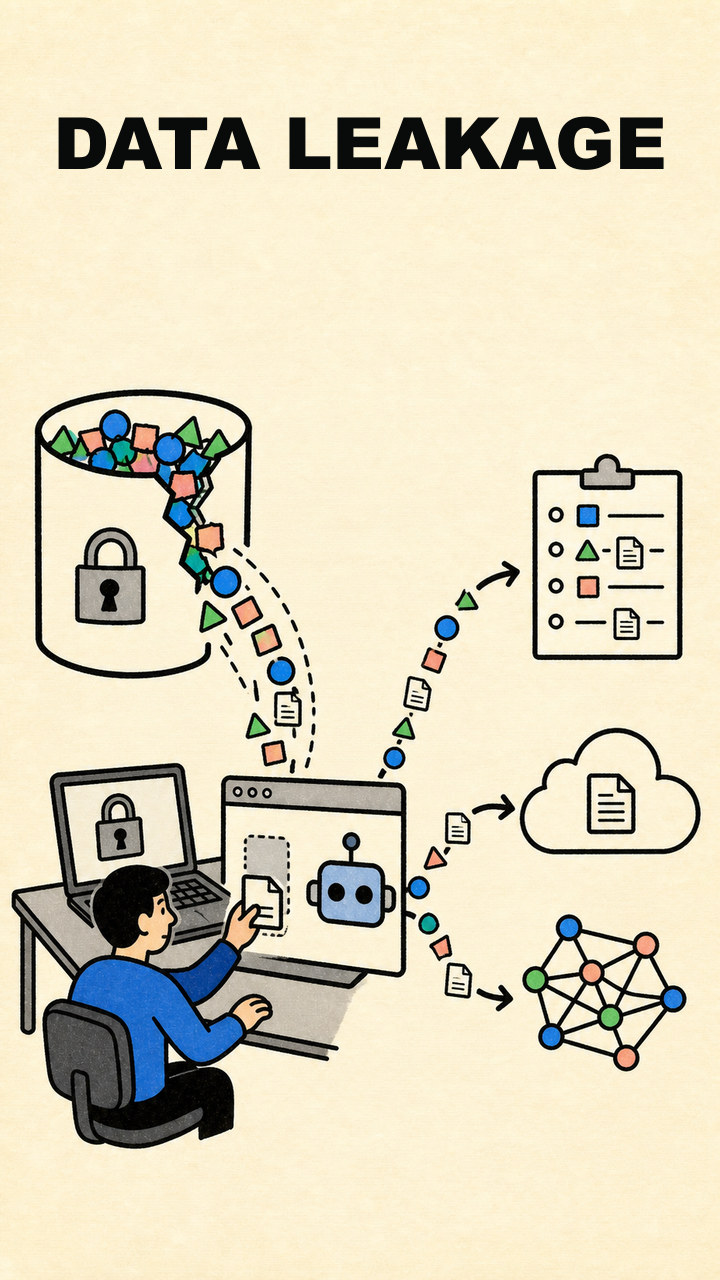
Data leakage is the unintended exposure, transfer, or disclosure of information to a person, system, model, or destination that is not authorized to receive it.
Note that machine-learning practitioners use the same phrase for a different problem: information from test or future data leaking into training, which makes a model look more accurate than it really is. This entry covers the disclosure sense.
- Review state
- Reviewed in POC
- Freshness
- Current
- Version
- 3
- Data Leakage
- Information Leakage
Remember it this wayInformation crossed a boundary it was not meant to cross.
In plain language
Leakage can happen through prompts, logs, outputs, training data, retrieval systems, integrations, exports, or access mistakes. The information may be visible immediately or recoverable later.
Why it matters
AI workflows often copy information across several services and contexts. Each handoff can change retention, access, and disclosure risk.
Example
An employee pastes client records into an unapproved public assistant whose service terms permit retention beyond the intended task.
Common misconception
Data leakage is not limited to a public breach. Sending information to an unauthorized internal tool or unintended model context is also leakage.
Related terms
Sources
- NIST AI 100-2 E2025, Adversarial Machine Learning: A Taxonomy and Terminology of Attacks and Mitigationsauthoritative treatment of privacy, inference, extraction, and information-disclosure attacks on AI systems.
Learn more
- Start with [[sensitive-information|Sensitive Information]] and examine every [[handoff|Handoff]].
Public history
46 recorded events · 46 public summaries
A potential shared concept was discussed and selected for initial glossary drafting.
The captured candidate received a complete initial draft and entered section-level human review.
Radar reviewed the initial definition draft for human consideration.
Radar reviewed the initial plain-language-explanation draft for human consideration.
Radar reviewed the initial why-it-matters draft for human consideration.
Radar reviewed the initial example draft for human consideration.
Radar reviewed the initial common-misconception draft for human consideration.
Radar reviewed the initial remember-it-this-way draft for human consideration.
Radar reviewed the initial related-terms draft for human consideration.
Radar reviewed the initial sources draft for human consideration.
Radar reviewed the initial learn-more draft for human consideration.
A proposal was opened for section-level human review while preserving the current version.
A human reviewer opened a proposed revision while preserving the current approved or captured version.
definition approved by a human reviewer.
plain-language-explanation approved by a human reviewer.
why-it-matters approved by a human reviewer.
example approved by a human reviewer.
common-misconception approved by a human reviewer.
remember-it-this-way approved by a human reviewer.
related-terms approved by a human reviewer.
sources returned for revision.
learn-more approved by a human reviewer.
Requested wording was prepared without changing approved or existing sections.
Radar reviewed the pending sources section for human consideration.
Radar must rereview the complete data-leakage term after an accepted text change.
Radar must rereview the complete data-leakage term after an accepted text change.
Radar must rereview the complete data-leakage term after an accepted text change.
Radar must rereview the complete data-leakage term after an accepted text change.
Radar must rereview the complete data-leakage term after an accepted text change.
Radar must rereview the complete data-leakage term after an accepted text change.
Radar must rereview the complete data-leakage term after an accepted text change.
Radar must rereview the complete data-leakage term after an accepted text change.
Radar must rereview the complete data-leakage term after an accepted text change.
sources approved by a human reviewer.
sources approved wording became the current section text.
All section gates are approved; content version 2 is now a fully approved term.
Radar rereviewed the human-approved definition wording for this exact version.
Radar rereviewed the human-approved plain-language-explanation wording for this exact version.
Radar rereviewed the human-approved why-it-matters wording for this exact version.
Radar rereviewed the human-approved example wording for this exact version.
Radar rereviewed the human-approved common-misconception wording for this exact version.
Radar rereviewed the human-approved remember-it-this-way wording for this exact version.
Radar rereviewed the human-approved related-terms wording for this exact version.
Radar rereviewed the human-approved sources wording for this exact version.
Radar rereviewed the human-approved learn-more wording for this exact version.
Definition review recorded as replace.
Source: vault/Glossary/terms/data-leakage/term.md · sha256:7a6215d21ca7e80a3c4939df7a26aa15d23850e29bc5b16095c39af9215cdd63 · Release: rs-glossary-glossary-team-poc-0.5.5-2026-09-02