RS Glossary
LoRA
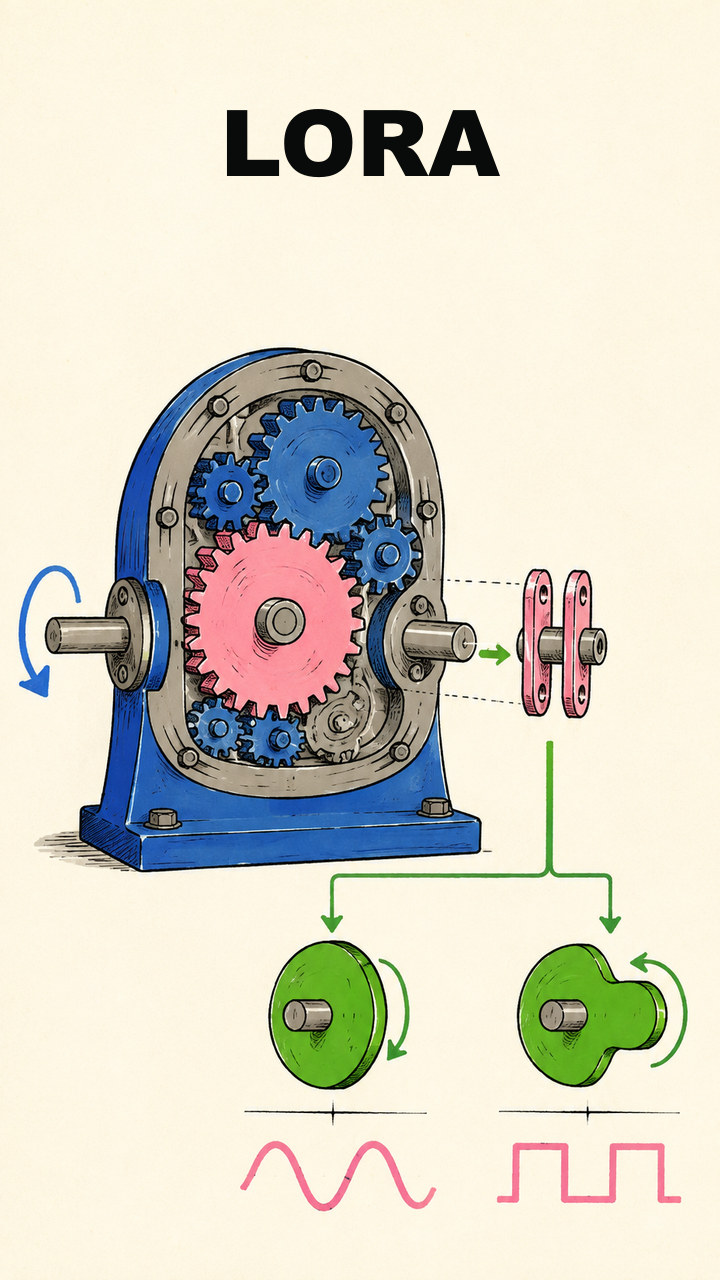
LoRA stands for low-rank adaptation, a technique for efficiently adjusting a model without retraining every parameter.
- Review state
- Reviewed in POC
- Freshness
- Current
- Version
- 2
- LoRA
- Low-Rank Adaptation
Remember it this wayFreeze the base; train a small low-rank adapter.
In plain language
LoRA, short for Low-Rank Adaptation, fine-tunes a model by training small low-rank matrices while keeping the original model weights frozen. The resulting adapter can be stored separately from the base model.
Why it matters
LoRA can reduce the compute, memory, and storage needed for adaptation. It does not remove the need to evaluate the training data, base model, adapter behavior, or deployment combination.
Example
A company adapts one base language model to several departments by training and loading a small LoRA adapter for each domain.
Common misconception
LoRA is not a new base model and does not update every original weight. Its behavior depends on both the frozen model and the trained adapter.
Related terms
Sources
- Edward Hu and colleagues, “LoRA: Low-Rank Adaptation of Large Language Models”introduces low-rank trainable matrices applied while pretrained weights remain frozen.
Learn more
- Compare [[fine-tuning|Fine-Tuning]], [[weights|Weights]], [[parameters|Parameters]], and [[supervised-fine-tuning|Supervised Fine-Tuning]] to place LoRA in the surrounding system.
- Follow the cited source material above for the method, standard, or research context behind this draft.
Public history
23 recorded events · 23 public summaries
A potential shared concept was discussed and selected for initial glossary drafting.
The captured candidate received a complete initial draft and entered section-level human review.
Radar reviewed the initial definition draft for human consideration.
Radar reviewed the initial plain-language-explanation draft for human consideration.
Radar reviewed the initial why-it-matters draft for human consideration.
Radar reviewed the initial example draft for human consideration.
Radar reviewed the initial common-misconception draft for human consideration.
Radar reviewed the initial remember-it-this-way draft for human consideration.
Radar reviewed the initial related-terms draft for human consideration.
Radar reviewed the initial sources draft for human consideration.
Radar reviewed the initial learn-more draft for human consideration.
Definition review recorded as approve.
Plain-Language Explanation review recorded as approve.
Why It Matters review recorded as approve.
Example review recorded as approve.
Common Misconception review recorded as approve.
Remember It This Way review recorded as approve.
Related Terms review recorded as approve.
Sources review recorded as approve.
Learn More review recorded as approve.
Sources review recorded as replace.
Radar verified the learner-facing sources after personal origin provenance was removed.
All nine current wording approvals were reconciled to Approved term status.
Source: vault/Glossary/terms/lora/term.md · sha256:eb05362582016b271916e2d7db9440a6dcd9e938ea81c80407f233635e9036bb · Release: rs-glossary-glossary-team-poc-0.5.5-2026-09-02