RS Glossary
Supervised Fine-Tuning
SFT stands for supervised fine-tuning, a stage where a pretrained model is further trained on labeled examples to improve task-following behavior.
- Review state
- Reviewed in POC
- Freshness
- Current
- Version
- 2
- Supervised Fine-Tuning
- SFT
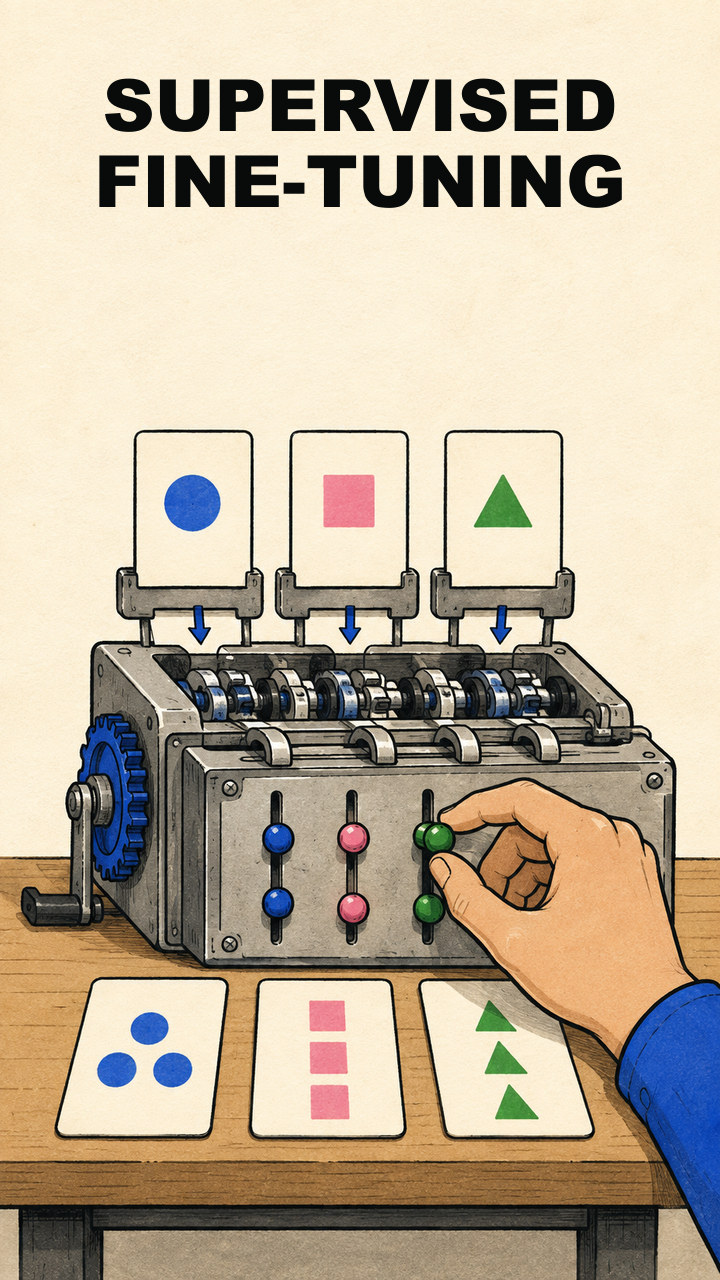
Remember it this wayShow labeled examples, then continue training the model on them.
In plain language
Supervised Fine-Tuning, or SFT, continues training a pretrained model on labeled input-output examples that demonstrate the desired task or response behavior.
Why it matters
SFT can teach format, task behavior, and domain patterns, but it reproduces the strengths and blind spots of the demonstrations. Data selection and review remain central.
Example
A pretrained language model is fine-tuned on prompts paired with carefully reviewed support answers so it learns the organization’s response style and escalation rules.
Common misconception
SFT is not the same as prompting and does not guarantee broad alignment. It changes model parameters based on a specific demonstration set.
Related terms
Sources
- Long Ouyang and colleagues, “Training Language Models to Follow Instructions with Human Feedback”documents supervised fine-tuning on human-written demonstrations as the first InstructGPT post-training stage.
Learn more
- Compare [[fine-tuning|Fine-Tuning]], [[pretraining|Pretraining]], [[supervised-learning|Supervised Learning]], and [[rlhf|RLHF]] to place Supervised Fine-Tuning in the surrounding system.
- Follow the cited source material above for the method, standard, or research context behind this draft.
Public history
23 recorded events · 23 public summaries
A potential shared concept was discussed and selected for initial glossary drafting.
The captured candidate received a complete initial draft and entered section-level human review.
Radar reviewed the initial definition draft for human consideration.
Radar reviewed the initial plain-language-explanation draft for human consideration.
Radar reviewed the initial why-it-matters draft for human consideration.
Radar reviewed the initial example draft for human consideration.
Radar reviewed the initial common-misconception draft for human consideration.
Radar reviewed the initial remember-it-this-way draft for human consideration.
Radar reviewed the initial related-terms draft for human consideration.
Radar reviewed the initial sources draft for human consideration.
Radar reviewed the initial learn-more draft for human consideration.
Definition review recorded as approve.
Plain-Language Explanation review recorded as approve.
Why It Matters review recorded as approve.
Example review recorded as approve.
Common Misconception review recorded as approve.
Remember It This Way review recorded as approve.
Related Terms review recorded as approve.
Sources review recorded as approve.
Learn More review recorded as approve.
Sources review recorded as replace.
Radar verified the learner-facing sources after personal origin provenance was removed.
All nine current wording approvals were reconciled to Approved term status.
Source: vault/Glossary/terms/supervised-fine-tuning/term.md · sha256:39174dcb981016a42a5dc42c51829af0ed272031cbe19c6e68f74eadd4e77ddd · Release: rs-glossary-glossary-team-poc-0.5.5-2026-09-02