The spark
Lately, YouTube has decided that I need videos of cats and dogs looking guilty after making a mess. That habit made me notice something familiar about chatbots. When a conversation goes wrong, they apologize. They promise to do better. The language can sound remarkably like self-awareness.
But an apology is not evidence that a chatbot understands what it did, remembers a hidden chain of events, or has inspected its own reasoning. It is an output that fits the conversation.
That distinction is not an insult to the system. It is a better way to use it.
A representation is not a check
René Magritte's famous painting of a pipe is a useful reminder: a picture of a pipe is not a pipe. A representation of a thing is not the thing itself. A language model can produce an explanation of a policy, a person, or a feeling without having checked the relevant record or lived the experience.
Transformer language models — a common design for today’s chat models that weighs relationships in the text to predict what comes next — generate text that way. That can produce explanations, comparisons, and apparently reflective language. It does not give us a direct window into a private inner narrative. (Attention Is All You Need)
The same caution applies when a chatbot explains its own answer. Its explanation may be helpful as a hypothesis about what to test. It is not an audit trail unless the surrounding system has been designed to provide one.
Turn the answer into an experiment
When a response feels unusually insightful—or unusually wrong—I can investigate the system around it.
- Write down the exact claim. What does the answer assert, and what would count as evidence for it?
- Check the materials. Which instructions, documents, retrieval results (documents the system looked up), and tools were available to the system?
- Change one condition. Rephrase a question, remove an irrelevant instruction, or replace a source with a better one. Then compare the outcome.
- Use an independent reference. Check an authoritative source or a domain expert rather than asking the chatbot to certify itself.
- Record what changed. For consequential work, note the model or version, settings, source set, reviewer, and decision.
This method does not reveal every internal mechanism. It does make the behavior more testable and gives a team something better than a story about what the model "really meant."
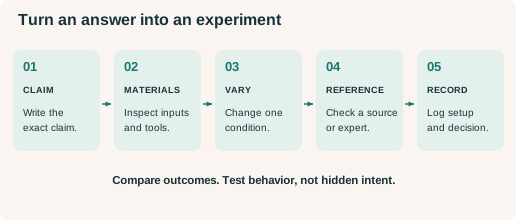
Start with the claim, inspect the materials, vary one condition, check an independent reference, and record the result. The sequence tests behavior; it does not reveal a private inner narrative. Conceptual diagram created with Codex for Renaissance Solutions. CC0-1.0.
Look for gaps without inventing them
Language models reflect the data, design choices, and system context available to them. That means a response can omit perspectives, flatten distinctions, or repeat a familiar account more readily than a less documented one.
One weak answer does not prove that a history was absent from a training corpus or that a model has a particular bias. It does justify a better question: Which sources, perspectives, or terms are missing from this answer, and how can we check them?
That question matters in historical work. A researcher who finds a thin answer about an event such as the Tulsa Massacre should consult reliable historical sources and compare accounts, not infer the contents of an opaque training set from one chat response.
Design for evidence, not theater
For an AI system that supports real work, the answer should be able to travel with its context: source links where appropriate, the date of retrieval, known limits, and a person responsible for using it. NIST’s Generative AI Profile treats risks and controls as lifecycle work, including documentation, testing, and monitoring rather than a one-time prompt choice. (NIST AI 600-1)
That does not make the interaction less human. It gives us a way to use a fluent system without confusing performance with understanding.
The illusion of knowing can still teach us something. It can teach us to ask better questions about evidence, context, and our own readiness to believe an answer that sounds right.