If you saw “FAA” and “AI” and a huge dollar figure and pictured chatbots flying planes, you were right to ask.
Of course, Aviation automation deserves caution. "No" answers one specific fear — chatbot control of air travel — not “stop worrying about AI in aviation.”
Lets go down this rabbit hole and learn: What kind of AI? What job? How is it checked? Which decisions stay human?
AI does not mean chatbot
An LLM / chatbot generates open-ended language in a conversation. A predictive or optimization tool performs different jobs: forecasts congestion, compares options, and scores plans against constraints.
Of course, non-chatbot AI is not automatically safe. But the architecture, the constraints, the validation, and who keeps authority is what matter.
Public reporting on the FAA’s SMART effort also says the model types are unclear — so we will not invent a “no LLM inside” claim.1
What we know about SMART
SMART (Strategic Management of Airspace, Routes, and Trajectories) is part of a longer FAA modernization of traffic-flow tools — FMDS (the FAA’s traffic-flow modernization program). Public FAA language describes SMART as a planning layer that works alongside existing systems — not a replacement for controllers.2
Decision support, in plain words: it helps people choose; it doesn’t take the stick. The FAA fact sheet says SMART updates forecasts and planning recommendations for operational decision-making, and that air traffic controllers remain responsible for keeping aircraft safely separated.2
It analyzes schedules, weather, airport capacity, airspace conditions, and operational constraints.23 From that picture it predicts traffic flows and flags potential conflicts before flights depart.
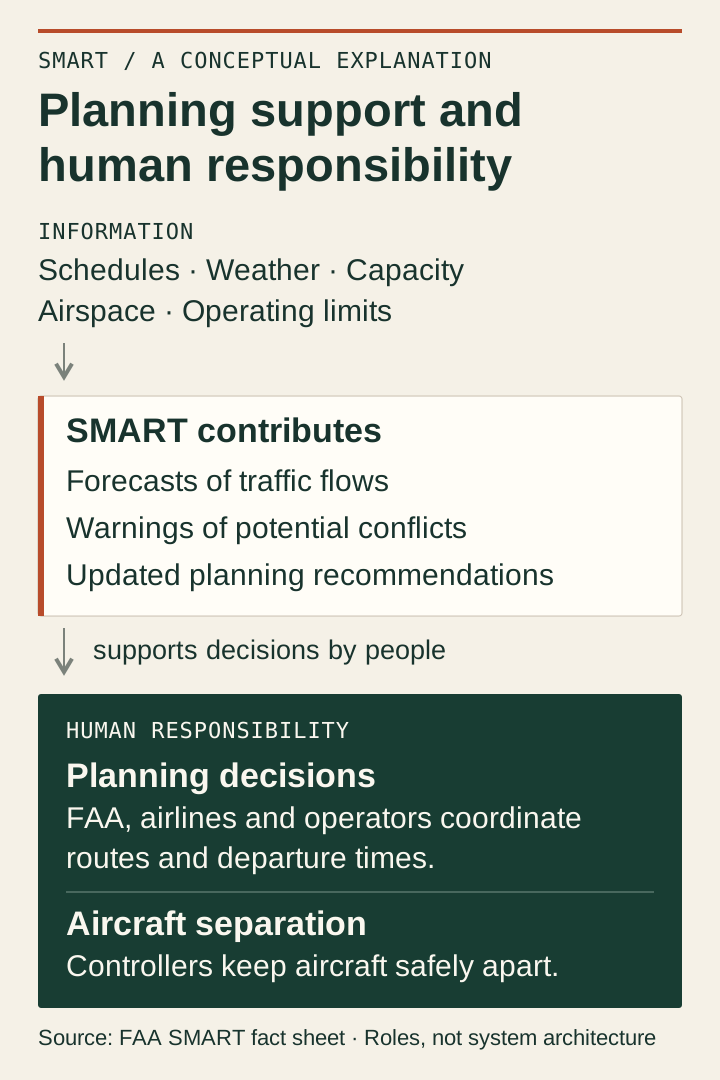
Conceptual explanation based on the FAA’s public description of SMART. Planning recommendations support human decisions; controllers retain responsibility for aircraft separation. This is not an official system architecture or evidence of proven safety.
The vendor behind the award describes a related platform pipeline in their own words. Fuse data, then build a four-dimensional twin — a time-and-space model of the operation. Predict and simulate, optimize options, communicate, then replay what happened for later review. Decision-makers can simulate a plan before implementing it.4 Treat that as their description of the commercial stack — not a safety certificate.
Airline ancestry for the same family of tools looks similar: assist dispatchers with recommendations; dispatchers always make the final call.5
The big number — about $875 million over 12 years — is a long-term modernization contract for FMDS and SMART, not “they bought one AI model.” Call it a contract ceiling style figure: the top of what the multi-year deal can cover, not a sticker price for a chatbot.6
Testing, not flipping a switch
FAA primary language points to initial operations beginning Fall 2026, not a nationwide overnight flip.23 Staged introduction is the reassuring feature we can support from public sources — introduce, observe, compare to outcomes, expand on evidence. That is not the same as claiming success is guaranteed.
Why this is a good kind of job for AI
As described, the problem is bounded. The data is mostly structured. Predictions meet reality quickly. You can simulate before you act. You can replay afterward. Humans stay in the loop.
My take on what this system is about is: Help predict the traffic jam. Don’t fly the airplanes through it. Improve the crystal ball — modestly — without replacing the controller.
Keep skepticism on
Architecture that makes technical sense is not the same as a deployment proven safe. So, here are some of the questions that we still need answers for:
- What exact models sit under the hood? (Publicly: unclear.)1
- How does it behave under real workload and messy data?
- Who owns the outcome when a recommendation is wrong?1
- Will people over-trust a polished forecast (automation bias — trusting a polished automated answer more than we should)? Observation only; no invented rates.
- Broader air traffic control modernization still has cost and schedule governance questions at the program level — that is separate from proving SMART’s model safety.7
Close
Caution about aviation automation is reasonable. But, assuming every “AI” label is a chatbot or an autonomous agent is a mistake.
From the reporting so far, I believe we can conclude chatbots will not be controlling air travel, at least not as the FAA has described this job. Something potentially more useful is on the table: better tools for seeing tomorrow’s traffic jam before humans have to deal with it. Keep asking how that tool is checked, and who still decides.
Footnotes
-
Jeremy Hsu, Ars Technica, 2026-09-18:
- https://arstechnica.com/ai/2026/09/faa-tees-up-875m-ai-tool-to-help-manage-air-traffic-congestion/ — model types “unclear”; chatbots used as a contrast category; expert concerns on evidence gates and ownership when a prediction is wrong.
-
FAA SMART Fact Sheet (PDF):
- https://www.faa.gov/newsroom/SMART_One-Pager.pdf — planning layer; planning recommendations; initial operations Fall 2026; controllers remain responsible for separation.
-
FAA Modern Skies announcement, 2026-06-22:
-
https://www.faa.gov/newsroom/modern-skies-trumps-transportation-secretary-sean-p-duffy-selects-air-space-intelligence — FMDS backbone; SMART enhancement; predict traffic flows before departure; initial operations this fall.
-
FMDS program page: https://www.faa.gov/air_traffic/technology/fmds
-
-
ASI PRESCIENCE platform (vendor wording):
↩ -
Alaska Airlines / ASI partnership, 2021-05-25:
- https://news.alaskaair.com/newsroom/alaska-airlines-and-airspace-intelligence-announce-first-of-its-kind-partnership-to-optimize-air-traffic-flow-with-artificial-intelligence-and-machine-learning/ — recommendations to dispatchers; dispatchers always make the final call.
-
ASI PR Newswire, 2026-06-22:
- https://www.prnewswire.com/news-releases/asi-selected-by-faa-to-modernize-the-national-airspace-system-302806855.html — “12 year, $875 Million” for FMDS and SMART. Prefer ~$875M / nearly $876M over 12 years; exact $875.95M ceiling still
[NEED SOURCE].
- https://www.prnewswire.com/news-releases/asi-selected-by-faa-to-modernize-the-national-airspace-system-302806855.html — “12 year, $875 Million” for FMDS and SMART. Prefer ~$875M / nearly $876M over 12 years; exact $875.95M ceiling still
-
GAO-26-107992 (Sep 2026) — BNATCS cost/schedule planning governance; not SMART model-safety evidence. PDF mirror used in research pack; prefer canonical gao.gov URL when available. ↩